Gear Guide
VLA-2A vs VLA-3A: Which Opto Compressor for Which Source


People treat “the LA-2A” like it's one box. It isn't. There were two famous optical Teletronix units, and they don't sound the same or behave the same. The LA-2A ran a tube amplifier. The LA-3A ran solid-state gain. Same optical heart, two very different personalities. If you've ever put an opto on a snare and thought “this feels slow and mushy,” you probably grabbed the wrong one.
So this is the LA-2A vs LA-3A question, mapped to real sources instead of spec sheets. In plugin terms that's our VLA-2A against the VLA-3A, and I use both, on different days, for different jobs.
What the circuit change actually does
Both units lean on the same trick: a light source glued to a photoresistor (the T4 cell), and the brightness of that light rides your signal. More signal, more light, more gain reduction. The cell's release is program-dependent and gloriously non-linear — fast at first, then a long slow tail. That's the opto sound, and neither unit throws it away.
The difference is what sits around the cell. The LA-2A puts a tube gain stage in the path. Tubes are slower to settle and they add a soft, thick harmonic layer, so the whole thing feels unhurried and rounded. The LA-3A swaps that for solid-state gain. Faster to react, tighter on transients, and a little more forward and gritty when you push it.
Put plainly: the tube version smooths and thickens. The solid-state version grabs and punches. Same family, different temperament.
Where the VLA-2A wins
Anything you want to sit deeper and feel bigger rather than tighter.
Intimate vocals first. A close verse, a lot of proximity, not much arrangement underneath it — the VLA-2A is what I reach for. Set Peak Reduction for maybe 4–6 dB of movement on the loud words and let that slow tube release drag the sustained notes out instead of snapping them back. The vocal breathes. It doesn't clamp.
Bass is the other obvious home. On a fingered electric bass or an upright, the slower response lets low-end energy through without choking the fundamental, and the tube warmth flatters the body of the note. A dB or two of reduction and the part gets steady and thick without sounding squeezed.
And mix glue. Not everyone uses an opto across the bus, but a hair of gain reduction — a single dB, sometimes less — knits a mix together without the pumping a faster comp would give you. The tube coloration is the point here, not a side effect. It's the softest, most forgiving glue in the box.
Where the VLA-3A wins
Drums are where the LA-3A earns its reputation. That faster solid-state response actually catches the front of a transient, so instead of letting a snare bloom past it, the VLA-3A grabs the hit and lets the tail swell behind it. Crank the reduction on a room mic or a parallel drum bus and you get that aggressive, in-your-face smack that opto compression is famous for on rock records. The VLA-2A just can't move quick enough to do that; it feels a step behind on percussion, every time.
Aggressive vocals, same story. A screamed rock chorus or a hard rap delivery that's already spitting energy at the mic — the LA-3A holds it forward and adds a bit of grit while it works. It keeps the aggression instead of rounding it off. Push it into 6–8 dB of reduction and it starts to sound like part of the performance rather than a corrective.
Guitars too. Both electric and a strummed acoustic that needs its dynamics reined in without going polite. The faster grab keeps pick attack alive and the part cuts. On a driven electric it can add just enough edge to help it sit against a wall of amps.
The short version
Reach for the VLA-2A on intimate vocals, bass, and mix glue — anywhere you want warmth, weight, and a slow, forgiving hand.
Reach for the VLA-3A on drums, aggressive rock and rap vocals, and guitars — anywhere you want speed, punch, and a bit of grit.
Practical settings, and the honest trade-offs
Neither unit gives you an attack and release dial, which is the point. You set Peak Reduction until the meter moves the way you like and trim the gain to match. That's it. Start with the loud moments hitting 4–6 dB and adjust from feel, not from a target number.
The trade-offs are real, so here they are. The VLA-2A's slowness is a liability on anything transient-heavy; put it on a snare and you'll fight mush. The VLA-3A's speed costs you the thick, blooming warmth — on a delicate verse vocal it can sound a touch clinical and hard next to the tube. And both are program-dependent, which means they behave differently at different levels. Ride your input gain into them like an instrument. A quiet passage and a loud one will not compress the same, and that's a feature, not a bug.
One more, because parallel work matters: run either one on a blend bus, slam it, and mix it back under the dry signal. That's how I get aggressive drum compression out of the VLA-3A without losing the dry snap, and thick bus glue out of the VLA-2A without flattening the transients. If you'd rather not build the send, the VLA-2A Mark II bakes that blend right in with a Mix knob.
What about the Mark II?
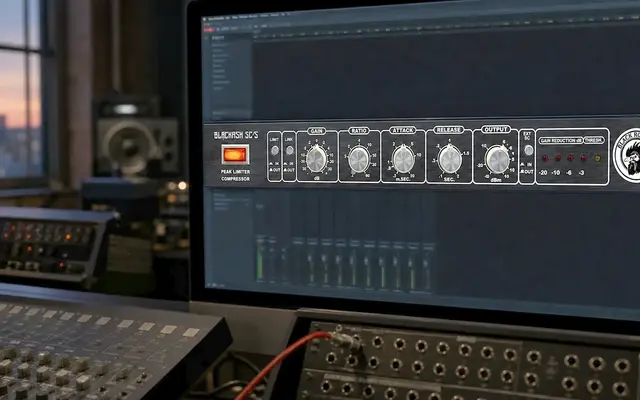
The original VLA-2A keeps it simple: Peak Reduction, Gain, a Compress/Limit switch and a selectable VU meter. If you want more control over that tube character, the VLA-2A Mark II adds the moves the hardware never had — a built-in Mix knob for parallel compression, an external sidechain, an Emphasis control to shape what the detector hears, and a choice of three optical cells (A, B and C) with different attack and release speeds. Same slow, warm grab; a lot more say in how it lands. It's the version I'd point a working mixer at.
So which one?
Stop thinking of it as a competition and think of it as two tools for opposite ends of the same problem. Slow and thick for things that should feel big. Fast and punchy for things that should feel sharp. Most engineers who mix a full record end up owning both, because a lead vocal and a snare are simply not asking for the same compressor.
If you only want to start with one, pick by the work in front of you: singer-songwriter, jazz, hip-hop with soulful hooks — the VLA-2A. Rock, aggressive rap, anything drum-forward — the VLA-3A. Then grab the free trial of the other, throw the same source at both, and let your ears settle the argument in about ten minutes. That's faster than any blog post, mine included.

Add a comment
You need to be logged in to add comments.