Gear Guide
Sidechain Without the Pump: What the External Input on the SC-5 Is Really For

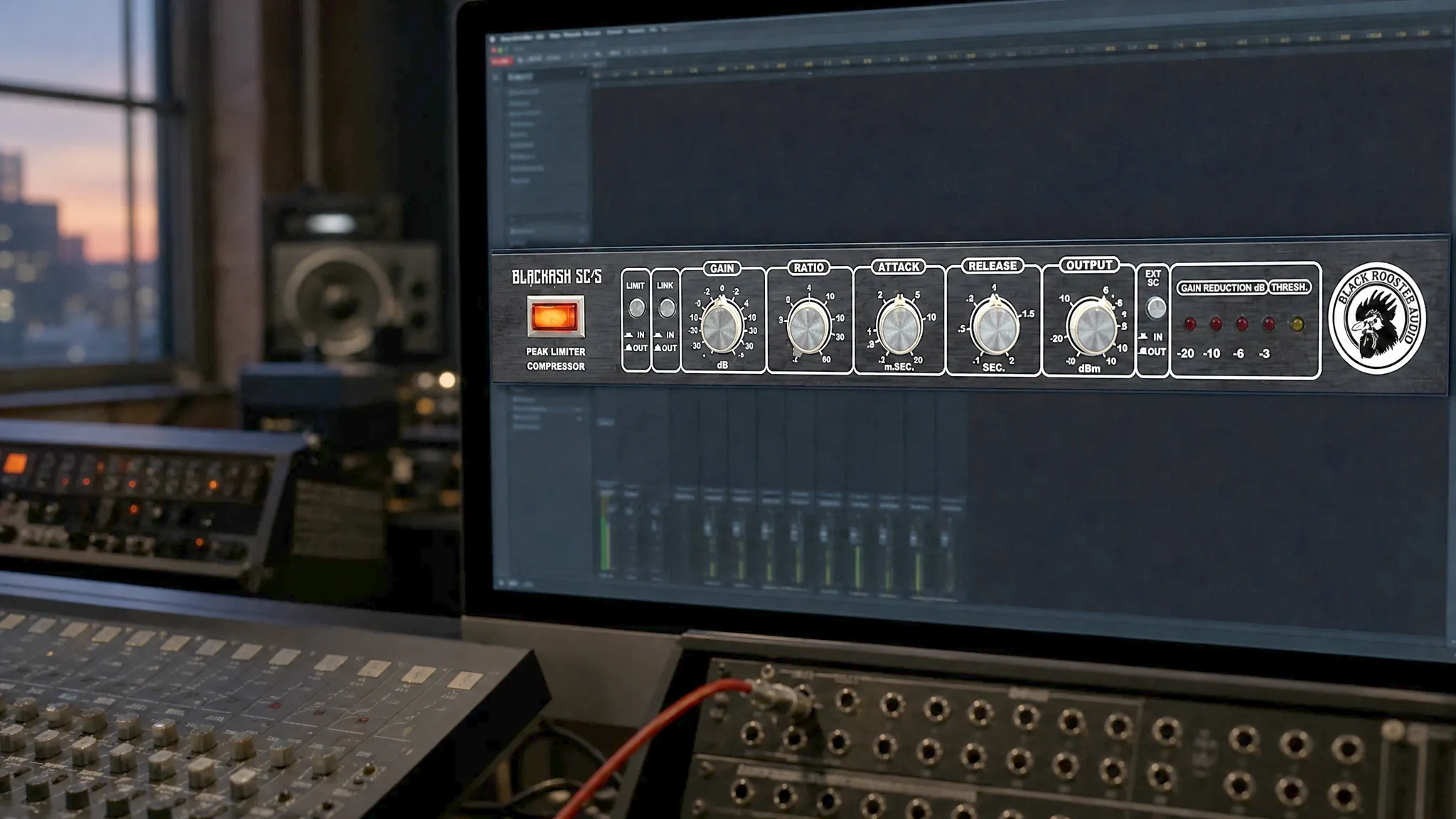
A client sent back a mix note last spring that I still think about. Three words: bass sounds seasick. He was right, and I knew what I'd done. I had keyed the bass compressor off the kick drum, pulled 6 dB, set a fast release and congratulated myself on a tight low end. Solo'd it sounded controlled. In the track it sounded like somebody leaning on a pedal four times a bar.
That trick, bass ducking under kick, is where every sidechain tutorial stops. It's also the job an external sidechain input is worst at doing gracefully, and the reason isn't the input.
It's the compressor behind it. The SC-5 handles an external key differently from almost anything else in my folder.
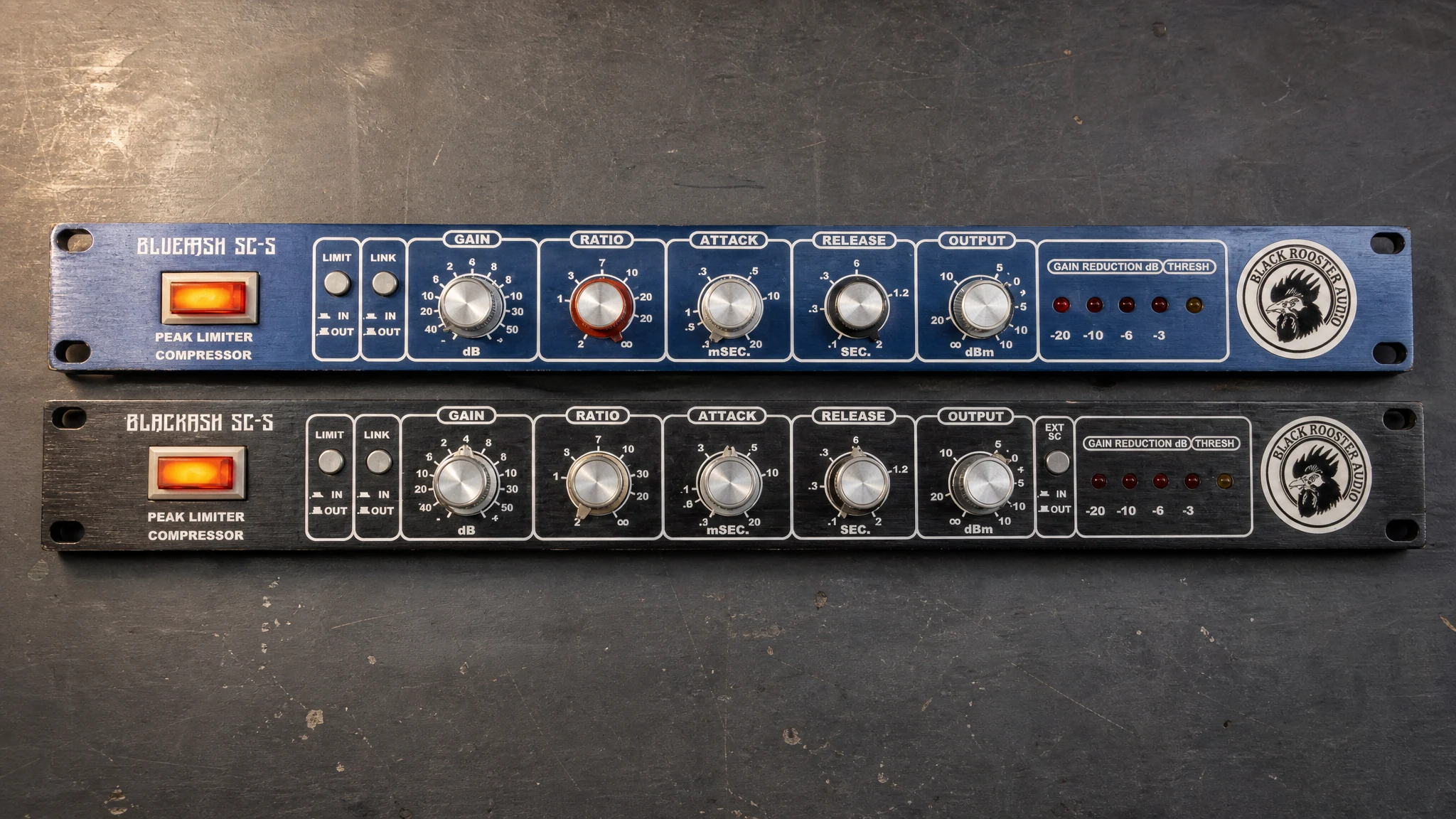
Only the black one has the input
There are two SC-5s in the catalogue and they aren't two versions of one plugin. The BlueAsh SC-5 models the blue-faced 1970s Ashly SC-50; the BlackAsh SC-5 models the black-faced 1980s revision. Same VCA lineage, same fixed-threshold layout where you drive the input Gain instead of lowering a threshold, same numbers on the knobs: attack 200µs to 20 ms, release 100 ms to 2 s, ratio stepping 2, 2.5, 3, 5.5, 7, 10, 20, 30, 100 and then infinity.
They part company sonically over one filter. The black revision runs a first-order lowpass at 31.2 kHz that the blue one doesn't have. Above the band on paper, but a gentle slope starting there already shades the top of the cymbals, and most of why the BlackAsh reads dark and the BlueAsh reads open.
The difference that matters here is blunter. The BlueAsh has no external sidechain. Not hidden, not buried in a menu: there's no sidechain bus at all, because the hardware it models didn't have one. The 1980s revision added it, and so did we. To key an SC-5 from another track, it's the black one or nothing.
Worth saying plainly, because I've answered that support email: owning the blue one and wanting the input means buying the black one, not updating it.
The detector never lets go of the output
The SC-5 is a feedback compressor. Its detector doesn't watch the input, it watches the output, after the VCA has already done its work. That's the old way of building these, and it's why the grab feels self-correcting rather than surgical: the loop spends the whole song talking itself out of the last decibel.
Press Ext SC and that doesn't change. The external signal isn't handed to a separate feed-forward detector the way most plugins do it. It's blended into the same feedback path, so the key reaching the detector gets multiplied by whatever gain reduction the VCA is applying right then. Clamp down hard and the key arrives quieter, and a quieter key asks for less.
So ducking on an SC-5 doesn't drop to a fixed depth and stay there. It settles: dips, backs off, and finds a level that depends on how loud the key is, how loud the source is, and how much reduction is already happening. Hard to make it pump, by design.
De-essing with an ugly copy of the vocal
This is what I use the input for most, and it has nothing to do with kick drums. Duplicate the lead vocal. On the copy, put an EQ in front and make it deliberately horrible: a high shelf around +12 dB from 6 kHz, everything under 3 kHz pulled into the floor. Route that copy to the BlackAsh's sidechain bus on the vocal it came from, press Ext SC, and the compressor goes deaf to everything but sibilance.
Ratio 5.5:1. Attack at the fast end. Release between 100 and 200 ms. Drive the Gain until the meter flickers 2 to 3 dB on the sharp consonants and nothing in between. You've built a de-esser out of a compressor, which is what every hardware de-esser ever was.
The feedback detector is why I prefer this to a dedicated de-esser on most singers. A feed-forward de-esser pulls exactly as much as the sibilance exceeds the threshold, every time, which is how vocals end up sounding lisped in post. The SC-5 eases off while it works: it takes the edge off an s and leaves the s there. It is broadband, though. Past 3 dB you hear the whole vocal move, so a take needing 6 dB wants a split-band tool.

Bass that moves under the kick without breathing
Back to the seasick bass. My mistake wasn't the idea, it was the key. I was feeding the compressor the close kick mic, which is almost all attack transient and sub, so the bass flinched on a spike and recovered in a straight line four times a bar. Send the whole drum bus instead and it moves with the groove rather than reacting to one drum.
Ratio 3:1. Attack 4 to 8 ms, slow enough that the first few milliseconds of each note get out before the compressor catches up, because that's where the note's identity lives. Release 200 to 300 ms so it recovers before the next eighth. Then Gain until the meter reads 3 or 4 dB on the downbeats.
What the feedback loop hands you is that a busy bar and a sparse bar don't duck by the same amount. A dense chorus has the bass sitting lower already, so the detector asks for less; a thin verse ducks deeper. Nobody programmed that. It falls out of the topology, and it's most of what people mean by musical.
If you want the four-on-the-floor pump you can hear from the car park, use something else. That needs a detector that does the same thing every bar.

Filter the key yourself, because the plugin won't
There's no high-pass on the SC-5's detector. Nothing in the sidechain path filters anything: what you send is what the detector hears, full range. Most modern compressors put a little HPF button next to the sidechain and it's easy to assume they all do. This one doesn't, and neither did the hardware.
That matters more than it sounds. Send a full-range key and everything under 60 Hz pulls reduction, so a kick-keyed bass reacts to the part of the kick that overlaps it rather than the transient that needs room. High-pass the key at 80 to 120 Hz and the ducking lands where you meant it. Our free VHL-3C does the job.
And one thing that will get you out of your chair: with Ext SC engaged and nothing routed to the sidechain bus, the detector sees silence, no reduction happens, and the input Gain comes through unchecked. At +20 dB that is a loud surprise. Check the routing before you press the button, monitors down.
Where I'd start
Black if you want the external input or the darker path, blue if you want the open, brighter unit and you key from the channel itself. I own both, reach for the blue one more on drums and the black one more on anything with a voice in it.
If de-essing is the only reason you want an external sidechain, there's a shorter route. The VLA-2A Mark II has an Emphasis control that tilts its own detector towards the highs: no duplicate track, no EQ, no bus. Different compressor, different sound, one knob instead of four steps.
Both run as a full 14-day trial from the license manager. Take one song, build the de-essing chain, and spend ten minutes with your hand on the Gain knob. Usually enough to know.


Add a comment
You need to be logged in to add comments.