
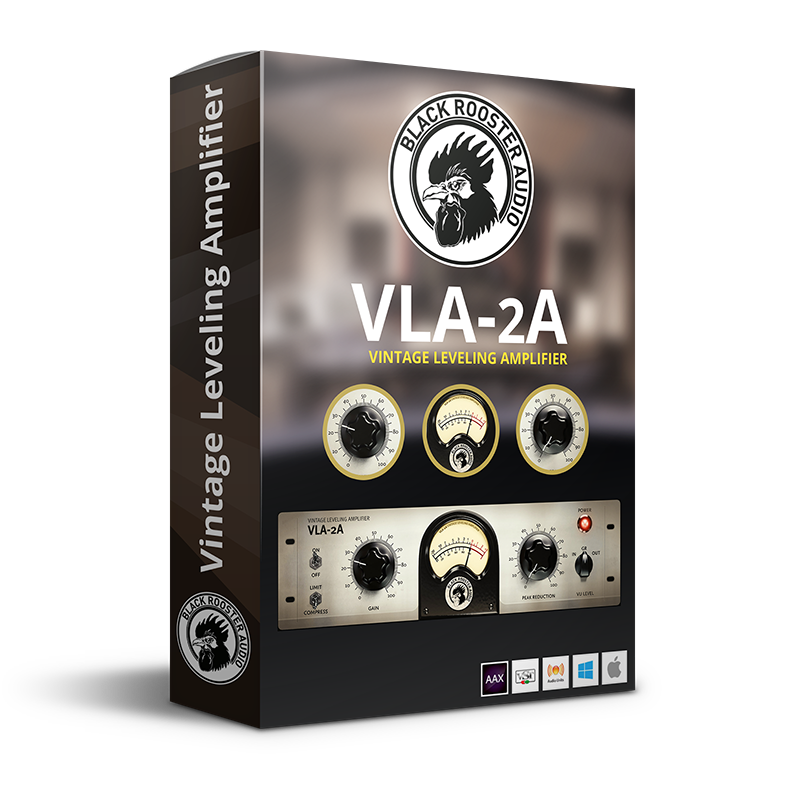
VLA-2A
Vintage Opto Leveling Amplifier
About the VLA-2A
Inspired by the Teletronix LA-2A: the optical leveling amplifier that turned "set it and forget it" into a genre. The VLA-2A is our opto compressor built around a faithfully modelled T4A photo-cell, matched against an original '68 reference unit.
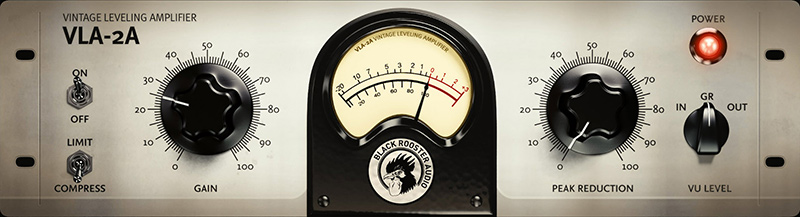
The VLA-2A is a vintage opto compressor, and it behaves like one — nothing like a modern digital comp with a threshold slider and a stopwatch. There are two knobs that matter and one switch. Peak Reduction decides how hard the T4A cell clamps down, Gain makes up what you lost (and pushes the tube stage into saturation when you want it), and the Ratio switch chooses between Limit and Compress. That's the whole conversation. The magic is in what happens between those controls and your source, because the optical cell reacts to the program itself rather than to a fixed attack and release you dialled in.
The Teletronix LA-2A, modelled cell and all
The LA-2A was born in the early 1960s and never really left the racks of serious studios. Its trick was the T4 electro-optical attenuator: a light source glued to a photoresistor, its glow driving how much the signal gets pulled down. That cell has a memory — it responds faster to loud transients and slower to sustained material, and it never fully resets between hits. We rebuilt the whole path with our real-time, SPICE-style circuit simulation: the input and output transformers, the sidechain and audio-path tube stages, the emphasis filter network and, at the heart of it, the T4A cell. Because the cell is modelled as a living component rather than baked into a fixed envelope, the VLA-2A breathes exactly the way the hardware does — the more you feed it, the more it leans into that slow, forgiving release.
Sound and character: slow, smooth, always musical
What you hear is level control that never announces itself. On its default Compress setting the ratio is gentle and the knee soft, so vocals sit forward without a hint of the pumping you'd get from a fast VCA. Flip to Limit and it grips harder for peaks that refuse to stay put. And the Gain knob isn't just make-up: turn it up and the tube amplifier adds a layer of even-order harmonic warmth, so you can print colour on a source even when you're barely reducing gain. Run it flat as a tone box and it still does something — that's the point of a good opto.
Using the VLA-2A on vocals, bass and the mix bus
Lead vocals are where the VLA-2A earns its keep: dial Peak Reduction until the loudest lines pull back a few dB, add Gain to taste, and the singer glues to the track without effort. On bass it evens out inconsistent playing while the transformers add weight, and it's a lovely, unobtrusive choice across a mix bus or a stereo submix where you want cohesion, not squash. Need a faster attack for drums and snappier percussive sources? Reach for the opto-solid-state hybrid VLA-3A instead, or the FET-driven VLA-FET when you want aggression. If you want the same smooth character with sidechain, cell selection, wet/dry mix and make-up gain, the VLA-2A Mark II is the expanded take.
VLA-2A Features
Modelled T4A opto cell
The core of the LA-2A recreated in real time — a light-dependent attenuator whose slow, program-dependent attack and release give the VLA-2A its signature smooth, self-adjusting compression that no fixed-envelope design can copy.
Peak Reduction and Gain
Two controls run the show. Peak Reduction (0–100) sets how hard the cell clamps; Gain (0–100) makes up level and gradually drives the tube amplifier into a warm, even-order saturation you can use as tone on its own.
Limit / Compress ratio switch
Toggle between a smooth, low-ratio Compress mode for everyday leveling and a firmer Limit mode that grips stubborn peaks — the classic two-position character of the original hardware.
Modelled tube path and detector network
Input and output transformers, the sidechain and audio-path tube stages and the internal emphasis filter network are all modelled and matched against an original 1968 reference unit, so the frequency-dependent detection behaves just like the real thing. (Emphasis here is fixed circuitry, not a control — for a variable emphasis knob, see the Mark II.)
Flexible metering
The VU meter monitors average input, gain reduction or output in dB, with a switch to select In / GR / Out. A readout of -14dB full scale in the plug-in equals a level of 0 dBu in the hardware.
Authentic circuit emulation
Our real-time, SPICE-type component-based circuit simulation captures the sound and feel of the analog counterpart in every nuance — transformers, tube stages and the T4A cell all faithfully modelled.
SSE2-optimised code
DSP operations are pipelined on the SSE2 instruction set for high-performance operation, even under complex processing.
Auto-adjusted oversampling
A low-latency, linear-phase Dolph-Chebyshev polyphase design attenuates aliasing and auto-adjusts to your session's sample rate to save CPU while staying transparent.
HighDPI / Retina support
Crisp, high-pixel-density rendering on macOS and Windows for a sharp interface on modern displays.
VLA-2A Examples & Videos
Industry Reviews

These 2 compressor plugins (the VLA-2A and 3A) are really, really good—very smooth, and they react a lot like the original hardware versions. In fact, I like the limiter part better than most….A really nice addition to the arsenal of compressor plugins out there.

I've been using it in every mixing session since day one. While it's a very clean and transparent compressor perfectly suited for clean vocals, bass, acoustic guitars and mix busses, you can still hit it harder with the gain knob and get wonderful saturation for extreme vocals, creative drum buss processing or anything else you can think of! And what's even more important it keeps the low end tight and present. Thank you for this valuable tool.
Your VLA-2A and VLA-3A are amazing.
VLA-2A — Customer Reviews
VLA 2A MK2
Tuyệt vời
Vintage Glue
Ideal sound for anything drums and vocals. I do own the original, and this plugin comes close! Nicely done.
Leave a Review
VLA-2A — Frequently Asked Questions
What hardware is the VLA-2A based on?
The VLA-2A is inspired by the Teletronix LA-2A, the classic optical leveling amplifier from the 1960s. It recreates the T4A electro-optical cell, the input and output transformers and the tube audio path using real-time circuit modelling, matched against an original 1968 reference unit.
What does the VLA-2A sound like and when should I use it?
It delivers slow, program-dependent opto compression that levels without pumping. Reach for it on lead vocals to keep them forward, on bass to even out playing, and across the mix bus for gentle glue. The tube gain stage also adds warm harmonic colour when pushed.
How is the VLA-2A different from the VLA-3A?
The VLA-2A (LA-2A) is the slower, smoother of the two, ideal for vocals and sustained sources. The VLA-3A (LA-3A) uses a discrete solid-state path with a faster, brighter response that suits drums, guitars and percussive material. Many engineers keep both.
What do the Peak Reduction and Gain knobs actually do?
Peak Reduction sets how hard the opto cell compresses the signal, and Gain makes up the level afterwards. Turning Gain up also drives the modelled tube amplifier into a subtle, musical saturation, so you can add warmth even when barely compressing.
Which plugin formats and systems does the VLA-2A support?
The VLA-2A ships as AAX, VST, VST3 and Audio Units (AU) for both macOS and Windows, including native Apple Silicon support. It runs in all major DAWs. See the product manual for detailed system requirements.
Is there a free trial of the VLA-2A?
Yes. Registered users can create a free 14-day trial license from the license manager and demo the VLA-2A in full before buying. You only need a free Black Rooster Audio account to get started.
Read more about this

LA-2A is a registered trademark of Universal Audio, Inc. Black Rooster Audio's products, specifically, the VLA-2A Vintage Leveling Amplifier, is developed by Black Rooster Audio, based on its own modeling techniques. Universal Audio, Inc. has neither endorsed nor sponsored Black Rooster Audio's products in any manner, nor licensed any intellectual property for use in this product.