Gear Guide
Tape Before or After the Compressor? Magnetite in Both Positions


Somebody asked this in a forum thread last month and collected eleven confident answers, no two of which agreed. That's usually a sign the question is badly posed rather than hard. So I set it up properly: one drum bus, Magnetite and a VCA compressor, the two possible orders, levels matched to within a couple of tenths of a dB, and somebody else clicking between them while I sat with my back to the screen.
At the settings I'd normally use, a couple of dB of tape drive and a couple of dB of gain reduction, I got it right about half the time. Coin flip.
Then we pushed both until each was plainly working, and I got it right every time, immediately. So the honest answer comes with a condition attached, and the condition is the interesting part.
Two nonlinear boxes don't commute
The theory fits in a sentence. Tape saturation and compression are both level-dependent. What each does to a signal depends on how loud that signal already is, and when you put two level-dependent processes in series, swapping them changes the result. That's the whole mechanism. It's the same reason a filter before a distortion doesn't sound like the same filter after it.
The corollary is the part nobody states, and it's the useful half. How big the difference gets scales with how nonlinear each block is being at the time. Run both gently and they're both behaving nearly linearly, and nearly linear processes nearly commute. Run them hard and they don't, and the gap opens up fast.
Which means "before or after" isn't a setting with a right answer. It's a decision that gets more consequential the harder you're working. At 1 dB of tape drive and 1 dB of gain reduction you're arguing about nothing. At 8 and 8 you're choosing between two genuinely different records.
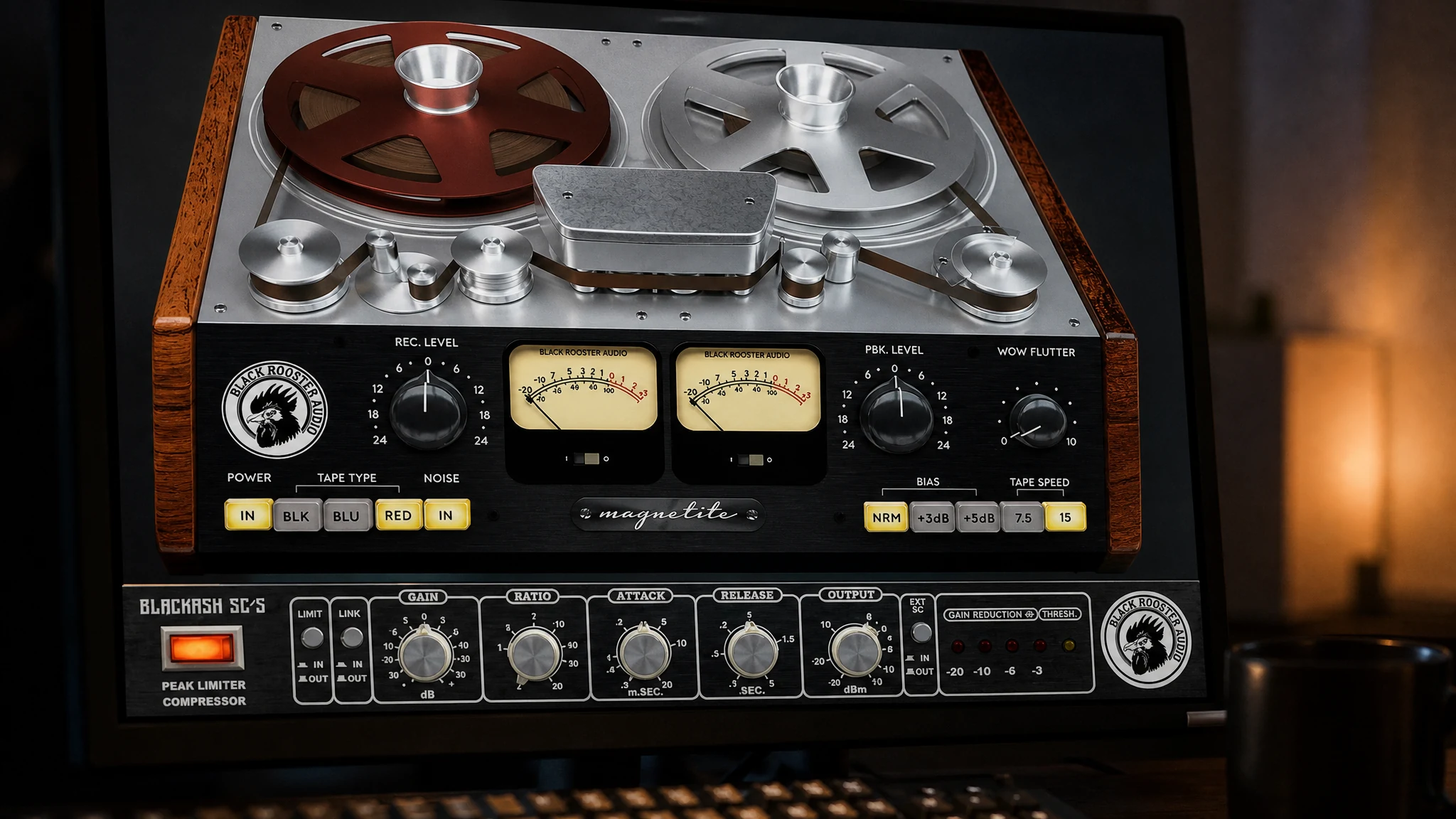
Tape first changes what the compressor hears
Put Magnetite in front and you've done two things to the compressor's input before the detector ever sees it. The obvious one is tone: each tape type and speed lays down its own frequency curve. The less obvious one is that tape rounds transients, and a compressor's detector is mostly a transient-reading device.
The tone part is smaller than people assume, and I'd rather show it than argue about it. Below is Magnetite's Black tape response at both speeds, drawn straight from the plugin's own filter values rather than from anybody's memory of what tape sounds like.
Two or three decibels at the extremes, and dead flat where the music lives. At 7.5 ips there's about +0.9 dB spread broadly below 150 Hz and roughly the same again above 13 kHz. At 15 ips the bottom tightens by a decibel at 30 Hz and the top rolls away to about −2 dB by 20 kHz. Between the two speeds that's a gap of roughly 2 dB at 30 Hz and 3 dB at the very top. It's a tilt, not a filter, and anyone telling you the tape type transforms a mix's frequency balance is hearing the saturation rather than the curve. Which makes the tone half of this argument the smaller half. The transient half is where the order really shows.
Feed a drum bus that has already been through tape at a healthy Recording Level to a fast VCA, and there is simply less spike left to catch. The BlueAsh SC-5 will attack in 200µs if you ask it to, and it still finds nothing to bite.
Same Gain setting, less gain reduction, and a softer edge on the reduction you do get. Drums come out rounder and you push the compressor further than you meant to. Meanwhile that +0.9 dB of low end goes straight into the detector, so the kick pulls harder.

Tape last means the compressor sets the drive
The other way round, the tape receives a signal whose dynamic range has already been squeezed into a narrow window, which is exactly what saturation likes. Instead of flickering between clean and driven from hit to hit, it sits at one operating point and stays there. You get consistency, density, and that quality people describe as sounding printed: the sound of a decision having been made and not revisited.
The trap is that you are no longer setting the tape drive. The compressor's Output knob is. Wind makeup gain up 6 dB because the compression cost you 6 dB, and you've just added 6 dB of tape drive you never asked for, and the saturation you carefully auditioned an hour ago is now a different saturation. Magnetite's VU meters are calibrated so 0 VU sits at roughly −14.5 dBu. Watch those, not the knob.
Which is also the fix. Right-drag the Recording Level and it inverse-links to the Playback Level, so you can change how hard the tape is driven without changing how loud the plugin is. That is the only way to compare anything here honestly, and it's the step almost everybody skips.
One limitation to plan around: Magnetite has no Mix control. Parallel tape means a bus in the DAW, not a knob on the plugin.

The case where it makes no difference
Under about 2 dB of gain reduction, with the Recording Level within a decibel or two of the VU's zero, I cannot hear the swap. I've now tried it on drum busses, on a full mix and on a bass DI, blind, levels matched, and I score chance. Not "subtle, but there if you listen". Chance.
If you're certain you hear a difference at those settings, check the level before you check your ears. Nearly every it completely transformed my mix turns out to be eight tenths of a decibel, and eight tenths of a decibel always sounds better. Match to within 0.2 dB and the magic tends to leave the room.
There's a practical upside. Don't spend the twenty minutes auditioning the order on a track where you're using either box gently. Put it somewhere, carry on mixing, and save the comparison for the one bus where you're genuinely leaning on both, because that's the only place the answer is worth having.
What I do, and why
Default: tape first on individual sources, tape last on a bus. On a source I want the tape to change what the compressor is working with, because that interaction is the point of running both, and rounder transients are usually what I'm after on a snare or a bass anyway. On a bus, everything arriving has already been compressed somewhere upstream, so the tape is a finishing stage and I want it fed something consistent.
The exception is when the compression is the effect. Pumped room mics, or a VLA-2A leaning hard on a piano: if I want to hear the compressor breathing, the tape goes after it. Tape in front takes away the transients that make the breathing audible, and the whole effect goes limp.
Magnetite runs as a full 14-day trial. Take one drum bus, build both orders as two chains, gain-match them with the inverse-link drag, and push both until the tape is obvious. The answer takes about four minutes, and then it's yours rather than mine.


Add a comment
You need to be logged in to add comments.