Gear Guide
The Best Pultec EQ Plugin: VEQ-1P and VEQ-5 in Real Mixes

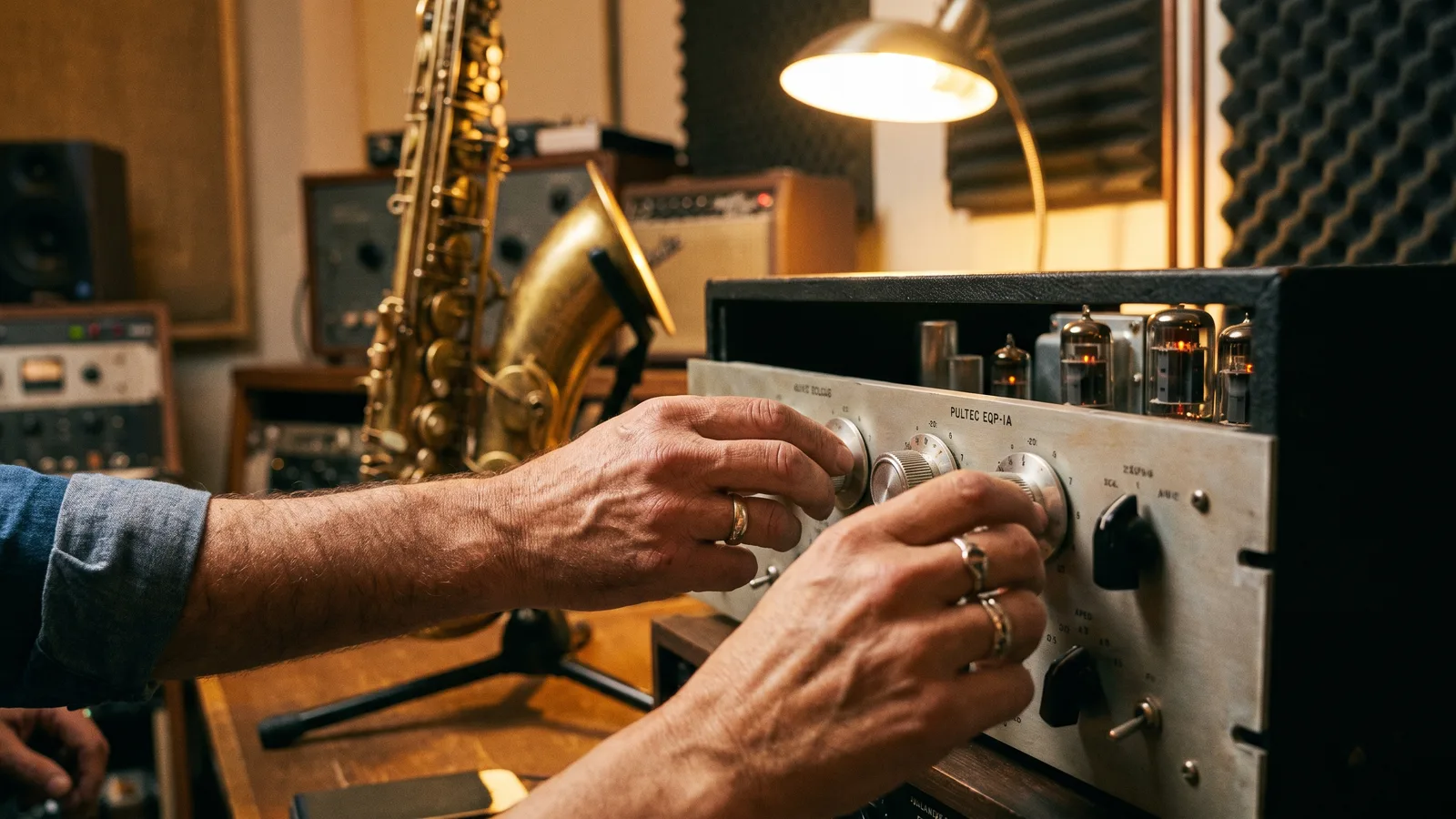
The first time somebody showed me the Pultec low-end trick I thought they'd misread the manual. Boost the same band you're cutting? On paper that cancels out. In practice it does something a parametric EQ can't do, and once your ears clock it you start hearing it on records everywhere — the kick that's fat but never muddy, the bass that fills the room without swallowing the low mids.
That trick is the reason people still chase a Pultec sound sixty years after the hardware left the factory. So if you're hunting for the best Pultec EQ plugin for your rig, let me save you some demo time and tell you how I actually use ours, and which one belongs on which track.
Why a passive EQ sounds different
Most EQs you reach for are active. They use amplifier stages to create a boost, and they're precise: you dial 3.2 kHz, you get 3.2 kHz. A Pultec is a different animal. The original EQP-1A is a passive design — the filter section only ever cuts, and a tube make-up amp brings the level back afterward. You're not lifting a band so much as carving everything else down and then pushing the whole thing back up through a valve.
Two things fall out of that. First, the curves are broad and gentle by nature, because passive components don't do sharp. Second, every move runs through that tube stage, so even a flat setting adds a little weight and a little harmonic thickness. Turn the plugin on with no changes and the signal already sounds a touch more solid. That's not a bug. For a lot of engineers it's the entire point.
The famous low-end trick
Here's the move that made the EQP-1A a legend. On the low band you get a Boost knob and an Atten (attenuate) knob, and crucially they sit at slightly different frequencies. Because of how the passive circuit overlaps, boosting and cutting the same selected band doesn't cancel — the boost peaks lower and the cut bites just above it.
Set the band to 60 or 100 Hz, push Boost up, then bring Atten up too. You get a fat, rounded bottom with a scooped spot in the lower mids where boxiness lives. On a kick drum that means thump you can feel with a clear window above it for the beater click. On a bass guitar it's fullness without the honk around 200–300 Hz that turns a mix to mud. I do this on nearly every kick I touch, usually 60 Hz boost, a hair of atten, and I stop fiddling. Our VEQ-1P reproduces exactly this behaviour, overlap frequencies and all, so the trick works the way it does on the hardware rather than as two knobs fighting each other.
That top-end air
The high band is the other half of the reputation. The EQP-1A gives you a broad shelf-ish boost up top — selectable from 3 kHz all the way to 16 kHz — and it's wide and smooth, not a spike. Push 12 kHz on a vocal and you get sheen and openness rather than harshness. It's forgiving in a way that a surgical EQ never is, because a wide gentle curve doesn't grab any single nasty frequency and shove it in your face.
This is why the Pultec high boost shows up on so many finished vocals and overheads and full mixes. You can be generous with it. I'll add several dB of 16 kHz air on a mastering-style pass and the mix just opens up, no ice-pick, no sibilance flare. Try that with a narrow bell and you'll be reaching for a de-esser five seconds later.
Broad and musical vs. narrow and surgical
Somewhere along the way a lot of us learned to fix mixes with tight cuts — hunt the resonance, notch it out, move on. That's real work and it matters. But it's corrective, and correction isn't the same as tone. A Pultec is a tone tool. Its curves are too wide to fix a single ringing frequency, and that's fine, because that's not its job. Asking it to solve a problem is how it ends up blamed for muddying a mix.
The rule I've settled on: reach for a narrow parametric when something is wrong — a resonant room mode, a harsh 3 kHz edge, a boxy 400 Hz on a snare. Reach for the Pultec when nothing's wrong and you just want the track to sound better: bigger low end, more air, more of that valve density. The two live happily on the same channel. Surgical cut first, musical Pultec sweetening after.
VEQ-1P or VEQ-5 — which for what
We make two Pultec-style boxes, and they cover different ground on the frequency map, so it's less "which is better" and more "which end of the spectrum are you working on."
The VEQ-1P is the classic EQP-1A voicing — the low-end trick, the airy high shelf, that broad passive character on the extremes. It's my default on kick, bass, full mixes, and any vocal that needs top-end sparkle. If you only buy one, buy this one, because it's the sound everyone means when they say "Pultec."
The VEQ-5 is modeled on the EQH-style mid-range unit, and it does the thing the EQP-1A can't: it shapes the middle of the spectrum with the same smooth passive touch. Broad boosts and dips through the mids, where guitars, snare body, vocal presence and the general "wall" of a mix live. When a rhythm guitar needs more chunk around 3 kHz without turning brittle, or a snare needs body without boxiness, the VEQ-5 does it musically where a parametric would sound clinical. I run both together often — VEQ-1P handling the top and bottom, VEQ-5 sorting out the middle. That pairing is basically a full passive tone chain.
And if the mids matter to you because you're building a whole channel rather than sweetening one track, it's worth knowing the same EQ philosophy shows up inside our Edelweiss'72 channel strip — useful when you'd rather commit tone on the way in than stack plugins after.
So where do you start
If you've never touched a Pultec, don't overthink it. Load the VEQ-1P on a kick, do the 60 Hz boost-and-atten trick, then throw a few dB of 12 kHz air on the lead vocal. Two moves, and you'll hear why this circuit refused to die. From there the VEQ-5 is the natural next step once you start wanting to shape the middle with the same broad, un-clinical hand.
Both run as free trials, so you can put them on your own tracks tonight and decide with your ears instead of a review. Grab them, do the low-end trick on something with a real bottom end, and see if you can go back to a plain parametric afterward. Most people can't.


Add a comment
You need to be logged in to add comments.