
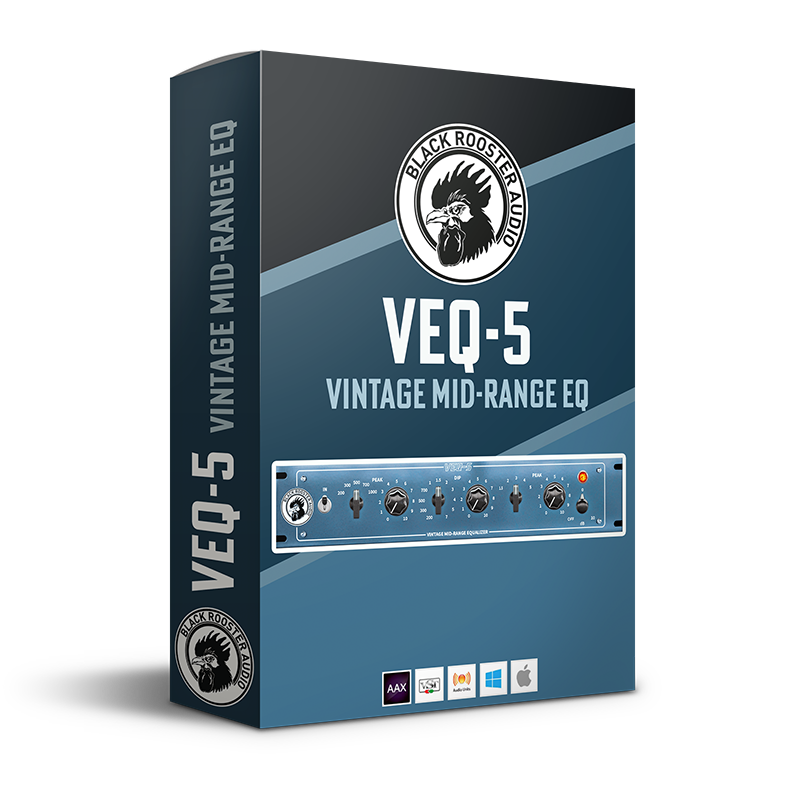
VEQ-5
Vintage Mid-Range Equalizer

About the VEQ-5
Inspired by the Pultec MEQ-5: the mid-range companion to the legendary EQP-1A, built for the band of frequencies where vocals, guitars and snares either sing or fight you.
Some equalizers are surgeons. The VEQ-5 isn't one of them. It's a vintage mid-range equalizer that works the way the old Pultec MEQ-5 did — broad, musical strokes across the 200Hz to 7kHz "power band" where most of a mix's character actually lives. You don't reach for it to chase down one ringing frequency. You reach for it when a vocal needs to step forward, when a guitar sounds boxy, or when a snare has plenty of body but no crack.
The Pultec MEQ-5, modelled circuit by circuit
The MEQ-5 was never the famous one. Its bigger sibling, the EQP-1A, got the glory — but engineers who knew both kept the MEQ-5 patched in for a reason. Its passive filter design and tube make-up gain give midrange moves a weight that later parametric EQs never quite matched. We rebuilt that behaviour with our real-time, SPICE-style circuit simulation: the passive filter network, the audio transformers and the tube amplifier stage are all modelled as a living circuit, not baked into a static curve. That's why boosting and cutting overlapping bands produces the same slightly unpredictable, always-flattering interaction the hardware is loved for.
Three bands, more colour than the knob count suggests
The layout looks almost too simple: a Low Boost, a Mid Cut (the "Dip") and a High Boost, each with its own stepped frequency selector. Set the Low Boost across 200, 300, 500, 700 or 1000Hz for up to roughly +13dB of chest and authority. The Mid Cut ranges far wider than most people expect — eleven steps from 200Hz all the way to 7kHz, up to about -10dB — so you can scoop mud out of the low mids or notch honk and sibilance higher up. Push the High Boost between 1.5 and 5kHz for as much as +9dB of presence and air. Now the trick the MEQ-5 is famous for: boost and cut around the same region at once, and the overlapping filters carve a shape no single band could manage on its own. And because the tube make-up amp stays in the signal path even when the EQ section is switched out, running the VEQ-5 dead flat still lays down a gentle layer of harmonic colour.
Where the VEQ-5 earns its place: vocals, guitars and keys
On lead vocals, a little High Boost around 3–5kHz with a small dip through the low mids clears space and pulls the singer over the track without ever turning harsh. On electric and acoustic guitars, the Mid Cut tames that boxy 400–800Hz zone while the Low Boost keeps the body intact. On keys, organs and Rhodes, it adds the kind of forward, recorded-to-tape midrange that sits a part inside a busy arrangement instead of piling on top of it. Want more grit? Drive the output a touch harder for extra transformer and tube saturation; need it clean? Trim it right back with the Power knob. When a mix needs both broadband low-end shine and focused midrange control, the VEQ-5 pairs naturally with its sibling, the VEQ-1P.
VEQ-5 Features
Passive Pultec-style filter network
The heart of the MEQ-5: a passive Low Boost, Mid Cut and High Boost section whose overlapping bands interact exactly like the original, so complementary boosts and cuts sculpt midrange in ways a clean parametric can't.
Switchable boost and cut frequencies
Low Boost across 200/300/500/700/1000Hz (up to ~+13dB), an eleven-step Mid Cut spanning 200Hz to 7kHz (up to ~-10dB), and High Boost on 1.5/2/3/4/5kHz (up to ~+9dB) — stepped selectors that keep you working in musical, repeatable moves rather than hunting for decimals.
Always-on tube make-up amplifier
Bypass the EQ section and the signal still passes the modelled tube amplifier and transformers, adding a gentle coloration you can print on a source even when you're not touching the bands.
Output gain and bypass on one knob
The multi-purpose Power control sweeps from a full processing bypass to roughly ±10dB of linear output gain, so you can gain-match before and after or push the circuit into saturation.
Authentic circuit emulation
Our real-time, SPICE-type component-based circuit simulation captures the sound and feel of the analog counterpart in every nuance — passive filters, audio transformers and tube stages all faithfully modelled.
SSE2-optimised code
DSP operations are pipelined on the SSE2 instruction set for high-performance operation, even under complex processing.
Auto-adjusted oversampling
A low-latency, linear-phase Dolph-Chebyshev polyphase design attenuates aliasing and auto-adjusts to your session's sample rate to save CPU while staying transparent.
HighDPI / Retina support
Crisp, high-pixel-density rendering on macOS and Windows for a sharp interface on modern displays.
VEQ-5 Examples & Videos
Industry Reviews
The VEQ-5 plugin is a must have for that broad, sweet eq that a Pultec is known for. The tonal shaping of a midrange eq is more important to me than the program type eq because most music lives in the midrange, and this plugin does a great job of sculpting a sound without sounding harsh.

Digital EQs and compressors rarely stack up against their analog counterparts. I often wonder why some companies continually release so many variations of plugins that weren't capturing the essence and consumer need of the original in the first place. That being said, Black Rooster's VEQ Bundle has nailed the sound of these EQs! Nothing is rivaling the VEQ Bundle. Loving it guys! Keep up the good work.
VEQ-5 — Customer Reviews
warm eq
it has such warm analogy touch in it, been using it with many mixes!
VEQ-5
One of those beautiful EQ plugins that can be pushed very far without sounding outlandish. Whenever my melodic instruments sound flat and boring, a little boost on this thing really brings it to life. I personally like to boost vocals either at 300/500 or 1-1.5k by about 3db and cut with a dynamic EQ.
Leave a Review
VEQ-5 — Frequently Asked Questions
What hardware is the VEQ-5 based on?
The VEQ-5 is inspired by the Pultec MEQ-5, the mid-range counterpart to the famous EQP-1A. It recreates the MEQ-5's passive filter network, audio transformers and tube make-up amplifier using real-time circuit modelling rather than a fixed EQ curve.
What frequency range does the VEQ-5 cover?
It works the "power band" from roughly 200Hz to 7kHz, with three sections: a Low Boost (200–1000Hz), a wide Mid Cut or "Dip" that sweeps the full 200Hz–7kHz range, and a High Boost (1.5–5kHz). Boosting and cutting overlapping bands at once is the classic Pultec move.
When should I use the VEQ-5 instead of the VEQ-1P?
Reach for the VEQ-5 when you need to shape midrange — presence on vocals, taming boxy guitars, moving keys forward. The VEQ-1P (based on the EQP-1A) is better for broadband low-end weight and high-end air. Many engineers run both together.
Does the VEQ-5 still colour the sound when the EQ is bypassed?
Yes. The EQ In switch only bypasses the filter network — the signal still passes the modelled tube amplifier and transformers, so you get a subtle harmonic coloration even with all bands flat. It makes a useful "tone" insert on its own.
Which plugin formats and systems does the VEQ-5 support?
The VEQ-5 ships as AAX, VST, VST3 and Audio Units (AU) for both macOS and Windows, including native Apple Silicon support. It runs in all major DAWs. See the product manual for detailed system requirements.
Is there a free trial of the VEQ-5?
Yes. Registered users can create a free 14-day trial license from the license manager and demo the VEQ-5 in full before buying. You only need a free Black Rooster Audio account to get started.
Read more about this

Check out optomod's[nbsp]YouTube channel[nbsp]for the latest plug-in reviews.