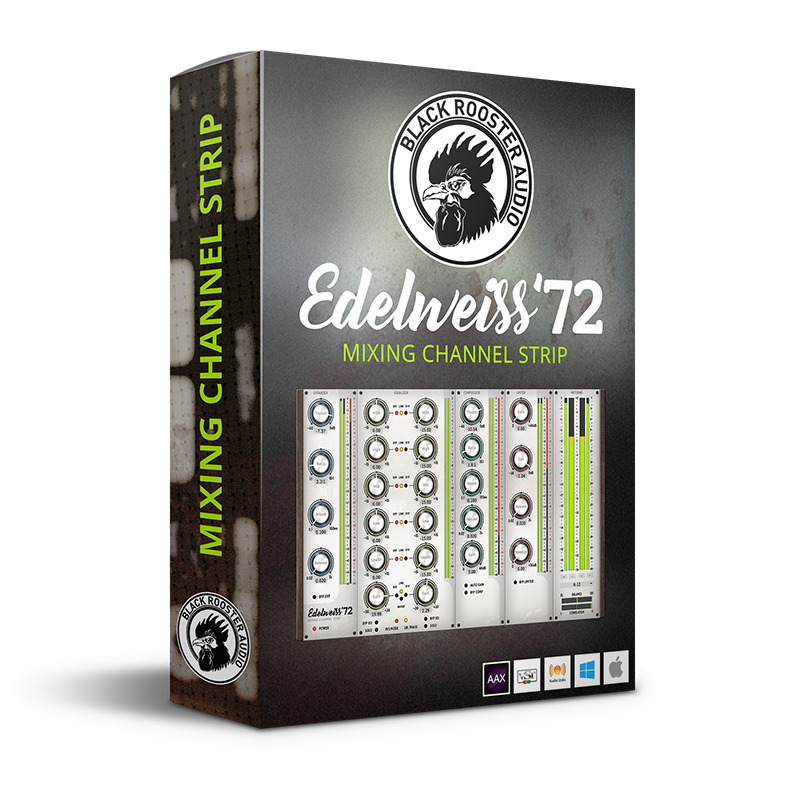
Edelweiss`72
Vintage Mixing & Mastering Channel Strip
About the Edelweiss`72
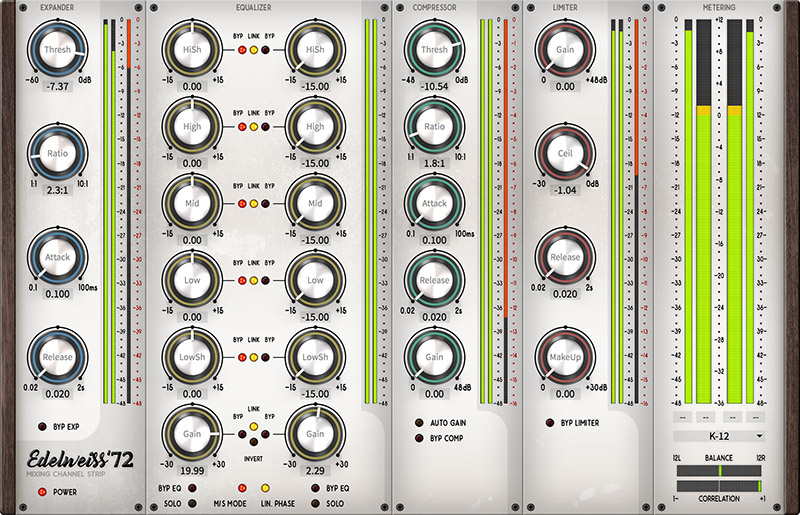
The Edelweiss´72 is a vintage-flavoured channel strip that puts a full mixing and mastering chain behind a single insert: an expander, a five-band equalizer, a compressor and a brickwall limiter, wired in the order a seasoned engineer would actually patch them. It's the plugin you reach for when a mix is nearly there but needs shaping step by step — open the dynamics back up, carve the tone, glue it together, and cap the peaks — without leaving the channel.
Most channel strips ask you to commit to their signal flow. This one hands you seventeen individual bypasses and per-section solo, so you can audition each stage on its own, compare before and after, and switch a module out of the path the moment it stops helping. That kind of granular control is the difference between guessing and knowing.
A mastering-grade toolchain, one module at a time
The chain opens with an expander — the module nobody else puts first. Feed it a mix that's been squashed by over-compression and the expander widens the dynamic range back out, decimating unwanted distortion around the threshold with a static soft-knee before the tone shaping even begins. From there the signal hits a five-band EQ with fixed, carefully chosen frequency centres: an 80Hz low shelf, a 450Hz low band, 1.5kHz in the middle, a 4.5kHz high band and a 12kHz high shelf, each offering ±15dB, with a per-section ±30dB output gain trim on top. Flip it to M/S mode and you're editing the mid and side signals separately; engage linear-phase filtering and the band edges stay phase-coherent, which matters on a bus or master where IIR phase smear would otherwise creep in. After the EQ, a soft-knee compressor with auto-gain adds density and tightens the range, and a final limiter with its own ceiling and auto-gain catches whatever pokes through.
Why the metering matters as much as the processing
Shaping dynamics blind is how mixes get over-cooked. The Edelweiss´72 keeps a full metering toolchain in view: K-12, K-14 and K-20 scales borrowed from Bob Katz's metering system, plus phase correlation and L/R balance monitoring. So when you push the compressor or widen the sides with the EQ's anti-circular gain linking, you can see the impact on your loudness reference and your stereo image in real time — not discover it two bounces later.
Using the Edelweiss´72 on the mix bus and in mastering
On the mix bus, run the expander gently to recover snap on a drum-heavy submix, park the EQ in M/S to brighten the sides without touching the centred vocal and lead, then let the compressor and limiter do the glue-and-cap work in a single pass. In a mastering context, the same chain gives you surgical, linear-phase spectral moves and controlled final loudness with the K-scale meters guiding your gain staging. If you want a purely tonal pass first, our VEQ-5 pairs well ahead of the strip for broad Pultec-style midrange colour.
Edelweiss`72 Features
Front-of-chain expander
A dedicated expander (Threshold, Ratio from 1:1 to 10:1, Attack, Release) sits first in the chain to widen dynamic range and undo over-compression. Its static soft-knee decimates unwanted distortion around the threshold before any tone shaping happens.
Five-band fixed-frequency EQ
Five static bands — 80Hz low shelf, 450Hz low band, 1.5kHz mid, 4.5kHz high band, 12kHz high shelf — each with ±15dB of range and a matching ±30dB output-gain trim per L/R or mid/side section, for repeatable, musical curves rather than endless fader hunting.
L/R and M/S processing modes
Switch the EQ section from regular stereo to M/S to edit the mid and side signals independently. Band linking uses anti-circular gain inversion, so a single move tightens or widens the stereo field smoothly.
Linear-phase EQ option
Flip the EQ from IIR to linear-phase FIR filtering to keep the band edges phase-coherent — spotless control of the spectrum without the phase incoherence that shows up on buses and masters. Expect higher CPU load when it's engaged.
Compressor with auto gain
A soft-knee compressor (Threshold, Ratio to 10:1, Attack, Release) adds density and tightens dynamics, with make-up Gain plus an Auto Gain mode that compensates for level loss based on your Threshold and Ratio settings.
Brickwall limiter stage
The final limiter caps peaks with its own Ceiling, Release and Gain controls plus Auto Gain, concentrating density at the end of the chain for a controlled mastering finish.
17 bypasses and per-section solo
Seventeen individual bypasses and multiple soloing options let you audition and compare each module — expander, EQ, compressor, limiter — in isolation for a precise, surgical workflow.
K-scale and correlation metering
A full metering section shows K-12, K-14 and K-20 scales alongside phase correlation and L/R balance, so you can watch loudness and stereo integrity while you process.
Authentic circuit emulation
Our real-time, SPICE-type component-based circuit simulation captures the sound and feel of the analog counterpart in every nuance across the dynamics and EQ stages.
SSE2-optimised code
DSP operations are pipelined on the SSE2 instruction set for high-performance operation even under the strip's complex, multi-stage processing.
Auto-adjusted oversampling
A low-latency, linear-phase Dolph-Chebyshev polyphase design attenuates aliasing and auto-adjusts to your session's sample rate to save CPU while staying transparent.
HighDPI / Retina support
Crisp, high-pixel-density rendering on macOS and Windows for a sharp interface on modern displays.
Edelweiss`72 Examples & Videos
Edelweiss`72 — Frequently Asked Questions
What is the Edelweiss´72?
The Edelweiss´72 is a vintage-style channel strip plugin that combines four processors in one signal chain: an expander, a five-band EQ, a compressor and a limiter. It handles a complete mixing or mastering pass — dynamics, tone shaping and peak control — from a single insert.
What modules are in the Edelweiss´72 signal chain?
Four, in this order: an expander to widen dynamic range, a five-band EQ (80Hz, 450Hz, 1.5kHz, 4.5kHz, 12kHz) with stereo or M/S mode, a soft-knee compressor with auto-gain, and a brickwall limiter. Seventeen bypasses let you switch any stage in or out.
Can the Edelweiss´72 work in mid/side?
Yes. The EQ section switches from regular L/R stereo to M/S, letting you edit the mid and side signals separately. Band linking uses anti-circular gain inversion, so one move can tighten or widen the stereo field — ideal for brightening the sides without touching a centred vocal.
When should I use the Edelweiss´72 — mixing or mastering?
Both. On a mix bus it recovers dynamics, shapes tone in M/S and glues the submix together. In mastering, the linear-phase EQ and K-12/K-14/K-20 metering give you surgical spectral moves and controlled final loudness. The expander-first chain makes it especially good at rescuing over-compressed material.
What is the linear-phase EQ mode for?
It switches the EQ from IIR to linear-phase FIR filtering, keeping the band edges phase-coherent so you avoid the phase smear that IIR filters introduce on buses and masters. It costs more CPU, so reach for it on the master bus rather than every channel.
Which plugin formats and systems does the Edelweiss´72 support?
The Edelweiss´72 ships as AAX, VST, VST3 and Audio Units (AU) for both macOS and Windows, including native Apple Silicon support. It runs in all major DAWs. See the product manual for detailed system requirements.
Is there a free trial of the Edelweiss´72?
Yes. Registered users can create a free 14-day trial license from the license manager and run the full channel strip before buying. You only need a free Black Rooster Audio account to get started.