Studio Stories
Bill Putnam Built the Room You Still Mix In
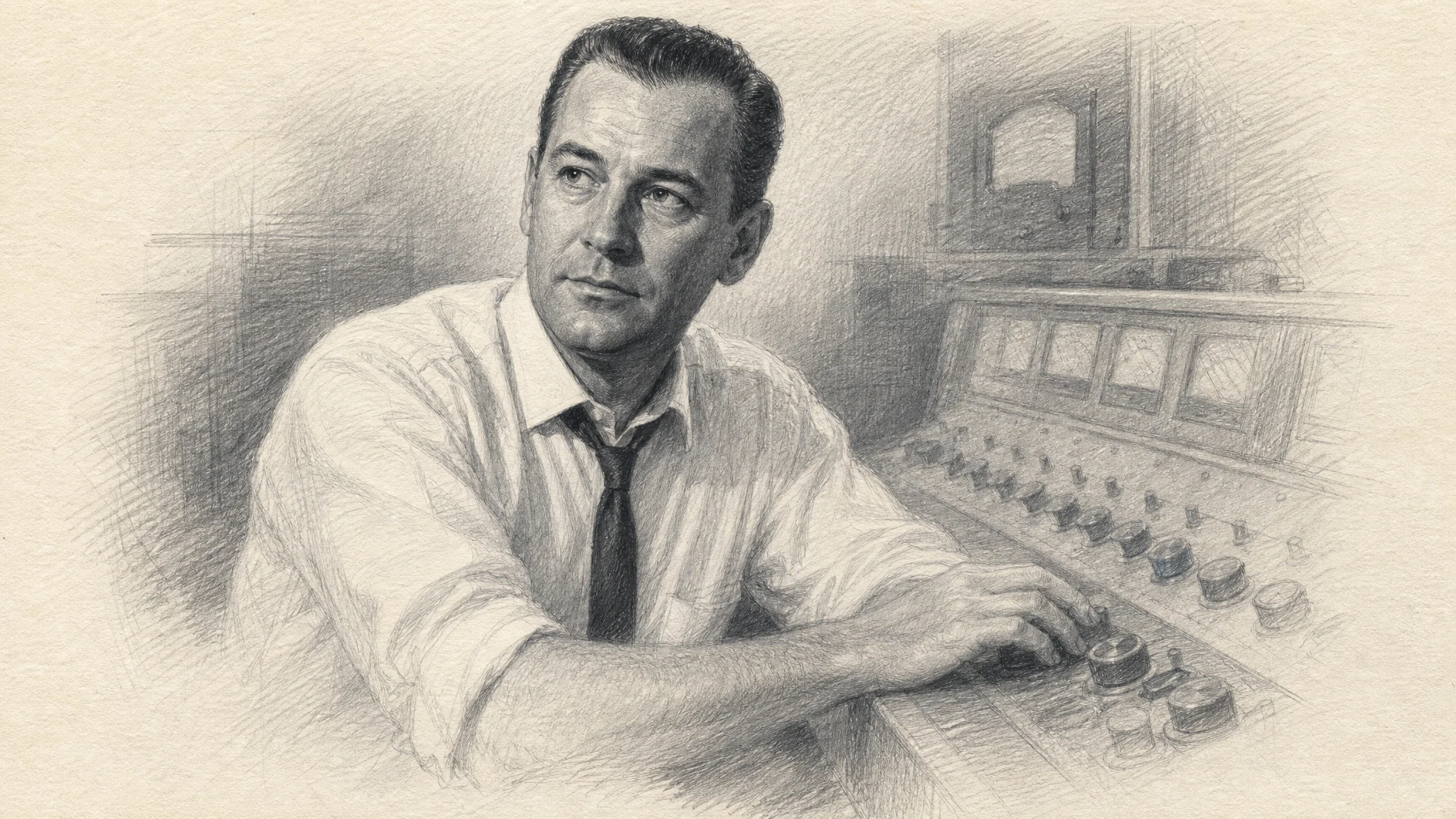
Open any mix session at random and two of the compressors on it probably descend from boxes connected to the same man. The 1176 and the LA-2A have touched more hit records than any other pair of devices in the building. He designed one of them. The other he bought, kept in production and put his company's name on, which is the less heroic story and the more useful one.
Milton T. Putnam, known to everyone as Bill, is usually introduced as the inventor of the modern mixing console. That is roughly right and it makes him sound like the wrong kind of person. He was not a man in a lab. He was a studio owner with a payroll, and almost everything he is remembered for started as a session that was not working properly.
Conveniently, he wrote it down. His 1980 AES paper covers thirty-five years of studio history, and it is harder on him and his colleagues than his admirers have been since.
Chicago, 1946, and a men's room with a sign on it
Putnam came out of broadcasting. He trained at Valparaiso Technical Institute, worked at Illinois radio stations, and spent the war on Army electronics work and recording big bands for Armed Forces radio. That background matters, because broadcast was where the technique of the day came from, and he spent the next decade arguing it was wrong for records.
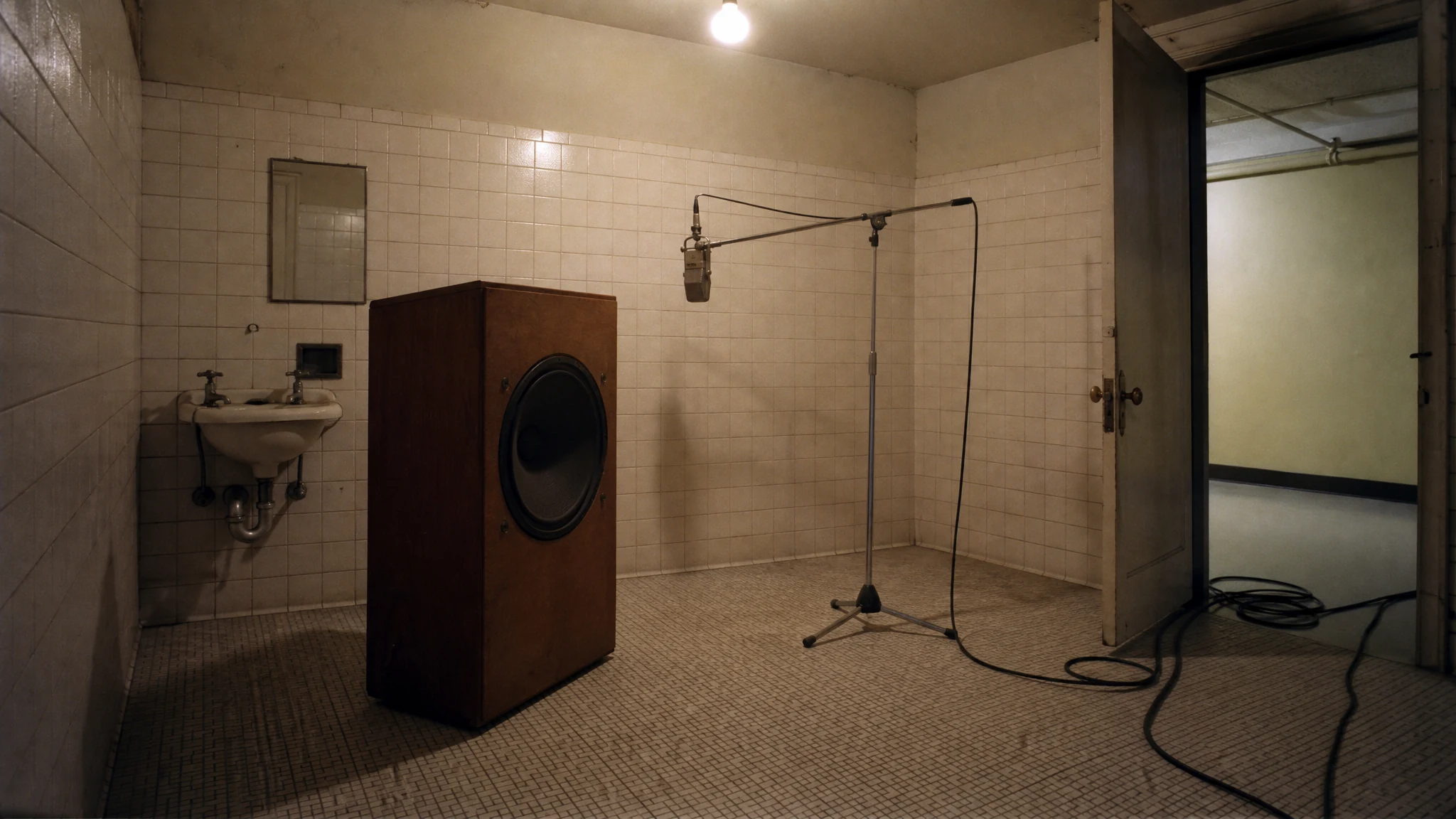
Universal Recording Corporation started in 1946 and moved in 1947 into the Civic Opera Building in Chicago. That same year he co-founded a label, Vitacoustic, and put out "Peg o' My Heart" by the Harmonicats. It went to number one, stayed on the chart twenty-one weeks and sold something like 1.4 million copies. The echo on it came from a speaker and a microphone in a tiled restroom down the hall.
"When Universal was still in the Civic Opera Building, we found an excellent men's room and, except for the times when trespassers ignored the 'out of order' sign, we had few problems. (These moments are recorded for posterity on several records.)"
You will read that this was the first record to use artificial reverb. It was not, and Putnam never claimed it. His wording is "one of the first 'pop' records, which exploited reverberation for artistic effect". Radio drama had echo chambers in the 1920s. What was new was treating the room as a colour you pick, a line that runs to the plate and then to a plate emulation on your bus.
His diagnosis was that the studios were the problem
The interesting part of that paper is not the anecdotes, it is the fault-finding. On the muddy, undefined sound of 1940s recordings he blames room reverberation at low frequencies and the off-axis behaviour of the microphones in use. Then he points at the people holding them, himself included.
"In addition, the microphone placement was 'handed down' technology from broadcasting and was ripe for improvement, insofar as records were concerned."
Elsewhere in the same paper he writes that studio operators had to "awaken to the fact that we were perhaps the 'weak link' in the chain", and flatly that "we were compelled to produce better recorded sound than we did in the 1940's." That is not modesty, it is a work order. From about 1950 he rebuilt his own practice around it: a roll-around vocal booth that doubled as a drum cage, measured monitor response in the control room, and what he cheerfully calls "primitive attempts at equalization".
The method underneath it is dull and worth copying. Find what sounds wrong, work out which part of the chain is doing it, change that part even if that means building something. A mid-fifties Mercury percussion date survives in his paper down to the mic list: two U47s overhead, onto an Ampex 350-2 at 30 ips.
What he built, and what he only bought
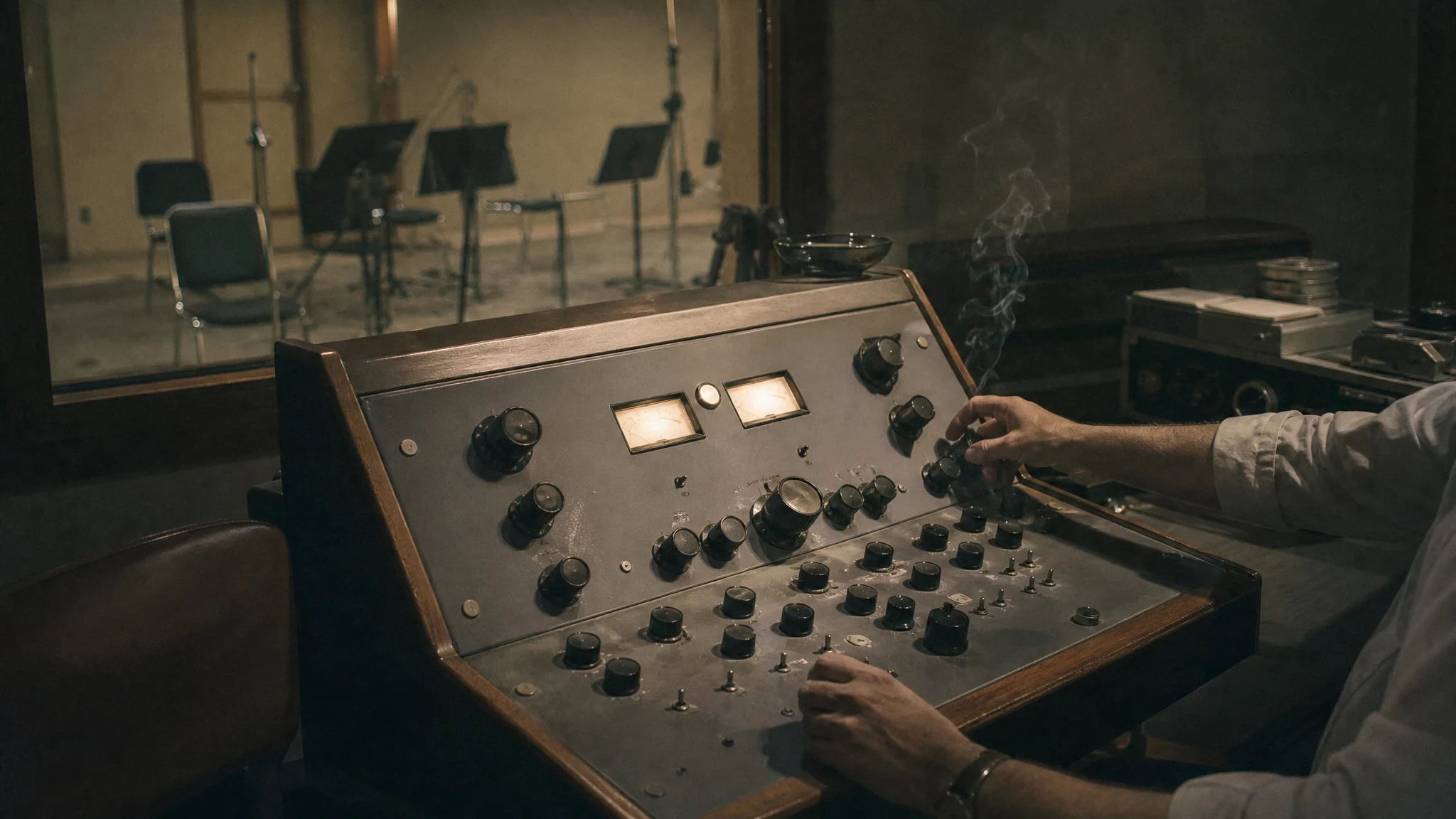
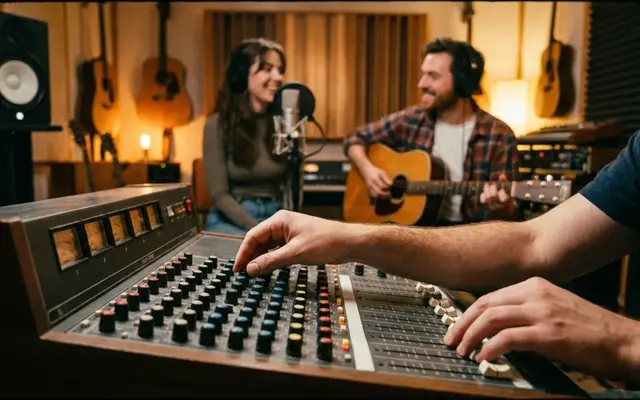
The console credit is the big one, and it holds up as long as you say "credited with" rather than "invented". Bruce Swedien called him the father of modern recording, and the list people quote is his: channel equalisation, cue sends, echo sends, multitrack switching, gathered into one desk built for making records instead of transmitting them. Better documented still is the control room. He gave the AES a paper in 1959 describing what its abstract calls "a decided departure from conventional control room design", aimed at stereo monitoring. The room as a measuring instrument rather than a cupboard with a window.
He missed things too, and said so. In 1954 his studio demonstrated eight-track recording with staggered heads, with Pentron, at a signal-to-noise ratio of roughly 30 dB. Nothing came of it. What he took from the failure was the part that mattered: that "studios designed for monaural recordings would ultimately be unsatisfactory for multi-track recording". Not a bad call for 1954.
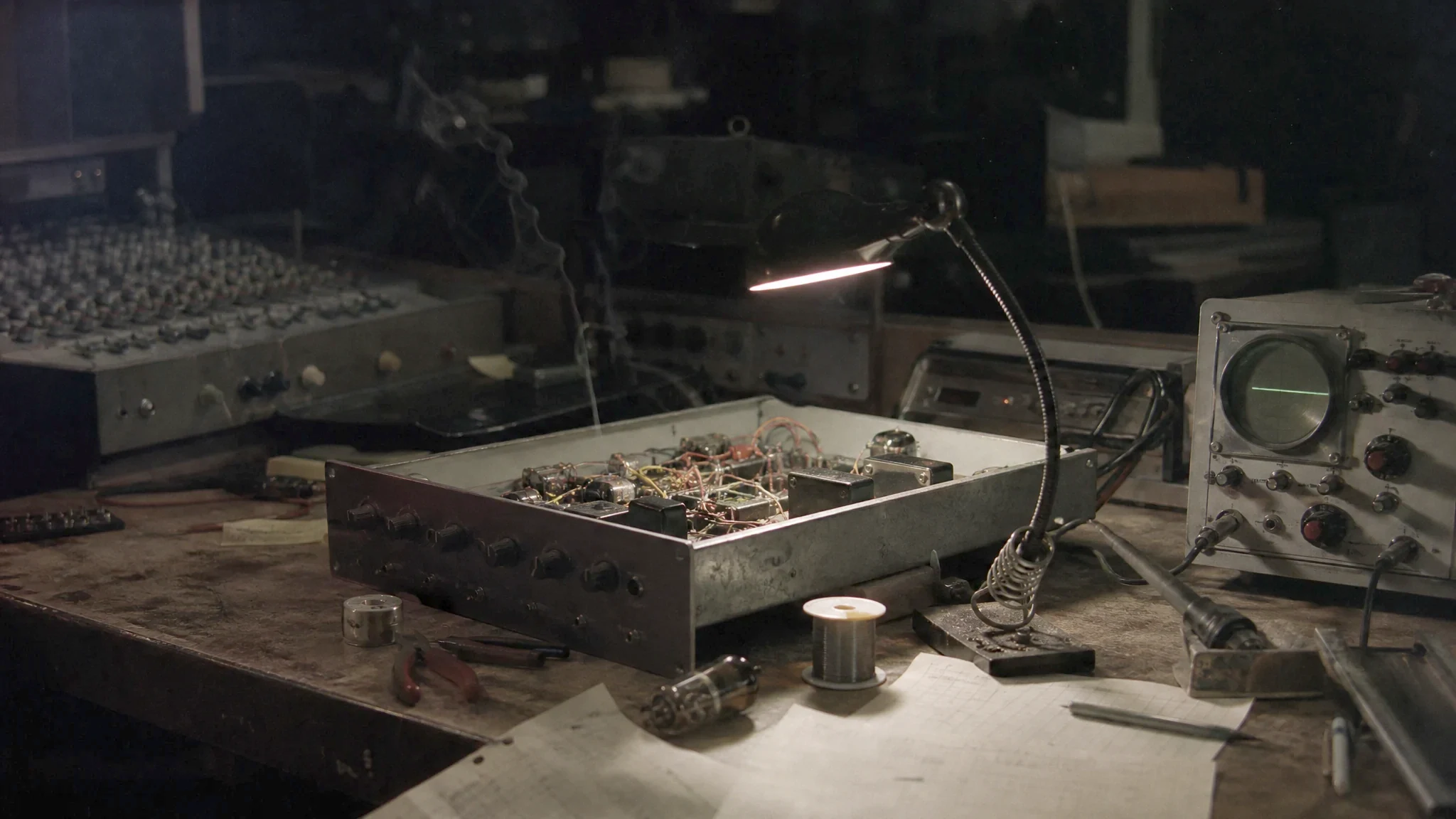
Then the compressors. The 1176 is his, built around the then-new field-effect transistor, first revision shipping in June 1967, its low-noise circuit added by Brad Plunkett at the start of 1970. Nobody knows who first held all four ratio buttons down at once. The LA-2A is not his: Jim Lawrence designed it at Teletronix, and Putnam's company acquired the line in 1967 with the rest of Babcock's broadcast division.
Hollywood, and a room you have definitely heard
He sold his Chicago interest in 1957 and went west. United Recording Corp went up at 6050 Sunset in 1958, in a converted film soundstage, with Frank Sinatra as both encourager and investor and Bing Crosby also putting money in. Universal Audio began the same year in a loft upstairs, making the amplifiers, equalisers and, before long, the 610 console modules his rooms needed. In 1961 he bought Western Recorders next door and the complex became United Western.
This is where the client list gets abused. Pet Sounds was largely cut in Western Studio 3, engineered by Chuck Britz, who worked for him. "California Dreamin'" came out of the same room, Bones Howe at the desk. Putnam engineered plenty himself, Sinatra and Ray Charles among them, but the honest split is that he engineered what he engineered and otherwise built the room the record was made in.
The honours arrived in an odd order. The AES made him a Fellow in 1959 and an honorary member in 1983. He sold United to Allen Sides in the mid-eighties, where it became Ocean Way, and died in 1989. His sons brought Universal Audio back in 1999. The Recording Academy gave him a Technical Grammy in 2000, eleven years too late.
What is still in your session
Look at a channel strip in any DAW. Gain, a way of shaping tone, a send to a reverb and another to whatever the performer is hearing. That arrangement is not a law of physics. It is one man's answer to practical problems in Chicago in the early fifties, and it won so completely that it now looks like the only possible answer. His son put the brief plainly years later: gear you could reach over and adjust by feel, while looking at the musicians rather than the equipment.
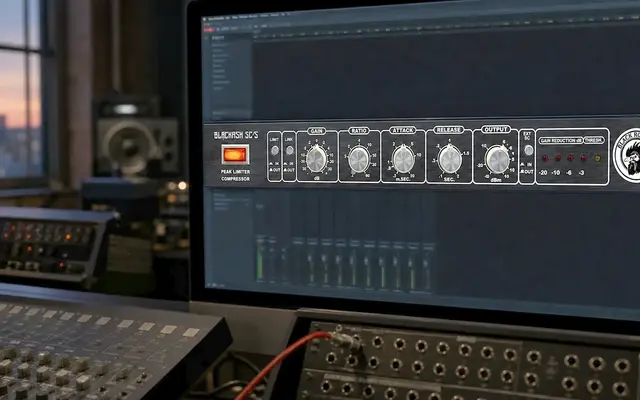
The other inheritance is subtler. His boxes were never only utilities. A compressor that also warms and thickens, an echo send used as an instrument rather than a repair: that habit is why we argue about which compressor, not just how much. When we model a FET compressor or a tube opto leveller, we are working inside decisions that turned out to be right the first time.
If you want the short version, put both on a drum bus and hear what each does to the same hit. Fast and rude against slow and forgiving. Two philosophies of level control, both still in daily use. Not bad for a man whose actual business was renting out rooms.
Add a comment
You need to be logged in to add comments.