Mixing Tips
A Vocal Chain in the Order the Signal Meets It


A friend sent me a session in the spring with a note saying the vocal was fine on its own and vanished the moment the band came in. He was right on both counts. The chain was a high-pass, a Pultec, a compressor, a tape stage, a delay and a plate, and every plugin in it was a defensible choice sitting at a defensible setting. I didn't change a knob. I dragged four of them into a different order, sent it back, and he asked which preset I had loaded.
Nothing clever happened there. It follows from one property almost everything on a vocal shares: these boxes are level-dependent, and the ones that aren't feed the ones that are. A compressor reacts to whatever reaches its detector. A saturator distorts in proportion to whatever reaches its input. Move either one and you've changed the diet of everything downstream, which is a slower way of saying you changed the sound without touching a setting.
So here is the order I work in, then each boundary in it, and what you hear when the two stages either side trade places.
Clean up before anything can react to it
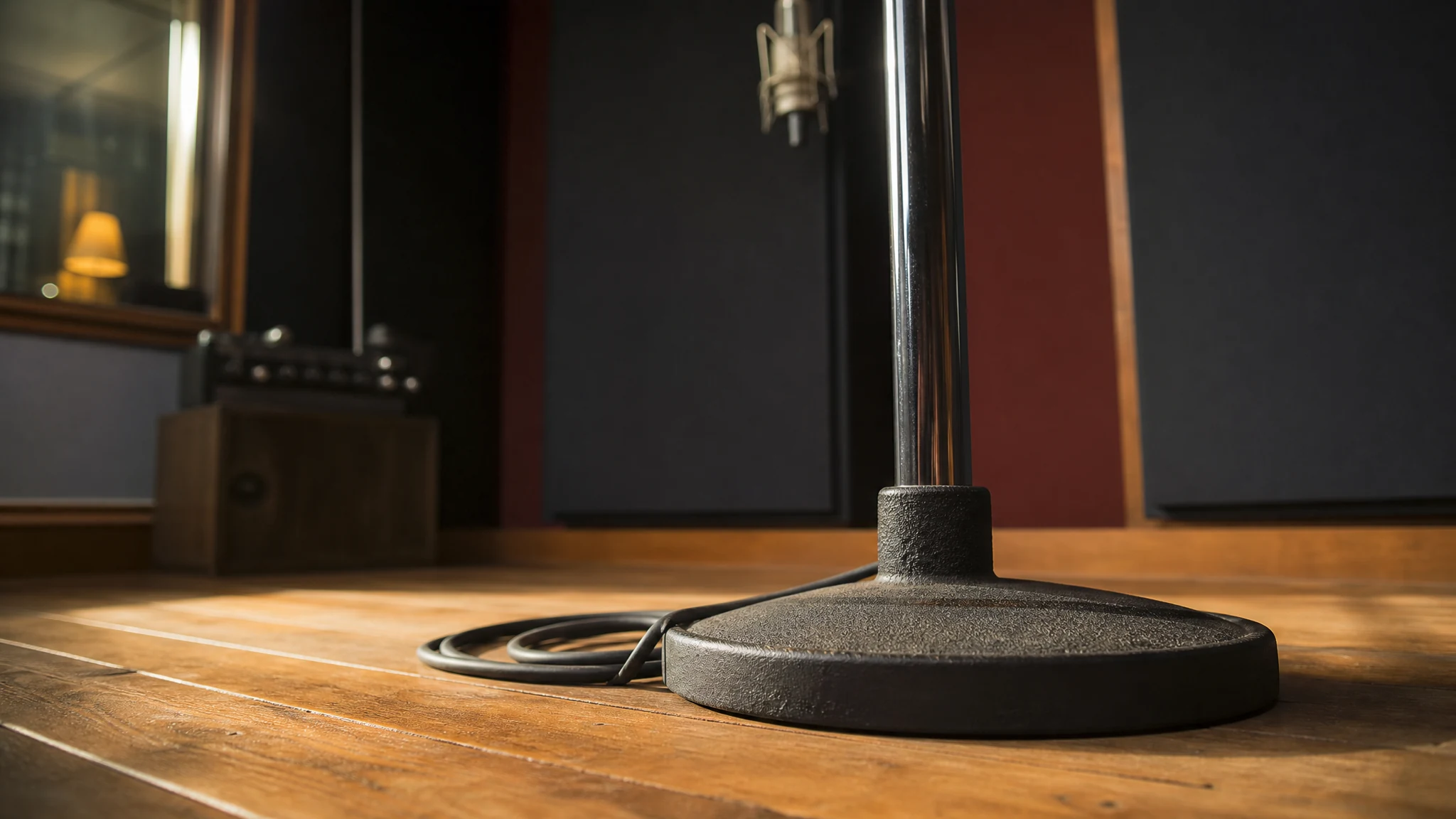
A vocal track arrives carrying things you are not listening to: floor rumble through the stand below 60 Hz, the room's air handling, a chair, the thump of somebody stepping in closer. None of it registers at conversational volume on nearfields. All of it is energy, and a compressor's detector is a broadband level meter with no opinion whatsoever about what you can hear. Low-frequency content is also slow, so it doesn't raise the detector by a steady amount. It makes the detector wobble at its own rate. You never hear the rumble. You hear the gain reduction moving to it.
Put the same filter after the compressor and the arithmetic looks identical. The output disagrees. The rumble is gone from what you hear either way, but in the second version the compressor spent three and a half minutes reacting to it, and that envelope is now part of the audio. This is the asymmetry the rest of the chain is built around: an EQ move can be undone by an opposite one, and a gain envelope cannot be undone by anything.
Breaths belong to this stage too, and they want clip gain rather than a gate, which answers an envelope problem with a second envelope. The free VHL-3C is built for precisely this: a passive low cut stepping 50, 80, 100, 150, 250 cycles and up, and a matching high cut. One of the four presets it ships with is called Remove Rumble.
Cut before the compressor, because the detector eats what you feed it
A broadband detector adds the whole spectrum together and compares one number against the threshold. So the loudest region in the vocal does most of the triggering, and on most takes that sits between 150 and 300 Hz: chest, proximity effect, whatever the room added. It is also the region you were going to thin out anyway. Doing it first changes two things rather than one: the tone, which you wanted, and which syllables the compressor leans on.
On a take last month, 4 dB out at 240 Hz took the gain reduction from roughly 6 dB to roughly 4.5 dB at the same threshold. That's the boring half. The interesting half is that it stopped pulling hardest on the low notes, so the compression started following the words instead of the vowels. I hunt for that note with the KH-EQ1, whose Listen button solos one band at +6 dB while you sweep it.
Now make that cut after the compressor instead. Hold one long note and the two versions are indistinguishable, which is why the swap looks harmless. Play the phrase and they are not. The tone matches, the movement doesn't. You removed the boxiness and kept the ducking it was causing.
Boost after the compressor, or pay for it twice
Add 4 dB at 10 kHz in front of a compressor and follow it through. If the boosted energy is part of what pushes the detector past the threshold, a 4:1 ratio hands back about a quarter of what you put in. You bought four decibels of air and kept one. That would be reason enough on its own, and it isn't the real one. The loss isn't constant: it tracks the gain reduction, and the gain reduction tracks the singer.
Through a quiet verse the compressor is barely working and the boost arrives intact. In the chorus it is pulling six, and most of the air leaves with it. The top end is now modulated by the performance, the wrong way round: bright where she is soft, dull where she pushes. People call that the vocal going dull once the track gets busy, so they boost harder, which drives the detector harder, which takes back more. Behind the compressor, 4 dB is 4 dB in the first bar and in the last.
There is one case where feeding a boost to a detector is the entire point. An emphasis control, or a sidechain EQ, is a boost that reaches the detector and nowhere else. Same curve, opposite job: it doesn't change the tone, it changes what the compressor thinks is loud.
Saturation asks the same question and answers it differently on a voice
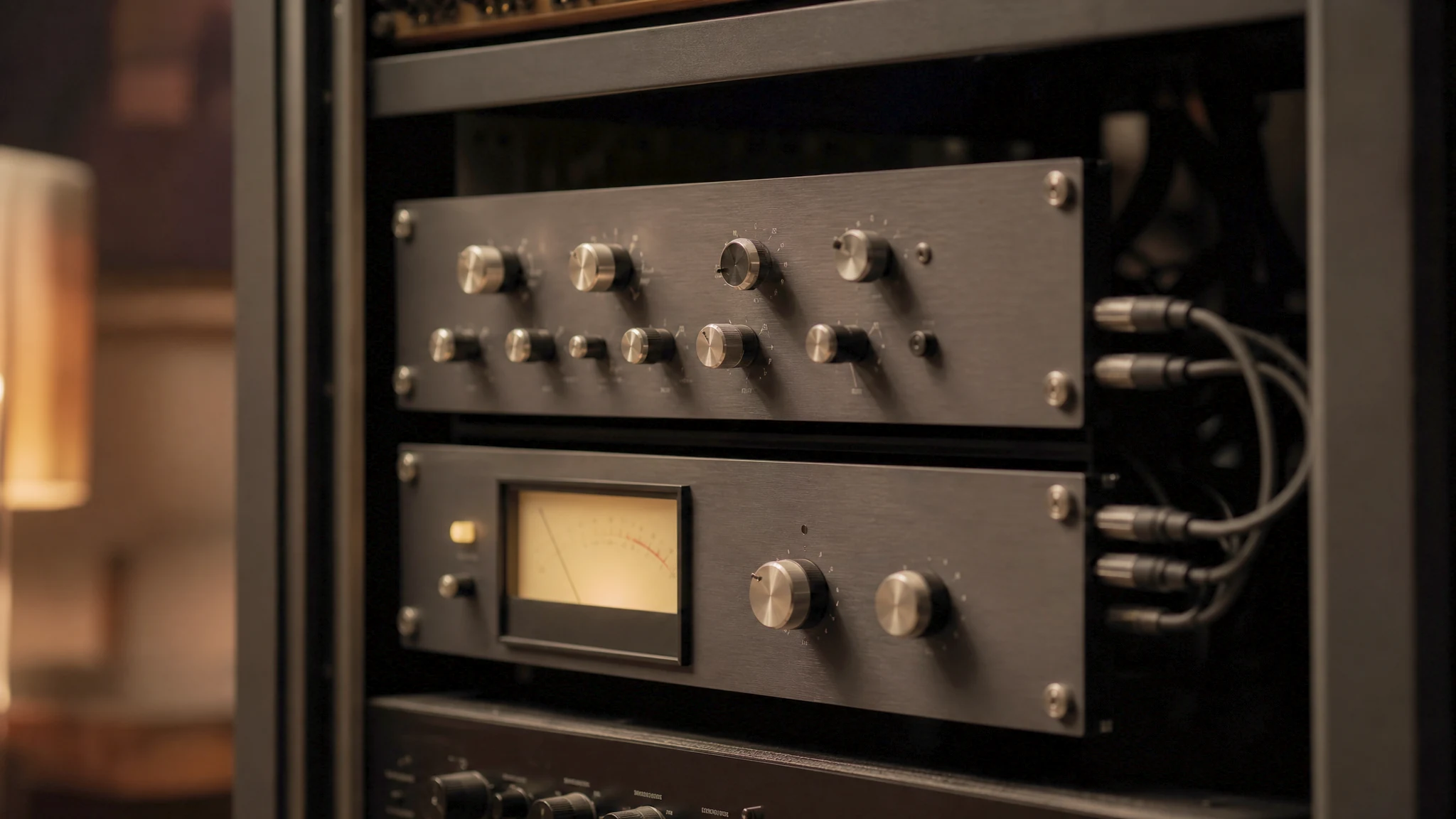
I've argued the general form already, on a drum bus: two level-dependent boxes in series do not commute, and the swap matters in proportion to how hard each one is working. The mechanism is identical on a vocal, so I won't run it again. What changes is the source. A drum bus is a stack of transients, so the swap is mostly about what survives the first box. A voice is one continuous sound with a slow envelope, and the question becomes whether the drive holds still.
Saturation in front means the drive follows the performance: clean in the verse, crunchy in the chorus, which is what a singer working a driven preamp sounds like and is often the record you want. Behind the compressor it meets a signal already squeezed into a narrow window, sits at one operating point, and gives one texture from the first word to the last.
The trap belongs to voices specifically. Saturation in front eats the peaks the compressor was hired to catch. You set a threshold, watch a healthy 5 dB of reduction, insert the tape stage ahead of it, and the meter reads 1.5 dB with nothing else touched. The compressor isn't broken. You handed its job to a box with no release time.
Delay and reverb are not in the chain at all
They go on a send, after everything, and the reason isn't tidiness. Put a reverb anywhere ahead of the compressor and the compressor ducks the tail every time the next word arrives. The tail breathes in and out in the rhythm of the lyric, loudest in the gaps and squashed flat under the voice, which is exactly backwards from how a room behaves. Soloed it's obvious; in a mix it just registers as cheap, and it survives every attempt to fix it with a different reverb.
The send also buys something an insert cannot: the return is a channel in its own right. Compress it separately if it needs holding down. De-ess the return, often more useful than de-essing the vocal, because the sibilance that bothers people is the one smeared across the tail rather than the one that lasted sixty milliseconds.
Inside the send there is an order too: delay first, plate after, so repeats and tails decay together as one gesture. Reverse them and you chop a continuous tail into rhythmic copies of itself. The RO-140 carries a Bass Cut sweeping 10 Hz to 1 kHz inside the plate, which is where I thin a tail rather than on the return, and its Mix goes to 100% on a send.
Where I break my own order
Two compressors instead of one isn't really a break: a slow unit first to level the performance and a fast one after it to catch what the slow one missed is two stages doing two jobs, not one stage in the wrong place. And when the compressor leaning on a boxy low note is the sound you want, the cut goes after it on purpose.
The PS-VC1 is this argument with the order welded shut: EQ, then compressor, then reverb, then delay, then width, with nothing to re-sort. The part worth stealing sits at the compressor, whose detector gets its own filters: a high-pass tied to whichever Low End preset you picked, and a fixed low-pass at 14 kHz, so air added upstream never reaches it. Reverb ahead of delay there looks like a contradiction of the last section until you notice the reverb mix is capped at 20%: it's a tone, not a space.
All of it runs as a full 14-day trial, so test the claim rather than take it. Load one vocal, build the chain twice in the same session, and move one plugin between the two versions. Not a knob. Just the plugin.


Add a comment
You need to be logged in to add comments.