
RO-140
Vintage Plate Reverb
About the RO-140
Inspired by the EMT 140: the plate reverb that turned a sheet of steel into the studio standard from 1957 onward, when engineers needed a room that didn't exist and a chamber they couldn't afford.
The RO-140 is a vintage plate reverb built the way the EMT 140 worked — a suspended steel sheet driven at one end and read back by pickups, its dense and slightly metallic shimmer folded into your signal in real time. We physically modelled that plate — the sheet, its transducer, its pickups and the way the metal rings — and deliver it through efficient real-time convolution, so the plate blooms and settles with the physics of the original rather than a generic digital tail. Then we did something the hardware never let you do: gave you six plate materials, a continuous size control and three routing modes on one panel.
The EMT 140, and why studios chained themselves to a 600-pound plate
Real reverb chambers were expensive, unpredictable and rare, so from the 1950s engineers strung up foil and steel plates to fake them. The EMT 140 made that idea famous — a suspended steel sheet with a driver at one end and pickups reading its vibration, all packed into a crate that weighed as much as a small piano. It sounded gorgeous and it was everywhere across the hit records of the late 50s and 60s. The RO-140 carries that voice forward: the dense, silky, unmistakably plate-like tail that glues a mix without the boxiness of a room or the wash of a hall.
Six plate materials, a size knob and the sound that follows
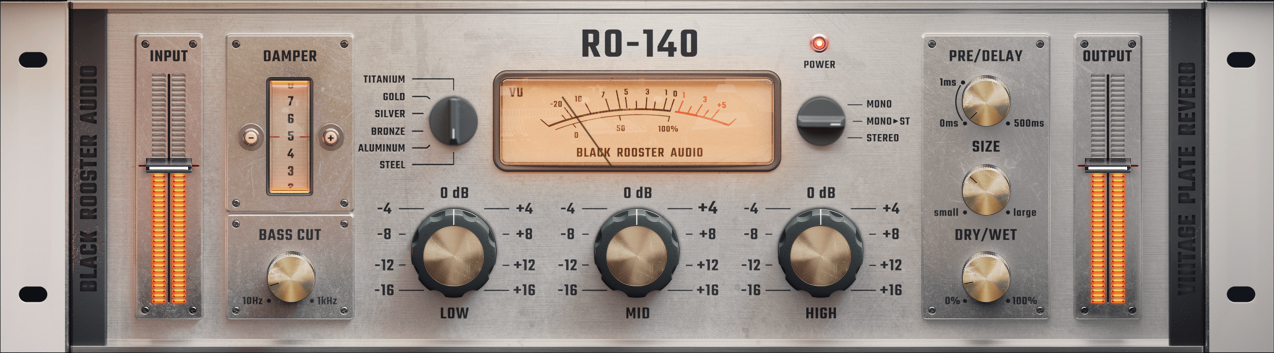
Here's the twist the hardware never gave you. Instead of one steel plate, the RO-140 offers six plate materials — steel, aluminum, bronze, silver, gold and titanium — each with its own density, brightness and decay character. The Plate Size control sweeps continuously from small to large, its transducer and pickups moving in real time to shift the tail from a tight, small-room shimmer to a wide, cavernous bloom. A Damper steps through ten positions to set decay time, exactly like the mechanical damper bar on the original. Sculpt the return with the 3-band parametric EQ (a 200Hz low shelf, a 400Hz mid peak and a 900Hz high shelf), tame boom with the Bass Cut high-pass (10Hz to 1kHz), place the tail with Pre/Delay running from 0–1ms of fine offset up to a full 500ms, and blend it in with the Mix control and Input/Output gain staging.
Using the RO-140 on vocals, snares and the mix bus
On lead vocals, a bright plate material with medium damping and a touch of pre-delay throws the singer into a space without smearing the words. On snares and toms, a shorter decay and a steel or titanium plate adds that classic 60s crack-and-bloom. Across a full mix or drum bus, the Mono2Stereo output mode is the secret weapon — feed it a mono source and it comes back as a wide image built from one transducer and two pickups placed on separate parts of the plate. Want a smaller, drier gold-plate flavour for free? Its stripped-back sibling, the RO-GOLD, covers that. Chasing spring drip and surf twang instead of a smooth plate tail? Reach for the RO-SPR.
RO-140 Features
Six plate materials
Steel, aluminum, bronze, silver, gold and titanium — six selectable plate materials, each with its own density, brightness and decay character, so a single panel covers everything from a bright, snappy drum plate to a warm, mellow vocal tail. Six very different reverbs share one knob.
Continuous Plate Size control
Sweep Plate Size from small to large and the transducer and pickups move in real time, sliding the tail from a tight, small-room shimmer to a wide, cavernous bloom. It reshapes the reverb live, not just its length.
10-position Damper
Set decay time across ten damper positions with the + and – buttons, recreating the mechanical damper bar that pressed against the original steel sheet to shorten the ring — from short, tight tails to long, open blooms.
Three output modes: Mono, Mono2Stereo, Stereo
Mono sends one channel to a single plate with one transducer and pickup; Mono2Stereo feeds a plate read by two pickups on separate parts of the sheet to build a wide image from a mono source; Stereo runs two separate identical plates. Mono2Stereo is the RO-140's mix-bus trick.
3-band parametric EQ and Bass Cut
Shape the wet return with a 200Hz low shelf, a 400Hz mid peak and a 900Hz high shelf, then trim rumble with the Bass Cut high-pass sweeping from 10Hz to 1kHz — all applied to the reverb, not the dry signal.
Split-range Pre/Delay
Pre/Delay covers 0–1ms of fine offset in its first third and 1–500ms beyond, placed before the plate so you can push the tail back behind the dry signal and automate it directly from your DAW.
Mix and Input/Output gain staging
A Mix control blends wet and dry in-plugin for insert use, while separate Input and Output sliders let you drive the plate and gain-match the return before and after processing.
Physically modelled plate, convolution-delivered
The RO-140's plate is physically modelled — the sheet, its size, material and damping — and rendered through efficient real-time convolution, so those settings interact to reshape the tail live rather than replaying one fixed, generic sample.
SSE2-optimised code
DSP operations are pipelined on the SSE2 instruction set for high-performance operation even under the RO-140's heavy real-time convolution.
HighDPI / Retina support
Crisp, high-pixel-density rendering on macOS and Windows for a sharp interface on modern displays.
RO-140 Audio Demos
Both takes play in sync. Press FX to switch the plugin in and out without losing your place.
RO-140 — Frequently Asked Questions
What hardware is the RO-140 based on?
The RO-140 is inspired by the EMT 140, the steel-plate reverb that became the studio standard from the late 1950s. We physically modelled the plate and deliver it through efficient real-time convolution, then expanded it to six selectable plate materials, a continuous size control and three routing modes instead of the original single sheet.
What do the six plate materials sound like and when should I use them?
Each material — steel, aluminum, bronze, silver, gold and titanium — has its own density and brightness. Steel and titanium give bright, snappy tails for snares and drums; gold and bronze sit warmer and mellower for vocals and strings. Pair them with the Plate Size control to move from tight rooms to cavernous halls.
How is the RO-140 different from the RO-GOLD?
The RO-140 is the full plate reverb: six plate materials, a continuous Plate Size control, a 3-band EQ and three output modes. The free RO-GOLD is a stripped-back single gold-plate with just Bass Cut, Damper, Pre/Delay and a Mix control — great to start with, but the RO-140 is the deeper toolbox.
Should I choose the RO-140 or the RO-SPR spring reverb?
Pick the RO-140 for smooth, dense, room-like reverb on vocals, drums and the mix bus. The RO-SPR is a spring reverb — bouncy, ringy and low-end heavy, built for surf guitar drip, dub and psychedelic effects. Plates glue and smooth; springs add character and mechanical splash.
Can I widen a mono source with the RO-140?
Yes. Set the output mode to Mono2Stereo and the plate is read by one transducer and two pickups placed on separate parts of the plate. Feed it a mono signal and the reverb return comes back as a genuine stereo image, which is why it works so well on mono vocals and buses.
Which plugin formats and systems does the RO-140 support?
The RO-140 ships as AAX, VST, VST3 and Audio Units (AU) for both macOS and Windows, including native Apple Silicon support, and runs in all major DAWs. See the product manual for detailed system requirements.
Is there a free trial of the RO-140?
Yes. Registered users can create a free 14-day trial license from the license manager and demo the RO-140 in full before buying. You only need a free Black Rooster Audio account to get started.