Mixing Tips
Two Microphones, One Waveform: Phase Without the Maths

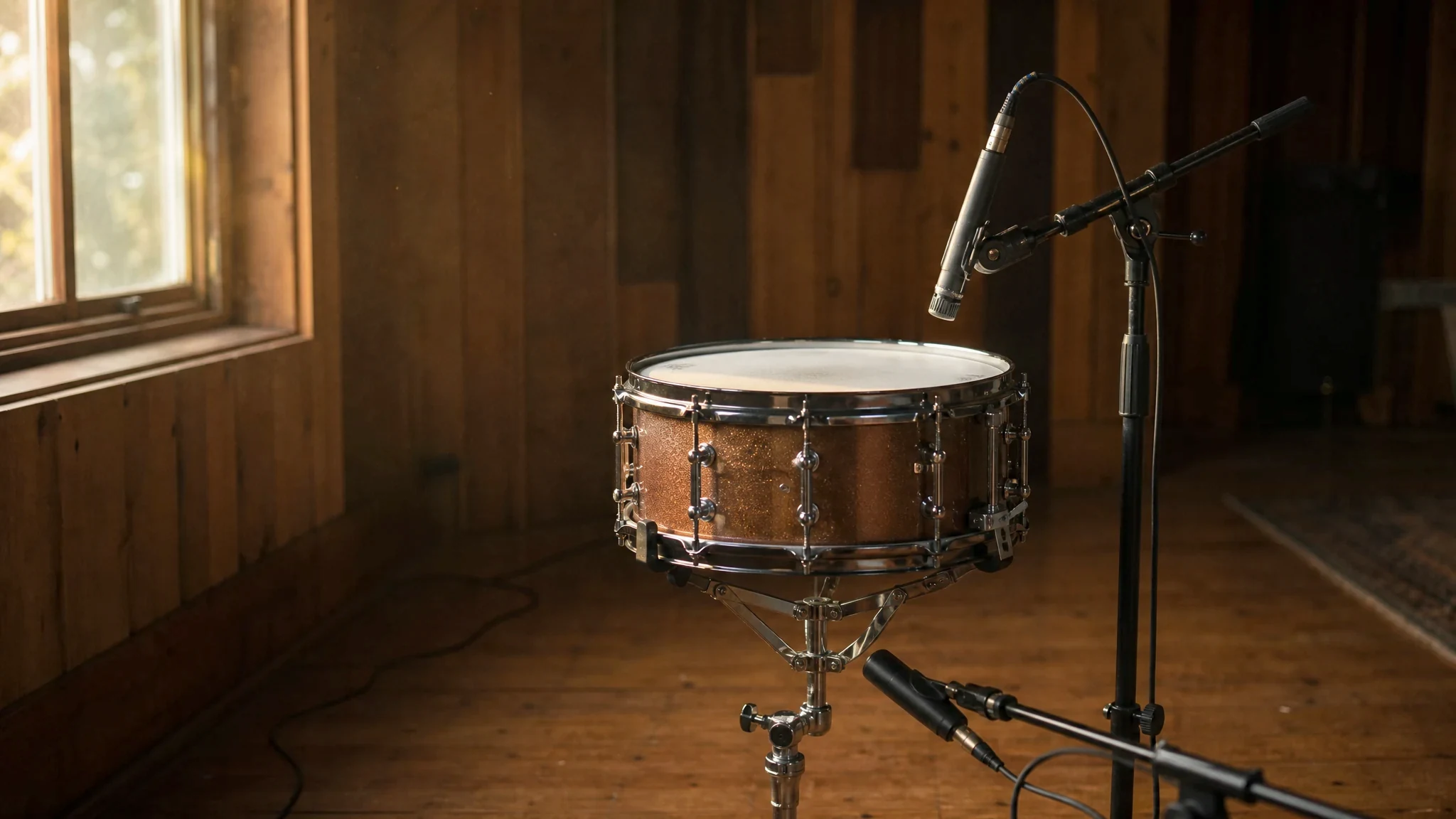
The first time it happened I blamed the drummer. A snare that cracked like a rifle in the room, one condenser over the top, and I thought the obvious thought: this will be better with a mic underneath catching the wires. I put one there, pushed the fader up, and the snare got smaller. Thinner through the body, hollow in the low mids. Muted the new channel and the drum walked back into the room.
It took me an embarrassingly long time to stop reaching for EQ there. Two mics on one source is an arithmetic problem before it is a tonal one, and the arithmetic runs whether you think about it or not.
You don't need the maths to work with it. You do need to know what it does, because the fix almost never lives in a plugin.
Two arrivals, one waveform
Sound covers about 34 centimetres in a millisecond, and that single number is most of what you need. If the top snare mic sits 5 cm above the head and the bottom mic 15 cm under it, the same hit reaches the second capsule roughly 0.3 ms later. Nothing has gone wrong yet. Solo either one and it sounds exactly the way it should. But sum those two channels to one fader and you are adding two copies of the same waveform that no longer line up, and what comes out is neither of them. The desk has no way of knowing it added the same thing twice.
Whether a frequency gets louder or quieter depends on where it sits in its own cycle when the late copy arrives. A 1 kHz tone takes exactly 1 ms to complete one cycle. Delay it by half a millisecond, crest meets trough, and the two erase each other. Delay it by a full millisecond and they line up again, so 1 kHz comes back 6 dB louder than one mic alone.
Every frequency gets its own verdict. Plot them all and the shape is unmistakable.
Why it reads as tone, not as echo
The teal curve is the worst case: both mics at the same level, one millisecond apart. Peaks of +6 dB every 1000 Hz, total cancellation halfway between them, evenly spaced all the way up. That even spacing is where the name comes from. Halve the delay and the pattern stretches to 2000 Hz; shrink it far enough and the first hole climbs clear of the audible range.
Below roughly 25 ms your ear refuses to hear two events. It hears one sound with a colour, and that colour is hollow and glassy, like a flanger stopped mid-sweep. The reliable tell is what happens when you move a mic five centimetres: room tone changes level, comb filtering changes character.
The amber curve is the same delay with the second mic 9.5 dB quieter. Same holes, same places, nowhere near the same damage: the deepest dip is 3.5 dB. Notch depth depends on the level difference, not the delay.
The 3:1 rule, and the number underneath it
Most of us learned the rule as a slogan. If the first mic is 10 cm from its source, keep the second at least 30 cm away from that same source. Three times the distance. Nobody ever explained where the three came from. It isn't folklore. Triple the distance and the inverse distance law drops the bleed by 20 × log10(3), which is 9.5 dB, and 9.5 dB is precisely the number that turns a hole into a wobble.
Feed that difference back into the sum and the comb collapses from infinite nulls to 6.0 dB between peak and trough, which leaves a ±3 dB ripple, about the size of an EQ move you would make on purpose and then forget about.
Push further and it improves slowly: 4.4 dB of ripple at four times the distance, 2.9 dB at six. Three is where the curves cross into liveable. One caveat: the rule is about bleed, one instrument leaking into a mic aimed at something else, not two mics on one source.
Polarity is not the same as delay
These two get treated as one control and they are not the same operation. Polarity inversion turns the whole waveform upside down: every positive sample becomes negative, at every frequency. A delay shifts the waveform along in time, which changes each frequency's phase by a different amount. The two coincide at exactly one frequency, and nowhere else.
So flipping polarity on a comb-filtered pair does not remove the comb. It moves it. Take the teal curve above and invert the second mic: peaks and nulls trade places, and the holes land on 0, 1000 and 2000 Hz instead. Same damage, redistributed. You are choosing between two combs, not escaping one.
Flip it anyway, every time. On a bottom snare mic the head moves away from one capsule while it moves toward the other, so the two really are close to opposite and the flip usually is the right answer. On our VPRE-73 the polarity switch sits next to the high-pass, which happens to be my order of operations: move the mic, align, flip, EQ.
The case the 3:1 rule can't save
Put a dynamic on the grille cloth of a guitar cab and a condenser a metre behind it. The distance ratio is far past 3:1, so by the rule you are fine. You are not, because the point of that second mic is to blend it, and blending means pushing its fader up until you can hear it. Once the two levels are comparable you are back on the teal curve, and the delay is now 2.9 ms — a null every 343 Hz starting at 171 Hz, straight through the part of the spectrum where a guitar lives.
The rule assumes the distant mic stays quiet. A deliberate blend breaks that assumption on purpose.
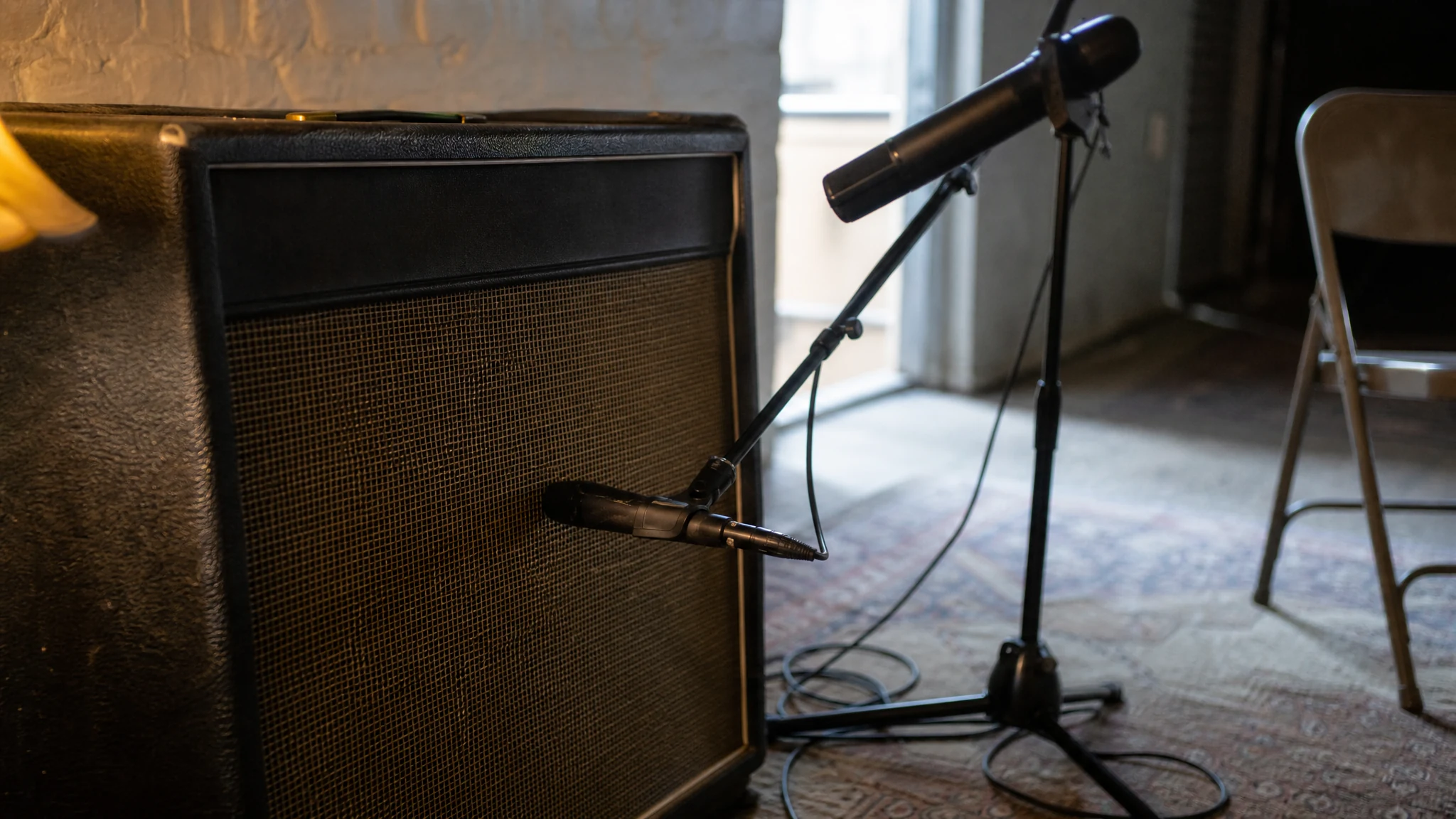
That leaves two honest options. Pull the far track forward by 2.9 ms per metre, then check by ear, because the arrival is rarely where the tape measure says. Or keep both mics within a couple of centimetres of the same path length, where a 2 cm difference puts the first null at 8.6 kHz and all you are shaping is air.
The old trick still beats both: have someone play while you slide the mic, and listen in mono.
What I do now
Mono button before anything else, on every multi-mic source. If the sound thins out when the stereo field collapses, the problem is timing, and I go and stand in the live room instead of opening a plugin. Ten minutes with a mic stand beats an hour of corrective EQ. Rolling the bottom off a distant mic helps more than people expect, because it removes that mic's contribution where the first and widest hole sits. A free filter like the VHL-3C on the far channel, low cut at 150 or 250 Hz, often gives back most of the weight the blend took away.
What does not work is boosting a notch back up. There is nothing there to boost. If a snare has lost its crack to cancellation, generate a new one instead: the Canary is free and synthesises attack rather than amplifying what survived.
Two mics, two arrival times, one sum. Get the distance right and the polarity checked at the source, and you stop chasing a hollowness that no EQ will reach. Try it on the next kit: one snare, two mics, five minutes with the mono button before you touch a fader.



Add a comment
You need to be logged in to add comments.