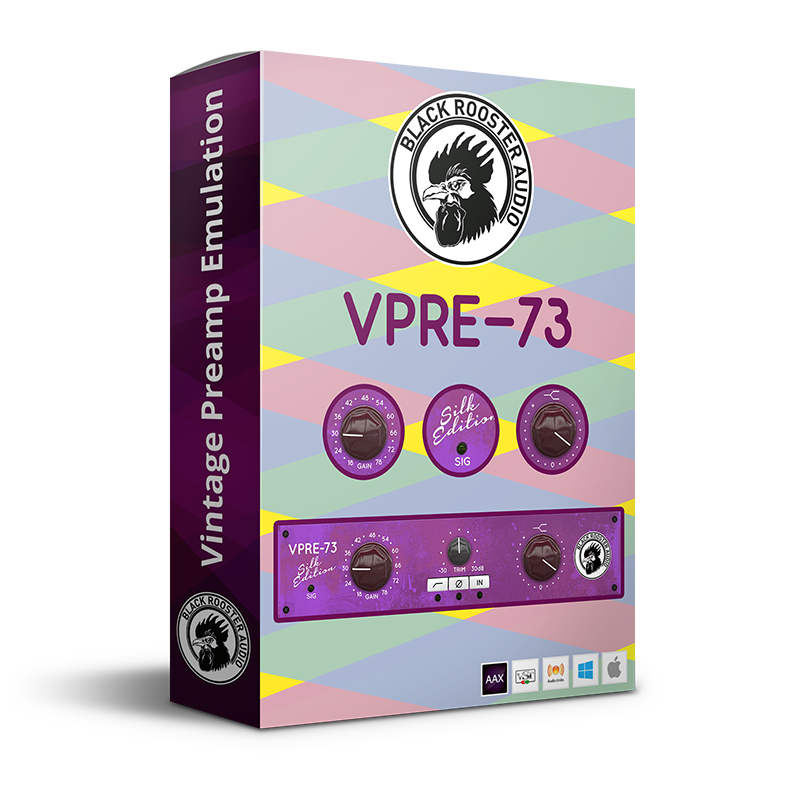
VPRE-73
Vintage Preamp Emulation
About the VPRE-73
Inspired by the Neve 1073: the transformer-driven console preamp behind more hit records than anyone has bothered to count, distilled down to the three things engineers actually reach it for — gain, iron and that high shelf.
The VPRE-73 is a vintage preamp plugin, and it does exactly what a great preamp is supposed to do: it makes a signal sound like it went through something. Not a clean gain stage. Something with input and output transformers, a discrete Class-A amplifier, and the pleasant, level-dependent distortion that engineers spent decades learning to lean into rather than fight. You push the Gain, the iron starts to sing, and a flat DI or a lifeless vocal picks up weight it never had on the way in.
The Neve 1073, streamlined to what matters
The original 1073 was a mic-pre and EQ module from a 1970s Neve console, and half the reason it became a legend is the way its transformers and Class-A gain stage colour a signal before you touch a single tone control. We modelled that behaviour with our real-time, SPICE-style circuit simulation: the input and output audio transformers, the discrete preamp circuit and the famous HF shelving band are all reproduced as a living circuit, so the harmonics shift with level the way the hardware's do. One deliberate change from the original — where the hardware's Gain is stepped in fixed increments, we made it continuous. That lets you dial the THD in gradually instead of jumping between coarse steps.
Where the character comes from: transformers, THD and the trim trick
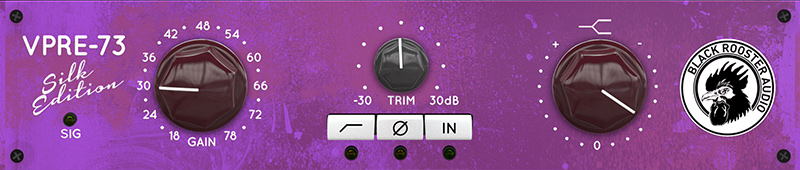
Gain runs from +18 to +78dB and controls how hard you drive the preamp circuit, which is where the harmonic saturation lives. The catch, as on any real preamp, is that more drive means more level — so the VPRE-73 borrows a hardware move: hold the right mouse button on the Gain knob and the Trim follows in the opposite direction. Now you can crank the THD without the track jumping 20dB louder. Trim itself spans -30 to +30dB and stays perfectly linear, adding no harmonics of its own, so it's a clean make-up stage. The HF shelf (roughly -15 to +15dB) is the recognisable 1073 top end — the air that flatters vocals and cymbals — and an 80Hz, 12dB/Oct highpass on the HP button clears rumble and pops before the preamp ever sees them.
Using the VPRE-73 on vocals, guitars, drums and the mix bus
On vocals, a touch of Gain and a small HF shelf boost pulls the singer forward with that recorded-to-a-console sheen. On electric guitars and bass DI, drive it harder for the grit and thickness that make a direct signal sit in a track. On drums, print it on the room mics or the whole kit for glue and low-end punch. It also earns a spot across a full mix or master bus, where a little transformer colour and shelf lift adds cohesion without ever sounding processed. Want the same iron with two extra tricks — a CRANK multiplier and a sweepable high-pass? Try the seasonal VPRE-73 Halloween Edition.
VPRE-73 Features
Continuous +18 to +78dB gain
Where the original 1073 stepped its gain in fixed increments, we made ours continuous, so you can creep the drive up degree by degree and land exactly the amount of transformer saturation and THD a source wants.
Linear -30 to +30dB trim stage
The trim is a completely linear output stage that adds no harmonics of its own — ideal for gain-matching before and after, or for compensating the level jump when you push the preamp hard.
Gain/trim opposite-drag linking
Hold the right mouse button on Gain and Trim tracks in the opposite direction (and vice versa), letting you dial in as much THD as you like without the track suddenly getting louder or quieter.
1073-style HF shelving band
The high shelf lifts or cuts the top end by roughly ±15dB after the preamp stage — the air and presence the 1073 is famous for, useful on vocals, acoustic guitars and overheads.
80Hz highpass filter
The HP button engages a 12dB/Oct highpass at 80Hz to strip rumble, handling noise and vocal pops before they hit the gain stage, plus phase-invert and a full processing bypass on the In button.
Authentic circuit emulation
Our real-time, SPICE-type component-based circuit simulation captures the sound and feel of the analog counterpart in every nuance — input and output audio transformers, the discrete preamp circuit and the HF shelving band all faithfully modelled.
SSE2-optimised code
DSP operations are pipelined on the SSE2 instruction set for high-performance operation even under complex processing.
Auto-adjusted oversampling
A low-latency, linear-phase Dolph-Chebyshev polyphase design attenuates aliasing and auto-adjusts to your session's sample rate to save CPU while staying transparent.
HighDPI / Retina support
Crisp, high-pixel-density rendering on macOS and Windows for a sharp interface on modern displays.
VPRE-73 Examples & Videos
Industry Reviews

VPRE-73: Sounds like rich dark chocolate syrup! Brings lushful body to thin sounding vocals.
VPRE-73 — Customer Reviews
sounds so good on vocals
Easy to use and adds character to a dry boring recording
Excelente!!!
Un plugin muy bueno!!!
Sounds Great
Really nice hot!
Thumbs up
This plugin is very user-friendly and it sounds great! I like it.
A Vintage Preamp That Truly Delivers
If you’re looking to add authentic vintage preamp character to your recordings — whether vocals, instruments or full mixes — VPRE-73 is a standout choice. It offers excellent value for money, delivers sonic quality that meets professional standards, and integrates seamlessly into a modern digital workflow. Highly recommended.
Holds up well
Been using it a long time and still regularly find myself reaching for it over other 73 plugins.
Leave a Review
VPRE-73 — Frequently Asked Questions
What hardware is the VPRE-73 based on?
The VPRE-73 is inspired by the Neve 1073, the transformer-coupled Class-A console preamp used on countless classic records. It models the input and output audio transformers, the discrete preamp circuit and the 1073's signature HF shelving band using real-time circuit simulation.
What does the VPRE-73 sound like and when should I use it?
It adds transformer weight, low-end thickness and a smooth, level-dependent THD — the sound of a signal that went through a real console. Reach for it to fatten vocals, drive guitar and bass DIs, glue drums, or add cohesion across a mix or master bus.
How do the Gain and Trim controls work together?
Gain (+18 to +78dB) drives the preamp and generates the harmonic saturation, while Trim (-30 to +30dB) is a clean, linear output stage. Hold the right mouse button on either knob and the other follows in the opposite direction, so you can add THD without changing the track's level.
What is the HP button on the VPRE-73?
The HP button engages a 12dB/Oct highpass filter fixed at 80Hz. Use it to remove rumble, handling noise and vocal pops before they reach the gain stage. The plugin also includes a phase-invert switch and an In button that bypasses all processing.
Which plugin formats and systems does the VPRE-73 support?
The VPRE-73 ships as AAX, VST, VST3 and Audio Units (AU) for both macOS and Windows, including native Apple Silicon support. It runs in all major DAWs. See the product manual for detailed system requirements.
Is there a free trial of the VPRE-73?
Yes. Registered users can create a free 14-day trial license from the license manager and demo the VPRE-73 in full before buying. You only need a free Black Rooster Audio account to get started.