
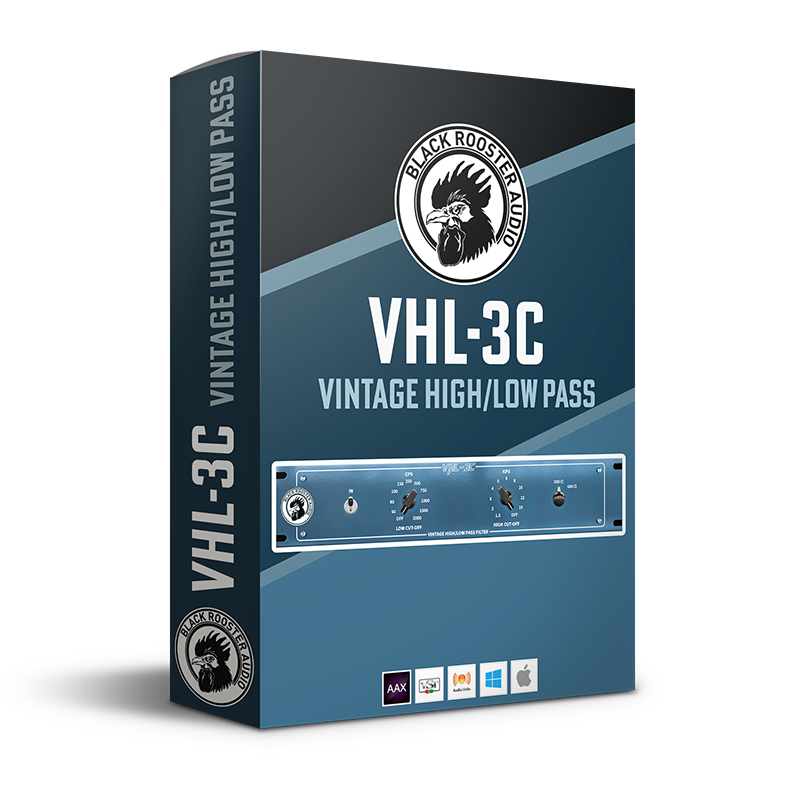
VHL-3C
Free Vintage High/Low Pass Filter

About the VHL-3C
Inspired by the Pultec HLF-3C: a passive high/low pass filter unit from the early 1950s, built around a cascade of two constant-K filter networks — the tool engineers reached for to shape the extremes of a signal without touching the middle.
The VHL-3C is a vintage high/low pass filter, and it's free. No trial timer, no account gymnastics — download it and it's yours. What you get is an entirely passive filter design with two controls and one job: cleaning up the top and bottom of a signal the way a classic Pultec-style filter did, with the musical, slightly interactive behaviour that only a constant-K network gives you. Reach for it when a track has too much rumble underneath, too much fizz on top, or both.
The Pultec HLF-3C and constant-K filtering
The hardware behind the VHL-3C was a sought-after passive processor from the early 1950s. Its filters weren't sharp digital brickwalls; they were gentle, resonant slopes built from inductors and capacitors that interact with the circuit's load. We modelled that whole passive network — including the filter-stage interaction and the influence of the load resistance — with our real-time SPICE-style circuit simulation, so the filters don't just cut, they colour. That interaction is exactly why the old boxes sound "musical" rather than clinical, and it's baked into the VHL-3C.
Two knobs, and a load switch that changes the character
The layout is deliberately minimal. The Low Cut-Off (high pass) steps through 50, 80, 100, 150, 250, 500, 750, 1000, 1500 and 2000 Hz — or OFF. The High Cut-Off (low pass) runs from 1.5kHz up to 15kHz across stepped positions, or OFF. Set both to their extreme positions and you get a narrow telephone-line bandpass, a classic lo-fi effect on its own. The third control is the one people miss: a Load Z switch between 500 and 600 Ohm. The filter network is designed for a 500 Ohm terminating resistor, so flipping to 600 Ohm gives you slightly overdamped filters — a subtly softer, tamer slope when you want it.
Where the VHL-3C earns its place: mix-bus cleanup and mastering
Slot it across the mix bus and roll the low cut up to 50 or 80Hz to strip sub-rumble and room mud that eats headroom, then trim a touch of harshness off the top with the high cut — instant clarity before your bus compressor. On individual sources it tames boxy low end on guitars or removes hiss and sibilant fizz from vocals and cymbals. In mastering it's a clean, characterful high-pass and low-pass pair for gently focusing a full mix without a surgical EQ's clinical edge. And because it costs nothing, it belongs on every template. Pair it ahead of a colouring EQ like our VEQ-1P when you want to clean up first, then sweeten.
VHL-3C Features
Cascaded constant-K filter network
A cascade of two passive constant-K filters — high pass and low pass — recreates the resonant, interactive slopes of the early-1950s hardware. The filters interact with the circuit load rather than cutting cleanly, which is what gives them their musical, characterful sound.
Stepped low cut-off (high pass)
The Low Cut-Off steps through 50, 80, 100, 150, 250, 500, 750, 1000, 1500 and 2000 Hz, or OFF — repeatable, musical positions for stripping rumble, sub-mud and low-end boxiness.
Stepped high cut-off (low pass)
The High Cut-Off sweeps from 1.5kHz up to 15kHz across stepped settings, or OFF, for taming harshness, fizz and hiss without a clinical brickwall.
Selectable 500 / 600 Ohm load
A Load Z switch changes the terminating resistance. The network is designed around 500 Ohm; switching to 600 Ohm slightly overdamps the filters for a softer, tamer slope — a genuine hardware behaviour, not a cosmetic option.
Telephone-line bandpass trick
Set both cut-off controls to their extreme positions and the two filters close in on each other to produce a narrow telephone-line bandpass — a ready-made lo-fi effect.
Authentic circuit emulation
Our real-time, SPICE-type component-based circuit simulation faithfully models the passive filter network, including the filter-stage interaction and the influence of the different load resistances.
SSE2-optimised code
DSP operations are pipelined on the SSE2 instruction set for high-performance operation even under complex processing.
Auto-adjusted oversampling
A low-latency, linear-phase Dolph-Chebyshev polyphase design attenuates aliasing and auto-adjusts to your session's sample rate to save CPU while staying transparent.
HighDPI / Retina support
Crisp, high-pixel-density rendering on macOS and Windows for a sharp interface on modern displays.
VHL-3C Examples & Videos
VHL-3C — Frequently Asked Questions
What hardware is the VHL-3C based on?
The VHL-3C is inspired by the Pultec HLF-3C, a passive high/low pass filter from the early 1950s. It recreates that unit's cascade of two constant-K filter networks using real-time circuit modelling, including the filter interaction and load-resistance behaviour of the original passive design.
Why use the VHL-3C instead of the high-pass filter already in my DAW?
A passive filter bends differently at the corner than a digital one does. The VHL-3C models the Pultec HLF-3C's two constant-K sections including how they interact with each other and with the load, so the slope softens where the circuit softens it. Your DAW's filter does the clean, surgical version of the same job, and on a mix bus that clean version can read as a hole rather than a cleanup. The VHL-3C is free with no trial timer, so the comparison costs you nothing.
Is the VHL-3C really free?
Yes. The VHL-3C is a completely free download with no trial timer and no cost. You only need a free Black Rooster Audio account to grab it, and it stays fully functional forever — it's a genuine giveaway, not a limited demo.
When should I use the VHL-3C?
Reach for it whenever a signal has too much rumble underneath or harshness on top. Common uses: mix-bus cleanup (roll off sub-rumble at 50–80Hz), taming boxy guitars, removing vocal or cymbal fizz, and gentle high-pass/low-pass shaping in mastering without a surgical EQ's clinical edge.
What does the 500/600 Ohm load switch do?
It changes the terminating resistance of the filter network. The circuit is designed around 500 Ohm; switching to 600 Ohm slightly overdamps the filters, giving a softer, tamer slope. It's a real hardware behaviour that lets you dial in a gentler filter character when you want one.
Can the VHL-3C make a telephone or lo-fi effect?
Yes. Set both the low cut-off and high cut-off to their extreme positions and the two filters close in to form a narrow telephone-line bandpass — a classic lo-fi, radio or old-phone sound straight out of the box, with no extra plugins needed.
Which plugin formats and systems does the VHL-3C support?
The VHL-3C ships as AAX, VST, VST3 and Audio Units (AU) for both macOS and Windows, including native Apple Silicon support. It runs in all major DAWs. See the product manual for detailed system requirements.
Read more about this


Check out[nbsp]optomod's[nbsp]YouTube channel[nbsp]for the latest plug-in reviews.