Gear Guide
Tubes vs FET: Two Ways to Compress, and the Plugins That Nail Them


Ask two engineers to make a snare hit harder and a vocal sit still, and you'll usually get the same two tools out of the drawer: a FET compressor and a tube compressor. They sound nothing alike. They fix different problems. And a surprising number of mixes go sideways because somebody grabbed the wrong one and then fought it for an hour.
The tube vs FET compressor question isn't about which is better. It's about speed and colour. Once you feel the difference in your hands, you stop guessing and start reaching for the right box on the first try.
Two circuits, two personalities
A FET compressor uses a field-effect transistor as its gain element. Solid-state, fast, no warm-up. The 1176 is the reference point here, and its whole reputation rides on how quickly it clamps down. Attack times measured in microseconds. That speed is why a FET grabs a transient by the throat before it fully forms, and why it leaves that aggressive, forward edge on everything it touches. People call it “bite.” That's exactly it.
A tube compressor colours the signal a different way. The gain reduction is usually slower and softer, and the valve stage adds even-order harmonics that read to the ear as thickness and warmth. It doesn't snap. It leans. On a full mix or a bass, that slow grip and harmonic bloom is the sound people mean when they say something sounds “expensive” without being able to explain why.
Fast and mean versus slow and rich. If you only remember one sentence from this piece, that's the one.
When the FET is the answer
Anything that lives on transients wants the fast one. Drums are the obvious case. Put a FET across a snare or a drum bus, set a quick attack, and you flatten the initial spike, which lets the release stage pump the body of the kit up behind it. That's punch. Not level, punch. Our VLA-FET does this the way the original hardware did, right down to the all-buttons-in behaviour where you can push the attack and ratio into territory that isn't technically “correct” and sounds fantastic anyway.
Rock and pop vocals love it too. A belted chorus vocal has spikes a slower comp will let through; the FET catches them and drags the whole take forward in the mix. And for parallel compression — the trick where you smash a duplicate to dust and blend it under the dry signal — a FET is the classic weapon. Crank the reduction to 15 or 20 dB on the parallel channel, dial the blend back to taste, and you get density and aggression without gutting the transients on the main.
The trade-off is honesty about what it does to tone. A FET pushes forward and brightens. On a dull source that's a gift. On something already sibilant or harsh, you'll pay for the extra energy up top, and you'll be reaching for a de-esser or an EQ dip afterward. Fast comes with edges.
When the tube is the answer
Now the other end of the room. Reach for a tube compressor when the job is to hold something steady and make it feel bigger, not sharper. Gentle vocal levelling is the everyday case: a dB or two of slow reduction that rides the performance without ever announcing itself. The singer doesn't sound compressed. They sound like they stood closer to the mic.
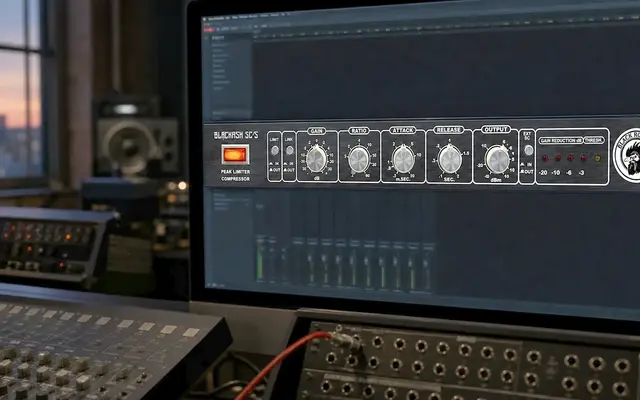
Glue is the other big one. A touch of tube compression across a mix bus or a stem — barely a dB of movement — and the elements start to feel like they were recorded in the same room instead of stacked on top of each other. Our VTC-2 is built for exactly this. It's a tube-driven design that leans into the warmth and the slow release, so you can push it for character or breathe on it for glue. Bass, too: the harmonic thickness fills out the low end and helps it read on small speakers.
The trade-off cuts the opposite way from the FET. A tube compressor will not save you on transients. Feed it a spiky drum loop and it just sits there looking warm while the peaks sail past. That slowness is a feature until the moment you need speed, and then it's a wall.
A quick word on the opto middle ground
Between fast-and-aggressive and slow-and-rich sits a third character worth knowing: the optical compressor. An opto like the LA-2A uses a light cell for gain reduction, which gives it a smooth, program-dependent release that's slower than a FET but more even than a valve. If you find the tube too thick and the FET too pushy for a delicate vocal, the opto is often the Goldilocks answer — our VLA-2A is where I'd start for that forgiving, rides-the-performance kind of levelling.
Three flavours, then, not two. But tube and FET are the poles, and most decisions live near one end or the other.
Picking on the fly
Here's the shorthand I actually use at the desk. If the source has transients I want to control or exaggerate — drums, a punchy bass line, a loud rock vocal, a parallel smash — FET. If the source needs to be held gently or made to feel thicker and more cohesive — a soft verse vocal, mix glue, a bass I want fatter — tube.
Ratios follow the same logic. FET work tends toward higher ratios and fast attacks because you want it to grab. Tube work sits at the gentler end — the VTC-2 runs from 2:1 up to 20:1, and for glue you stay low, just enough gain reduction to level and no more. When I'm not sure, I set both up on the same channel, bypass back and forth, and let the transients tell me. A snare will make the choice obvious in about three hits.
The real mistake isn't picking the wrong comp once. It's picking one and forcing it. A tube box will never punch a drum bus no matter how you twist it, and a FET will never glue a mix quietly. Match the character to the job and both of them get easy.
Try the pair
You can read about bite and bloom all day, but this is one of those things your ears settle in a minute flat. Load a drum loop and a vocal, put the VLA-FET and the VTC-2 across them, and swap the sources between the two. The moment you hear the FET make the snare crack and the tube make the vocal sit, the distinction stops being theory. Both are on free trial, so it costs you nothing but ten minutes and a bit of honest listening.


Add a comment
You need to be logged in to add comments.