Studio Stories
Tom Dowd Traded the Manhattan Project for a Mixing Desk

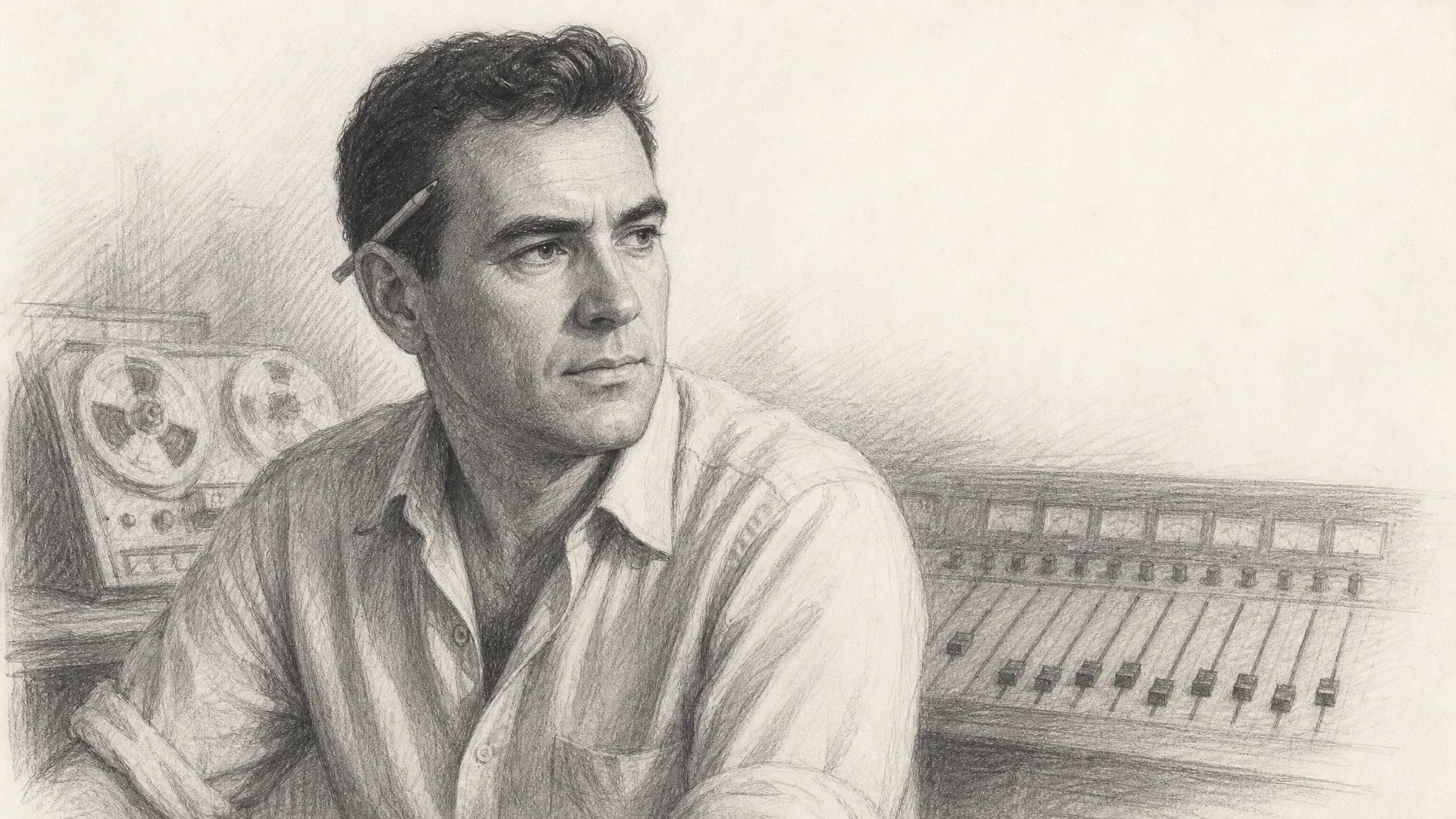
There is a gesture every mixing engineer makes without thinking about it. One hand on a fader, the other hand on a second one, both moving at the same time, eyes on the meter or closed entirely. It feels like the obvious way to handle a mix, the way a steering wheel feels like the obvious way to steer a car, and for much the same reason: you learned it early, and nobody thought to mention that it had been invented. It is not obvious at all. Somebody decided it, and he decided it because he had grown up playing instruments and wanted the desk to behave like one.
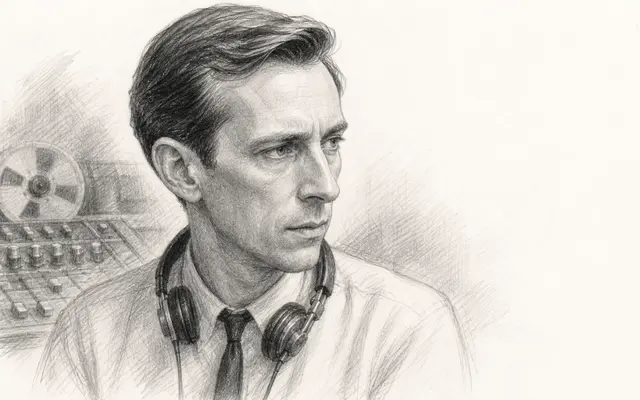
Tom Dowd engineered or produced a run of records that is hard to believe belongs to a single career. Ray Charles. John Coltrane. Aretha Franklin. Cream. Derek and the Dominos. Before any of that he spent the war inside a physics laboratory on the Columbia campus in Manhattan, working on a project whose purpose nobody would explain to him until the news broke in August 1945.
Those two halves usually get told as a party fact. They are one story, because the second half explains the first.
The degree he was never allowed to finish
Dowd was born in Manhattan on 20 October 1925 to musician parents, went to Stuyvesant High School and came out in June 1942 at sixteen, strong in maths and physics. He was already working in the Pupin Physics Laboratory at Columbia when he turned eighteen. The Army took him, sent him to basic training, then sent him straight back to the building he had just left. His orders read "US Army Corps of Engineers, Manhattan District". He was nineteen when the news from Hiroshima finally told him what the work had been for, and twenty in 1946 at Bikini Atoll for the Operation Crossroads tests, watching the thing dropped on a lagoon full of surplus warships.
Then the war ended and the arithmetic turned against him. He wanted the degree. But everything he had spent three years doing was classified, so the university could give him no credit for it, and he was not permitted to describe the work in enough detail to argue. To graduate he would have had to sit through coursework overtaken by what he already knew and could not mention. He left without finishing.
In 1947 he took an assistant's job at a New York recording studio while he worked out what to do about physics. He never worked it out.
A console you could play
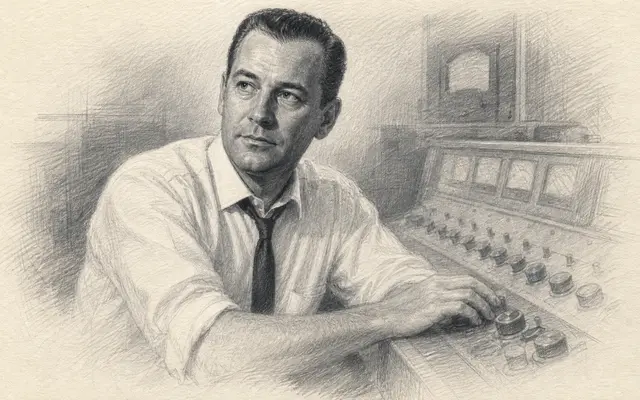
The change he is most often credited with looks trivial written down: he replaced rotary controls with linear faders. Think about what a rotary knob demands, though. It wants a thumb and a finger, it wants you to look at it to know where it is, and it gives you one control per hand. Two hands, two knobs. The moment a mix needs a third move at the same instant, you are out of hands, and the only way through is another pass or a splice. That was the working condition of every engineer before him, and it quietly decided what a mix could be.
Faders rewrite that arithmetic. One hand spans three or four of them, and the whole desk reads at a glance because position is height rather than angle. A level change stops being a setting you dial in and becomes a move you perform, in tempo with the music. Dowd was a musician first, and that is the difference he was after: he wanted to play the mix rather than transcribe it.
The version his family's archive tells has him building the first such desk himself, from slide potentiometers mounted on an old door. Whether the door is literal or has grown in the retelling, the credit is not disputed. Every mixer now works the way he wanted to, including the software one you opened this morning.
Eight tracks, nine years early
In 1958 Dowd heard about the eight-track machine Ampex had built for Les Paul, went to the manufacturer directly and talked Jerry Wexler into buying one. Atlantic ended up with one of the first two ever made, at a point when much of the record business was still arguing about whether three tracks were an extravagance and whether stereo was a fad that would embarrass everyone by 1961.
The gap that opened up is best measured by a session nine years later. In May 1967 Cream came into Atlantic's New York room to make Disraeli Gears, and Dowd had to explain to them what an eight-track recorder was and what you would want it for. Nine years, and a working British band had still never met one. The record was cut between 11 and 15 May, about three and a half days of recording, because the band's work permits ran out that week and no version of the plan had them staying longer.
That pairing is the point of him. More tracks never meant more time. The machine bought separation and the freedom to change your mind later, never permission to keep going.
The records he was in the room for
On 18 February 1959, Ray Charles and his orchestra recorded "What'd I Say" in Atlantic's small studio, Wexler producing, Dowd at the desk. It ran seven and a half minutes, which no radio station in the country would play, so it was cut in half and issued as two sides of a single. Dowd said later that nothing about the session felt special while it was happening. That May, back in the same building, he engineered Coltrane's Giant Steps.
Aretha Franklin arrived in January 1967. The first session ran at FAME Studios in Muscle Shoals and ended in a row bad enough to break the trip up, so the rhythm section was flown to New York to finish the album. "Respect" was cut at Atlantic on 14 February 1967, Wexler producing, Dowd engineering. Whatever that record is, it is not a careful afternoon.
Three years later he was at Criteria in Miami on an Allman Brothers album when Eric Clapton turned up to make what became Layla and Other Assorted Love Songs. Duane Allman asked whether he could come and watch. Clapton told him to bring his guitar. The most famous twin-guitar record of the decade started because one engineer was booked in one building for two jobs at once.
The tools in those rooms were plain and the thinking holds up. A slow optical leveller on a loud singer, catching peaks without announcing itself, which is the job our VLA-2A does. A broad passive curve on the way in rather than a narrow cut afterwards, the approach behind a Pultec and behind our VEQ-1P. Not nostalgia: it is what you reach for when the take must be right before the machine gets it.
A physicist who could hear
The physics is not decoration on the biography. Dowd could read a circuit and a specification sheet and understand exactly why a piece of gear behaved the way it did, and he could also read a chart and hear when a horn section was flat. That combination was rare then and it is rare now. Most of us have one of the two and bluff the other. He used the technical half in service of the musical half, never the reverse, which is why his name sits on so many records and so few pieces of audible cleverness.
It shows in how he treated the equipment. A compressor in his hands was not a safety device keeping the needle out of the red. It was a way of changing how a performance sat and breathed, picked for its character before its numbers, the same reason you choose a particular box for a particular voice today. That habit runs through to our OMNITEC-436C, a broadcast limiter of that era used for what it does to a sound rather than what it prevents.
It carried into producing. He produced Lynyrd Skynyrd's Gimme Back My Bullets and the live One More from the Road, both out in 1976, on the same principle: get the band playing, catch it, leave alone whatever works.
His gesture is still in your DAW
Dowd received the Recording Academy's Trustees Award in February 2002 and died that October, a week after his seventy-seventh birthday. The documentary Tom Dowd and the Language of Music came out the following year, and the Rock and Roll Hall of Fame got round to him in 2012, which is about the usual delay for people who make other people sound good.
What survives is more concrete than the awards. Eight tracks became unlimited tracks, a mixed blessing and not his fault. The fader survived intact: you drag one with a mouse or push one on a controller, and the reason it is a straight line and not a circle is a musician who wanted both hands on the music.
Try his version of it this week. Take the automation off a vocal, put your hand on the fader and ride the whole take live, three or four passes until one feels right. It will be less accurate than a drawn curve and usually sound better, because you spent the pass listening instead of watching a screen. Every plugin we make comes with a full trial, so you can borrow the tools as well as the habit.
Add a comment
You need to be logged in to add comments.