Mixing Tips
Think in Chords, Not Bands: Music Theory for Better EQ

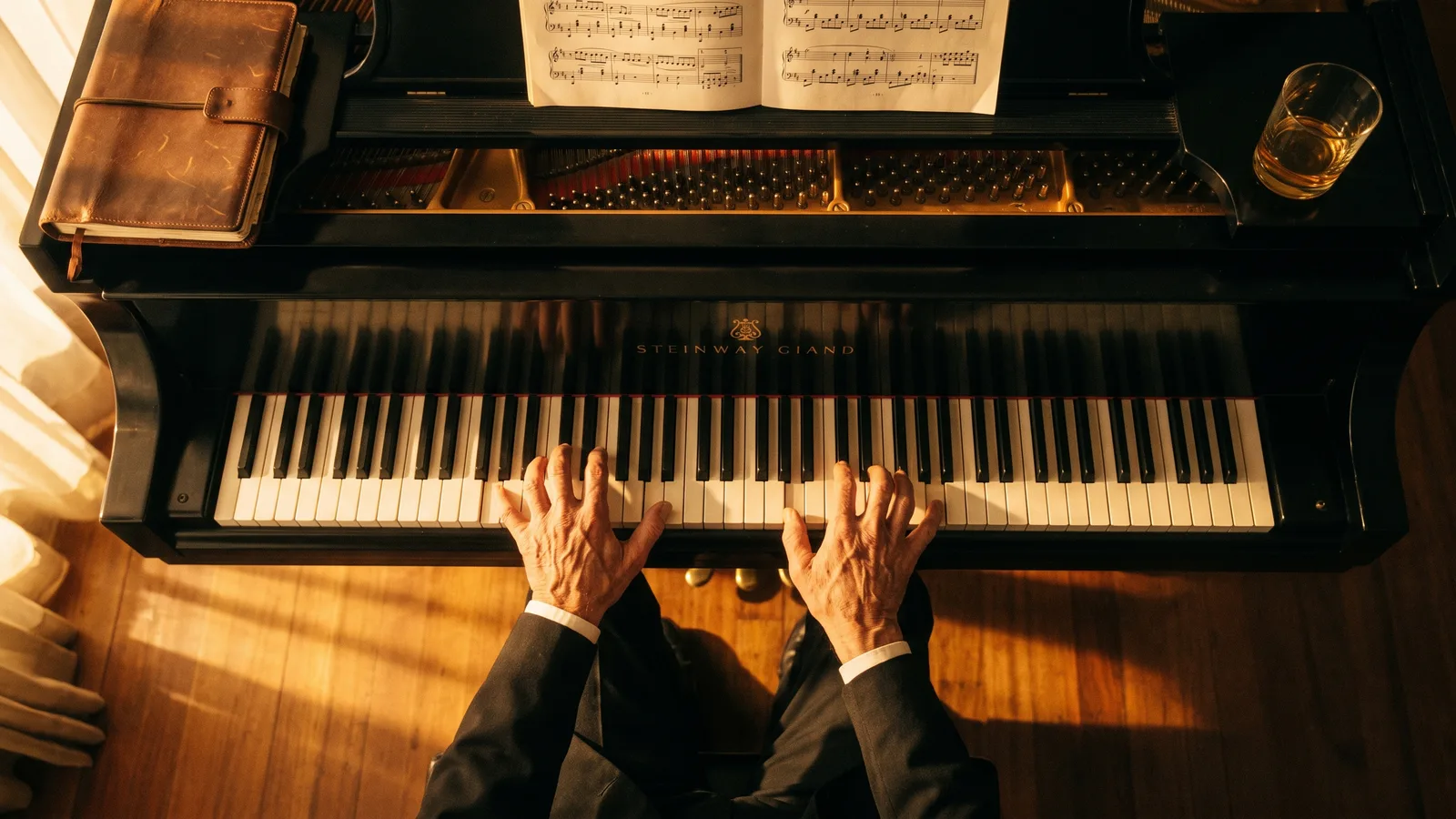
The first time a mix "clicked" for me without any surgical EQ, I was annoyed. I'd spent an hour hunting for a mud problem with a narrow band, sweeping around looking for the offending frequency like a dentist poking for the sore tooth. Then a friend who plays keys walked in, listened for ten seconds, and said "your bass and your piano left hand are playing the same note, just move the piano up an octave." He was right. I'd been trying to fix an arrangement problem with an EQ, which is a bit like fixing a spelling mistake with a louder pen.
That afternoon rewired how I think about frequencies. Not as numbers on a graph, but as notes. Because they are.
Every frequency is a note you already know
Pitch is frequency. A440 is literally 440 Hz, the A above middle C. Drop an octave and you halve it: 220 Hz. Halve again, 110. Keep going and you land at 55 Hz, which is the low A that lives right in the meat of a bass guitar. Those aren't random numbers on your EQ. They're the same A, four octaves apart. It runs the other way too. Double 440 and you get 880, the A an octave above, then 1760, then 3520. Same note the whole way up, and the distance in hertz doubles at every step.
Once you see that, the frequency spectrum stops being a foreign language. Middle C sits at roughly 262 Hz. The low E on a bass is about 41 Hz. The open low string on a guitar, 82 Hz. When your analyzer shows a spike at 100 Hz, your brain can now translate: that's around a G at the bottom of the staff. You're not staring at physics anymore. You're reading a score.
The harmonic series is why instruments have a "shape"
Play a low note on anything real and you're not hearing one frequency. You're hearing a stack. The fundamental (the pitch you'd name), then a quieter tone an octave up, then a fifth above that, then two octaves up, and so on, thinning out as they climb. That stack is the harmonic series, and it's the reason a cello and a trumpet playing the same note sound nothing alike. Same fundamental, different balance of harmonics.
This matters for EQ in a very direct way. When you boost 3 kHz on a bass guitar to get more "definition," you're not adding low end. The fundamental of that bass might be sitting at 60 Hz. What you're doing is lifting the upper harmonics, the part of the sound that tells the ear where the note is even on a small speaker. That's the whole trick behind hearing bass on a phone: the phone can't reproduce 60 Hz at all, but your brain reconstructs the missing fundamental from the harmonics that do come through. Boost the harmonics, keep the bass audible everywhere.
So the intervals stack up like a chord. Fundamental, octave, fifth, octave, major third. The harmonic series is a major chord, roughly, and it's baked into every note you record.
Why fundamentals and harmonics fight
Here's where mixes get muddy, and it's almost never a single guilty frequency. It's collision.
Say your kick drum has a thump around 60 Hz and its body around 100 to 120 Hz. Your bass guitar's fundamentals live in the same zone. Now the piano's left hand comes in, and its lowest notes are also parked there, plus all their harmonics fanning upward into the guitars. Four instruments, one crowded elevator. Nobody has room to breathe, so everything sounds thick and undefined, and you reach for the EQ and start carving.
Carving works, up to a point. But you're fighting a symptom. The real issue is that too many things are asking for the same octave at the same time. When two sources share a fundamental and the harmonics line up, you get comb-filtering and phase weirdness that no bell curve fully fixes.
Kick and bass: the octave handshake
The oldest trick in low-end mixing is octave separation between kick and bass, and it's pure music theory. Pick a home for each and keep them out of each other's octave. A common split: let the kick own the sub-thump around 50 to 60 Hz, and let the bass sit an octave up, with its fundamental energy centered nearer 80 to 110 Hz and its punch in the low mids. Or flip it, deep bass and a clickier, higher kick. Either works. What kills you is when both fight for the exact same 60 Hz.
Notice the interval language. You're not thinking "cut 60 on the bass." You're thinking "these two should be an octave apart, so one lives here and one lives there." Same result, but the second way tells you why, and it tells you what to do when the arrangement changes and the trick stops working.
The 2:1 ratio of an octave is the cleanest relationship two low sounds can have. Their harmonics interleave instead of colliding. It's the reason a bass line an octave below a melody sounds locked and supportive, while the same line a fifth away can sound tense. The math and the music are the same thing.
Arrangement in the frequency domain beats surgical EQ
Surgical EQ has its place. A resonant ring, a harsh 3.2 kHz on a cheap mic, a room mode you can't retrack around, cut it and move on. But treating the EQ as your first tool for a crowded mix is backwards. The best "EQ" happens before you open a plugin.
Voice the instruments so they don't overlap. Move the piano's left hand up an octave. Have the synth pad play inversions that sit above the guitars instead of underneath them. Roll off the low end of a rhythm guitar that has no business below 120 Hz to begin with, not because 120 is magic but because the note it's playing doesn't need those octaves to be recognizable. You're arranging in frequency the same way you'd arrange in time, giving each part a lane.
When you do reach for EQ after that, you'll find you need far less of it, and the moves are broader and more musical. This is where a gentle, wide, musical EQ earns its place over a scalpel. A Pultec-style curve like our VEQ-1P is built for exactly this kind of thinking: broad shelves, fixed musical frequencies, and that famous low-end trick of boosting and cutting the same band at once to shape weight without turning to mud. Its bigger sibling, the VEQ-5, gives you a few more of those wide, overlapping bands when you want to sculpt a whole instrument's tonal balance rather than snipe one frequency. Neither is the tool for hunting a single ringing node. Both are the tool for saying "this instrument should feel warmer and sit an octave lower in the picture," which is a musical decision, not a mathematical one.
You can hear the difference in how a mix ages, too. Mixes carved with a dozen narrow cuts often sound thin and brittle a week later, all the life notched out of them. Mixes built on good voicing and a few broad tonal moves tend to keep their body.
Start listening in notes
You don't need perfect pitch for any of this. You just need to stop treating the spectrum as a separate universe from the notes on the page. The next time something sounds muddy, before you sweep for the culprit, hum the low end. Ask what notes are actually down there and whether they belong in the same octave. Half the time you'll fix it by moving a part, not by cutting a frequency.
If you want to feel how a broad, musical EQ behaves compared to a surgical one, both the VEQ-1P and the VEQ-5 have free trials. Load one on a bus, forget about narrow bands for an afternoon, and shape things by octaves and shelves instead. It's a different way of hearing, and once it clicks you won't go back to poking for the sore tooth.

Add a comment
You need to be logged in to add comments.