Mixing Tips
The Thirty-Second Mono Check Every Mix Needs Before It Leaves


My brother keeps a paint-spattered Bluetooth speaker on top of his fridge, and that is where I first heard a mix of mine outside a studio. Vocal fine. Drums fine. The wide synth pad that carries the whole second verse, the one I had spent an afternoon on, was not quiet. It was absent.
Back at the desk I pressed the mono button, which I had not pressed once in four days of work, and there it was. The pad lost most of its body and all of its shimmer the moment the two sides met. The plugin that made it sound enormous built that size out of a delay, and a delay is a loan you repay in mono.
The check takes half a minute. It is the last thing I do before anything leaves the building, and it has spared me more embarrassment than any other habit.
Mono did not go away, it moved
The argument against bothering is that nobody listens in mono any more. Look at where music gets played. A single-driver Bluetooth speaker on a kitchen counter is mono by construction, and so is the smart speaker in the hallway and the radio in a workshop. A laptop has two speakers twenty centimetres apart firing down into a desk; a metre away the stereo image is a rumour. A phone speaker is one speaker. The voice note a client sends of the track playing in their car went through a codec that collapsed it on the way.
Then there is anywhere loud. Almost every PA feeds its subwoofers from a mono sum, because bass arrays only behave if they do. Plenty of smaller venues run the whole rig mono, one hang, no decisions to make. And in a properly flown stereo system, most of the floor still stands off to one side hearing mostly one half of your mix.
Social playback is its own case. The upload gets re-encoded, the viewer is holding a phone, and the part of your arrangement that exists only as a difference between two channels has nowhere to go. None of this is exotic listening. It is most listening, and the listening you control least.
What the sum takes away
Summing is addition, and addition has no memory of where the numbers came from. If the left channel sits at plus 0.4 at some instant and the right at minus 0.4, the sum is zero, and knowing that both sides sounded good on their own changes nothing about the zero. The common misreading is that this only concerns a channel someone has deliberately polarity-flipped, which makes it sound like a wiring fault you would have noticed. A flipped channel is just the loudest version of the problem. Everything pushed into opposition by time behaves the same way, and time is what every width trick in your plugin folder is made of.
A delayed copy does not cancel everything. It cancels whichever frequency has half a cycle in that delay, reinforces whichever has a whole one, and alternates between the two all the way up. I went through that arithmetic in the piece on phase and two microphones and will not rebuild it here. What changes is where the two copies live: not two capsules on one snare, but the left and the right of your stereo bus, added together in a speaker you will never see.
Here is what that addition leaves behind, for two offsets a mixing engineer meets every week.
Half a millisecond costs one notch in an unglamorous part of the spectrum and almost nothing below 500 Hz. Three milliseconds is a different animal: the deepest, widest hole lands at 167 Hz, straight through the bass guitar, and they keep coming every 333 Hz. Nobody would dial that curve on purpose.
Where the cancellation comes from
Stereo wideners on the master bus are the first place I look, and the thing that decides whether one is safe is how the plugin makes its width in the first place. A control that works in mid/side is arithmetically harmless: it turns the side channel up or down, and the mono sum is the mid channel, which the knob never touches. Sum it and you get exactly what you had. A widener that splits the signal and delays or all-passes one half is doing something else entirely: it borrows its width from the mono sum, and the bill comes due on the fridge. Both kinds sit in the same plugin folder and neither announces which it is.
The Haas trick is the honest version of the same debt. Copy a part to the other side twenty milliseconds late and it sounds gloriously wide on monitors. Sum it and you have a hole every fifty hertz: not a tonal colour, a different instrument.
Doubled guitars are subtler. Two genuinely separate takes, hard panned, sum politely: different fingers, different timing, so the result is quieter and slightly duller and nothing more. One take copied to the other side and nudged late is a comb filter with a guitar amp in front of it.
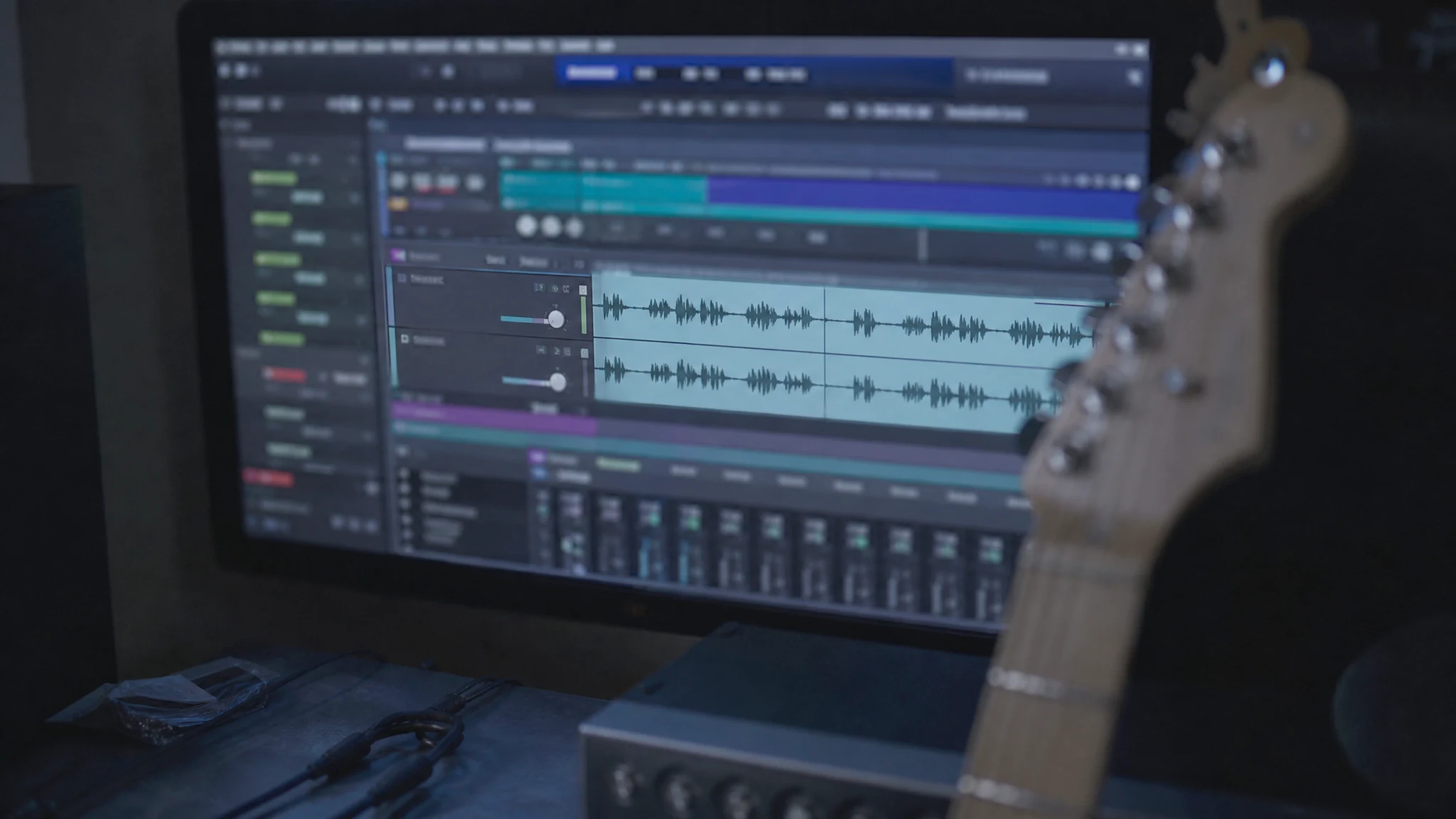
Stereo reverb on a mono source usually survives, but the algorithm decides. Dense plate tails behave; I run the mono check on the RO-140 return itself and it holds its weight. Modulated halls and anything with a hard-panned early reflection pattern can thin badly, and you hear it as the tail getting shorter rather than as a frequency problem. Multi-miked recordings arrive with their offsets already baked in, which is a job for the mic stand, not the mix.
The thirty seconds
Find out what your mono button actually does before you trust it. Some sum and drop six decibels, so a centred element comes out where it went in and level changes read honestly. Others sum at unity, which means everything centred jumps six decibels and every comparison is worthless. If yours is the second kind, put a gain stage after it and pull six back. One-time job, and it decides whether the rest of the check means anything.
Then loop the busiest twenty seconds you have, usually the last chorus, set a comfortable level and leave it alone. Toggle in and out of mono. Do not sit in mono and study it; the ear adapts within seconds and what you were listening for stops being obvious. Two or three toggles is the whole test.
Watch two things. The short-term loudness meter, which on a well-behaved mix falls between half a decibel and two; three or four means real cancellation. And your ears, where the question is not whether the mix got narrower, because it will, but whether anything left. If something did, solo the suspects in mono: pad, reverb return, doubled guitars, wide percussion. It is almost always one track.
Why the bottom belongs in the middle
Low frequencies are where a small timing error does the most damage, and the reason is geometry. A 120 Hz wave is nearly three metres long, so three milliseconds of offset is already a serious fraction of its cycle: by the chart above, 7.4 dB gone at 120 Hz and everything gone at 167. At five kilohertz the same offset makes holes so tightly packed that the ear averages across them and hears a texture rather than a loss. The bass has no such protection. Down there the holes are as wide as the notes.
The practical argument is shorter. Subwoofers get a mono feed, and the bottom two octaves are where headroom is spent. Two bass elements that partly cancel waste it.
So sum the low end. Most mastering tools have an elliptical filter or a mono-maker for it; if yours does not, a mid/side split with a high-pass on the side path does the same job, and a free filter like the VHL-3C is enough to do it with. A hundred or a hundred and twenty hertz is the usual crossover. You give up close to nothing: stereo information down there is room reflections and phase noise, not anything anyone wrote.

A side benefit: with the bottom as one signal, the low shelf on a VEQ-1P is one decision instead of two that argue.
Fix, or let it go
Fix anything that disappears. Fix a widener on the master bus, by removing it or by band-limiting it above three hundred hertz where the wavelengths are short enough not to matter. Fix doubles that came from a copy and a delay by recording a second take, which takes four minutes and sounds better anyway. Fix a bass that cancels before anything else on the list.
Then let the rest go. Two identical signals add up six decibels louder; two unrelated ones only three. That difference is not a fault, it is what addition does, and it means everything wide sits about three decibels lower against the centre once the sides meet. The image narrows, the reverb steps back, the hard-panned shaker turns polite. None of that needs repairing. You are not mixing for mono, you are making sure mono cannot take a hostage.
Loop the chorus, hit mono, toggle twice, go back. If nothing vanished, ship it. If something did, you found it thirty seconds before your listeners would have, and the filter that fixes most of it costs nothing.


Add a comment
You need to be logged in to add comments.