VEQ-1P
Vintage Program Equalizer
About the VEQ-1P
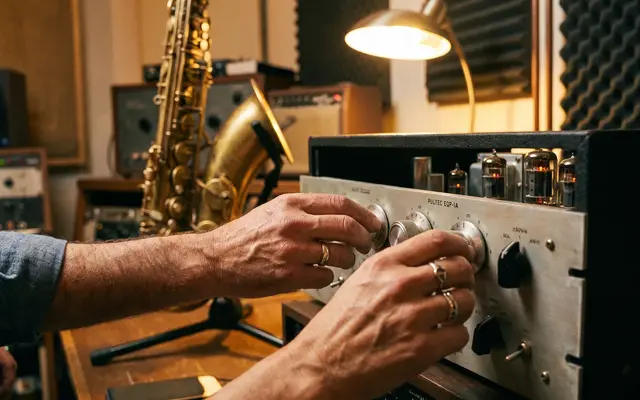
Inspired by the Pultec EQP-1A: the passive program equalizer that has sat across master busses and vocal chains since the 1950s, famous for the trick where you boost and attenuate the same low frequency at once.
The VEQ-1P is a vintage program equalizer built the way the original EQP-1A worked — a passive filter network, tube make-up gain and broad, forgiving curves that flatter almost anything you feed them. This isn't a scalpel. You don't reach for it to notch out a resonance at 437Hz. You reach for it when a bass drum needs weight and click without mud, when a full mix wants air on top, or when a vocal needs to breathe. Boost the lows hard and it never turns woolly. Open up the highs and they stay silky rather than brittle.
The Pultec EQP-1A, modelled as a living circuit
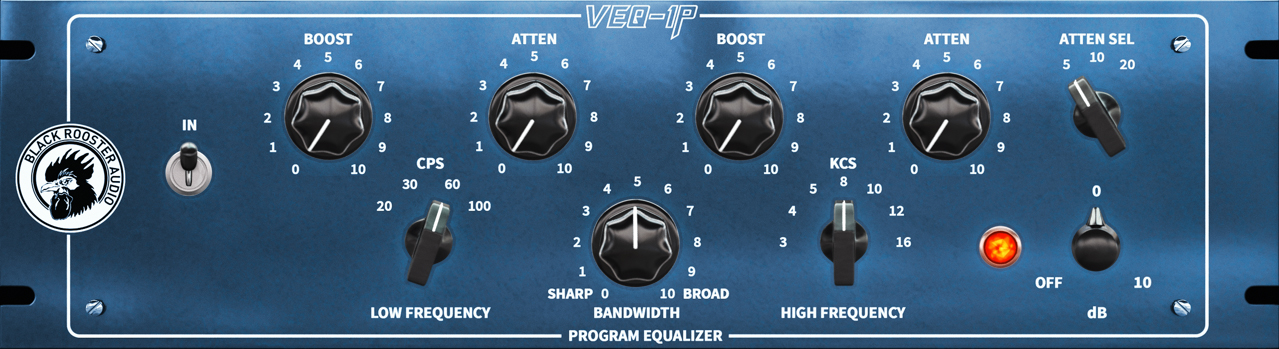
The EQP-1A earned its reputation on one counterintuitive detail: the Low Frequency section lets you boost and attenuate the same shelf at the same time. Because the filters are slightly off-tuned from each other, the boost and cut don't cancel — they carve a gentle dip just above the boosted region, giving you fat, defined low end that stays out of the low-mid mud. That's the "Pultec trick," and it only works because of how the passive components interact. We rebuilt that behaviour with our real-time, SPICE-style circuit simulation: the passive filter network, the audio transformers and the tube amplifier stage are modelled as a living circuit, not frozen into a fixed EQ curve. Set the CPS selector to 20, 30, 60 or 100Hz, ride the Boost up to +14dB and the Attenuation down to -18dB, and the interaction behaves exactly like the hardware.
Two shelves, one bell, and tube colour on tap
The Low Frequency section handles the bottom via those interacting shelves. Up top, the Bell Filter adds mid-high boost tuned by the KCS (kilocycles) selector — 3, 4, 5, 8, 10, 12 or 16kHz — with a Bandwidth control that sweeps from sharp to broad: a broad setting tops out around +10dB, a sharp one reaches +18dB for a tighter presence lift. The separate High-Shelf attenuates the top end by up to roughly -18dB, with its own edge frequency set by the Atten Select knob at 5, 10 or 20kHz. And the Power knob is the sleeper: turn it fully counter-clockwise to bypass the processing altogether, or clockwise for ±10dB of linear output gain to match levels or push the transformers.
Using the VEQ-1P on bass, drums, vocals and the mix bus
On bass and kick, dial the CPS to 30 or 60Hz and run the boost-and-cut trick for low-end that hits hard yet stays defined — try it on a bass drum for extra punch and spectral clarity. On a full mix bus, a touch of Low boost plus a High-Shelf lift adds the "expensive" polish records are mastered for. On vocals and acoustic guitars, the Bell Filter around 3–8kHz pulls a part forward without harshness. Because the tube make-up amp stays in the path even with the EQ section switched out, running the VEQ-1P flat still prints a gentle harmonic colour. Where the VEQ-1P owns the low end and the air, its sibling the VEQ-5 takes over the midrange — many engineers patch both in series for a full Pultec front end.
VEQ-1P Features
Interacting Low Frequency shelf (the "Pultec trick")
Boost (0 to +14dB) and Attenuation (0 to -18dB) act on the same low shelf, slightly off-tuned so they don't cancel. Dialing both at once carves a dip above the boosted region — fat, defined low end that stays clear of the low-mid mud.
Selectable CPS low frequency
The Low Frequency selector steps through 20, 30, 60 and 100Hz (cycles per second), so you can plant the boost under a kick, a bass or a full mix and keep your moves musical and repeatable.
Bell Filter with seven KCS frequencies
A mid-high boost tuned by the KCS (kilocycles) selector across 3, 4, 5, 8, 10, 12 and 16kHz, with a Bandwidth control sweeping from sharp to broad — up to +10dB broad for gentle presence, +18dB sharp for a tighter, more focused lift.
Independent High-Shelf attenuation
The High-Shelf rolls off the top end by up to roughly -18dB, with its own edge frequency set via the Atten Select knob at 5, 10 or 20kHz — handy for taming brittle sources or gently darkening a bus.
Multi-purpose Power knob
Turn it fully counter-clockwise to bypass all processing, or clockwise for ±10dB of linear output gain — gain-match before and after, or drive the transformers and tube stage into saturation.
Always-on tube make-up amplifier
The EQ In switch only bypasses the filter network. The signal still passes the modelled tube amplifier and transformers, so you can print a subtle harmonic coloration even with every band flat.
Authentic circuit emulation
Our real-time, SPICE-type component-based circuit simulation captures the sound and feel of the analog counterpart in every nuance — passive filter network, audio transformers and tube stages all faithfully modelled.
SSE2-optimised code
DSP operations are pipelined on the SSE2 instruction set for high-performance operation, even under complex processing.
Auto-adjusted oversampling
A low-latency, linear-phase Dolph-Chebyshev polyphase design attenuates aliasing and auto-adjusts to your session's sample rate to save CPU while staying transparent.
HighDPI / Retina support
Crisp, high-pixel-density rendering on macOS and Windows for a sharp interface on modern displays.
VEQ-1P Examples & Videos
Industry Reviews

What I can say is that this pultec emu is actually found it's way to my mixes, removing boxiness from the heavy guitars and allowing the classic low end trick for the kick.
VEQ-1P — Customer Reviews
Great Eq
Exactly what you want from a vintage style eq, great bottoms, detailed mids and lush highs.
Great Emulation
Thanks to devs for this warm emulation, it adds body and extra harmonics to instruments making it sound richer
This nise
excellent equalizer emulator
I'm Lovin' it!
I use this frequently.
Excellent
One of the best I've ever used, very good
Impressive
It produces a beautiful sound. The plugin is very good!
Leave a Review
VEQ-1P — Frequently Asked Questions
What hardware is the VEQ-1P based on?
The VEQ-1P is inspired by the Pultec EQP-1A, the classic passive program equalizer used on master busses and vocals since the 1950s. It recreates the EQP-1A's passive filter network, audio transformers and tube make-up amplifier using real-time circuit modelling rather than a fixed EQ curve.
What is the "Pultec trick" and can I do it with the VEQ-1P?
Yes — it's the whole point of the Low Frequency section. Boost and attenuate the same low shelf at once and, because the filters are slightly off-tuned, they don't cancel: you get fat lows with a clarifying dip just above. Try it on a bass drum at 30 or 60Hz for punch and definition.
When should I use the VEQ-1P instead of the VEQ-5?
Reach for the VEQ-1P when you need broadband low-end weight and silky high-end air — kick, bass, mix bus, mastering polish. The VEQ-5 (based on the Pultec MEQ-5) is the midrange specialist for presence and taming boxy tones. They're built to work together, so many engineers run both in series.
Does the VEQ-1P still colour the sound when the EQ is bypassed?
Yes. The EQ In switch only bypasses the filter network — the signal still passes the modelled tube amplifier and transformers, so you get a subtle harmonic coloration even with all bands flat. It makes a useful "tone" insert on its own.
What are the boost and cut ranges on the VEQ-1P?
The Low Frequency shelf boosts up to +14dB and attenuates down to -18dB across 20/30/60/100Hz. The Bell Filter reaches +10dB on a broad setting and +18dB on a sharp one, tuned to 3, 4, 5, 8, 10, 12 or 16kHz. The High-Shelf attenuates the top by up to roughly -18dB (edge at 5/10/20kHz), and the Power knob adds ±10dB of output gain.
Which plugin formats and systems does the VEQ-1P support?
The VEQ-1P ships as AAX, VST, VST3 and Audio Units (AU) for both macOS and Windows, including native Apple Silicon support. It runs in all major DAWs. See the product manual for detailed system requirements.
Is there a free trial of the VEQ-1P?
Yes. Registered users can create a free 14-day trial license from the license manager and demo the VEQ-1P in full before buying. You only need a free Black Rooster Audio account to get started.