RO-SPR
Vintage Spring Reverb
About the RO-SPR
Rooted in the Hammond spring line and the 1963 Fender Vibroverb: the mechanical reverb that gave surf guitar its drip, dub its splash and organs their haunt — starting with Laurens Hammond's 1939 patent.
The RO-SPR is a vintage spring reverb that captures the one thing plates and digital halls can't fake: the bouncy, ringy, low-end-heavy character of a real metal spring tank. Where a plate reverb glues and smooths, a spring reverb has attitude — that instantly recognisable boing when you knock the amp, the mechanical splash, the resonant low mids engineers used to shove under guitars and vocals on purpose. We physically modelled six different tanks — their springs, transducers and resonant behaviour — and deliver them through efficient real-time convolution, so you get four decades of that sound in one plugin instead of one static spring.
From Hammond's patent to surf, dub and stoner rock
Laurens Hammond filed the first spring-reverb patent back in 1939 — a transducer at one end of a coiled spring, a pickup at the other. The idea landed in Hammond organs from around 1960 and standalone units like the Accusonics Type 4 SR, but it was Leo Fender who made it famous by dropping a spring tank into the 1963 Vibroverb. Springs were cheaper and lighter than plates that could weigh 600 pounds, so they spread everywhere. Their low-end-heavy voice was technically a flaw, and engineers loved it — you hear that trick across records from The Doors to Queens of the Stone Age, where the spring's ring became the point rather than a problem.
Six spring tanks, and modern controls to tame them
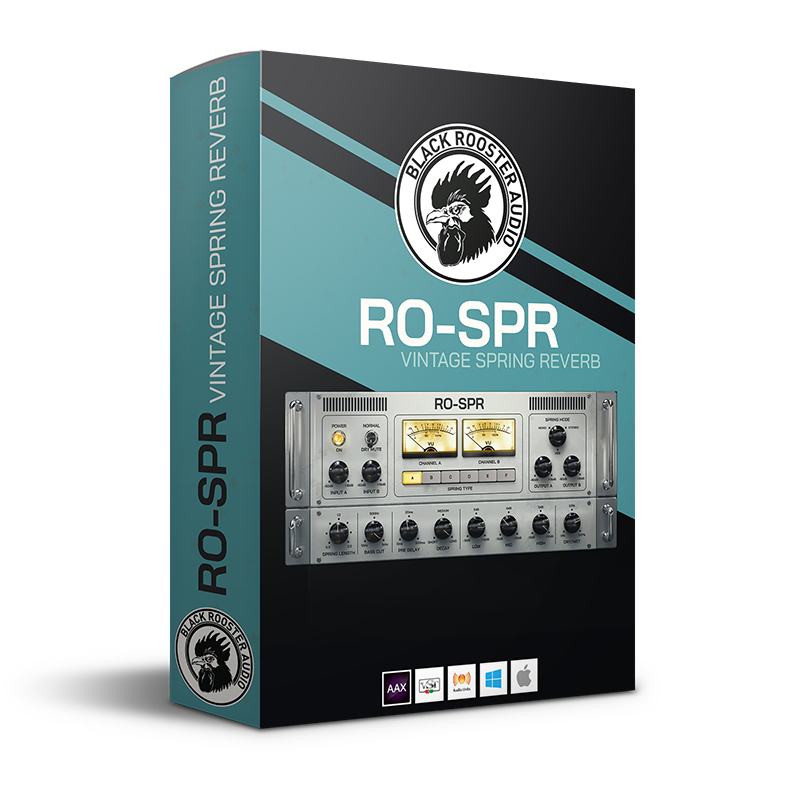
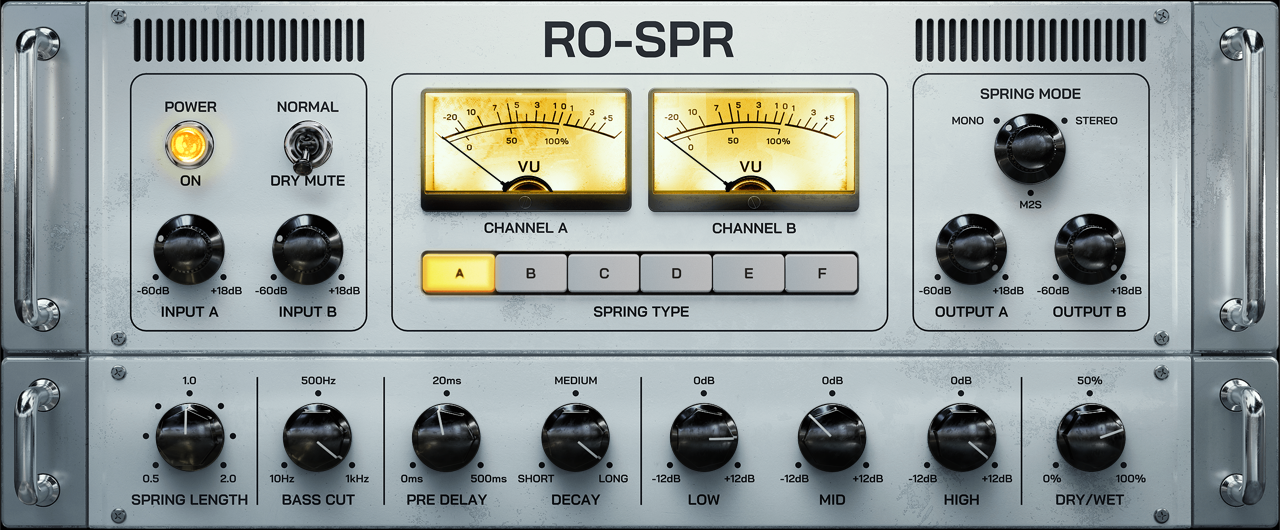
The RO-SPR ships six faithfully modelled spring types: a late-1970s British stereo unit (A), a 1960s classic dub tube spring (B), a 1970s home hi-fi spring (C), a medium 1980s Japanese echo unit (D), a 1960s Austrian large oil-bath spring (E) and an American guitar-amp large spring (F). Each has its own resonance and drip. Spring Length steps through seven positions that reshape the tank's ring from tight to atmospheric, while Decay stretches the perceived room size from short to long. Because springs are naturally low-mid heavy, we built in a 3-band EQ (Low at 200Hz, Mid at 400Hz, High at 900Hz) and a Bass Cut high-pass (10Hz to 1kHz) so you can keep the character but pull the mud. Pre-Delay places the tail up to 500ms behind the dry, a Dry Mute switch turns the whole thing into a clean send effect, and per-channel Input/Output gain staging lets you balance the natural stereo spread of multiple springs.
Using the RO-SPR on guitars, vocals and synths
On electric guitar, spring type F with a longer Decay is pure amp-in-a-room drip — surf, garage, psych, the lot. On vocals, a shorter spring and a little Bass Cut adds vintage character without drowning the words in low-mid ring. On drums and brass it lends a mechanical, slightly unhinged splash a plate would never give you. Feed it synths and the Mono2Stereo mode is the trick: send a mono source through two non-identical springs and it returns a genuinely wide, slightly detuned stereo image. Chasing smooth, dense, room-like tails instead of mechanical drip? That's what the plate-based RO-140 and the free RO-GOLD are for.
RO-SPR Features
Six spring tanks
A late-1970s British stereo unit, a 1960s dub tube spring, a 1970s home hi-fi spring, an 1980s Japanese medium echo unit, a 1960s Austrian oil-bath spring and an American guitar-amp large spring — six distinct tanks, faithfully modelled, covering four decades of spring character.
Seven-position Spring Length
Step through seven modelled spring lengths that reshape each tank's ring. Combined with the six spring types, the setting takes you from a tight, controlled drip to a long, atmospheric, almost dub-like ring.
Decay control
Independent of length, Decay stretches how long the processed signal rings out, shifting the perceived room size of the selected spring from short and snappy to long and cavernous.
Mono, Stereo and Mono2Stereo modes
Stereo sends the left and right channels to independent springs; Mono2Stereo routes a mono source through two non-identical springs to build a wide, slightly detuned stereo image from a single input — the RO-SPR's secret weapon on synths and mono guitars.
3-band EQ and Bass Cut
Springs are naturally low-mid heavy, so a dedicated Low (200Hz shelf), Mid (400Hz peak) and High (900Hz shelf) EQ plus a Bass Cut high-pass (10Hz to 1kHz) let you keep the mechanical character while pulling the mud — or leave the low end in for that classic, deliberate spring boom.
Pre-Delay, Dry Mute and Dry/Wet
Pre-Delay places the wet tail up to 500ms behind the dry signal, a Dry/Wet control blends the reverb in-plugin, and the Dry Mute switch suppresses the dry path entirely so the RO-SPR drops straight into a send/return bus as a pure effect.
Dual-channel gain staging with link
Separate input and output gain per channel let you balance the natural stereo image of multiple springs, and the Gain Stage Link ties left and right together with a right-click when you want them moving as one.
Physically modelled tanks, convolution-delivered
Each spring tank is physically modelled and rendered through efficient real-time convolution, with the Spring Length and Decay controls reshaping the tail live — so the tanks ring, bounce and splash the way the originals did rather than replaying one fixed sample.
SSE2-optimised code
DSP operations are pipelined on the SSE2 instruction set for high-performance operation despite the RO-SPR's complex real-time convolution.
HighDPI / Retina support
Crisp, high-pixel-density rendering on macOS and Windows for a sharp interface on modern displays.
RO-SPR Audio Demos
Both takes play in sync. Press FX to switch the plugin in and out without losing your place.
RO-SPR — Frequently Asked Questions
What hardware is the RO-SPR based on?
The RO-SPR draws on the whole lineage of spring reverb, from Laurens Hammond's 1939 patent and the Hammond organ springs to Leo Fender's 1963 Vibroverb and units like the Accusonics Type 4 SR. Rather than one tank, we physically modelled six different spring types spanning four decades of studio and amp reverbs and deliver them through efficient real-time convolution.
What do the six spring types sound like and when should I use them?
Each tank has its own drip and resonance: A is a late-1970s British stereo unit, B a 1960s dub tube spring, C a 1970s home hi-fi spring, D an 1980s Japanese medium echo, E a 1960s Austrian oil-bath spring and F an American guitar-amp spring. Use F for surf and amp tones, B for dub, and the others for anything from tight vocal ambience to wide synth wash.
How is spring reverb different from a plate reverb like the RO-140?
Spring reverb is bouncy, ringy and low-end heavy with an obvious mechanical splash — great for surf guitar, dub and psychedelic effects. Plate reverb, like the RO-140 or free RO-GOLD, is smooth, dense and room-like, better for gluing vocals, drums and buses. Springs add character; plates add space.
How do I control the boomy low end of a spring reverb?
Springs are naturally heavy in the low mids, so the RO-SPR gives you a Bass Cut high-pass and a 3-band Low/Mid/High EQ to tame it. Roll off the lows for a cleaner vocal or drum tail, or leave them in for that classic, deliberate spring boom under a guitar.
Can the RO-SPR turn a mono source into stereo?
Yes. Switch Spring Mode to Mono2Stereo and the mono input is routed through two non-identical springs, returning a wide, slightly detuned stereo image. It is especially effective on synths and mono guitars where you want width without a stereo source.
Which plugin formats and systems does the RO-SPR support?
The RO-SPR ships as AAX, VST, VST3 and Audio Units (AU) for both macOS and Windows, including native Apple Silicon support, and runs in all major DAWs. See the product manual for detailed system requirements.
Is there a free trial of the RO-SPR?
Yes. Registered users can create a free 14-day trial license from the license manager and demo the RO-SPR in full before buying. You only need a free Black Rooster Audio account to get started.