Mixing Tips
The Loudness Trap: How to Judge Your Own Mixes Honestly

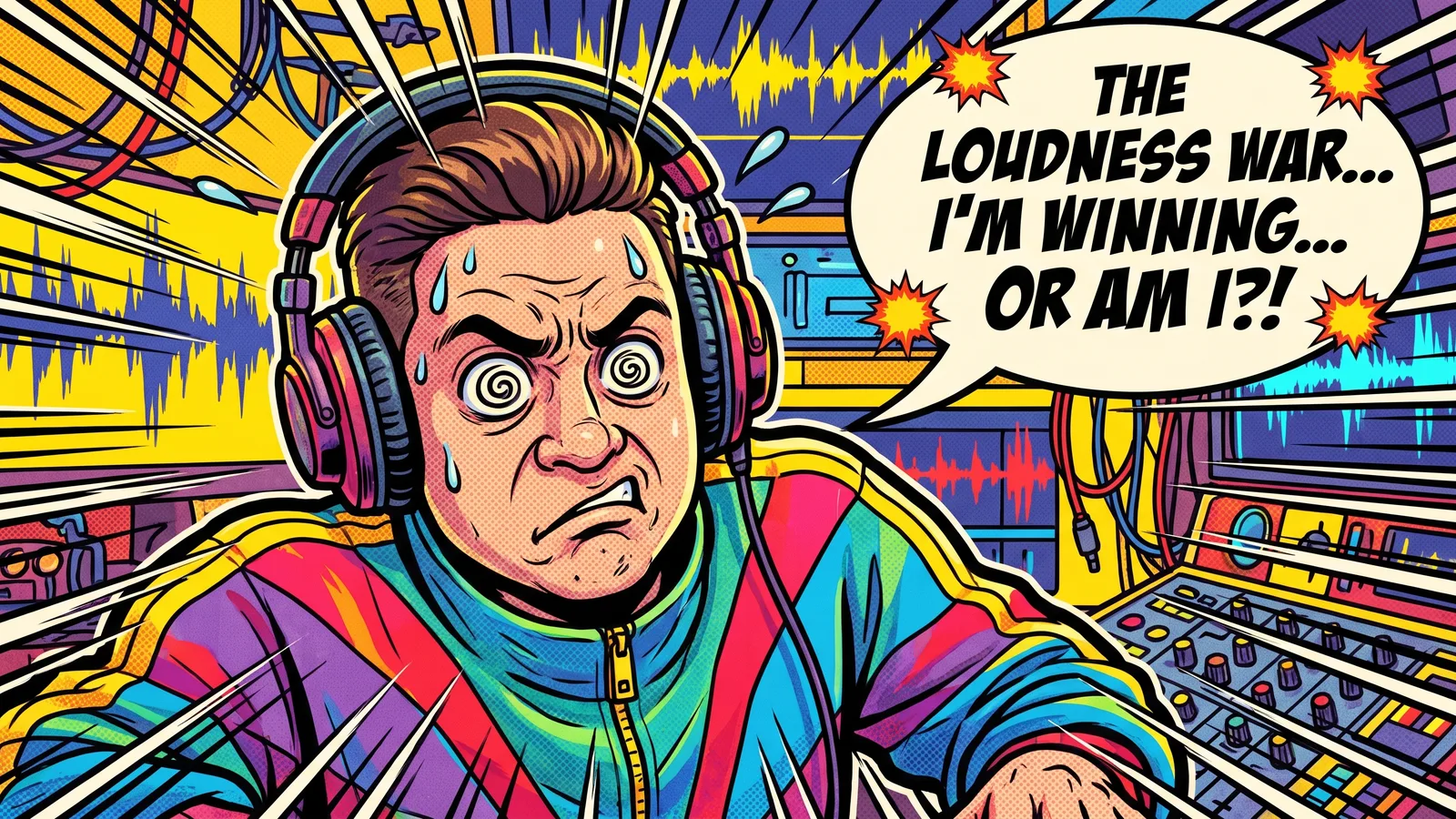
Here's a trick you can run on yourself in about thirty seconds. Take any mix you're proud of, duplicate the track, and put a limiter on the copy so it's a couple of dB louder. Now switch between them without looking at the meters. The louder one wins. Every time. It sounds fuller, wider, more finished, more expensive. Then you gain-match the two so they hit your ears at the same level, switch again, and the magic evaporates. Same mix. The loudness was doing all the talking.
Once you've felt that happen, you can't unfeel it. And it explains a depressing number of mixing decisions I've watched people make, including me, for years.
Why louder always wins the first round
This isn't a matter of taste or weak willpower. It's how your ears are wired. Back in the 1930s two Bell Labs engineers, Fletcher and Munson, mapped how loud different frequencies need to be for us to perceive them as equally loud. The short version of their equal-loudness contours: at low listening levels your ears roll off the bass and the very top end. Crank the volume and those extremes come rushing back in.
So when a track gets louder, you don't just hear "the same thing, but bigger." You hear more low end and more air. More weight, more sparkle. Your brain reads that as a better mix, when really it's the same mix played into a more flattering part of your own hearing. The gear didn't improve. Your ears just changed the deal.
This is the loudness trap, and it's quietly rigged against you all day long. The plugin demo that sounds incredible? Often it's just outputting a hair hotter than the bypassed signal. The "before and after" that made you buy something? Check whether the after was level-matched. Usually it wasn't.
How it fools you mid-mix
The dangerous part isn't the obvious A/B. It's the slow creep during a session.
You solo the vocal, add some saturation, and it sounds richer, so you keep it. But saturation adds harmonics, harmonics add level, and level flatters. Did the tone actually get better, or did it just get louder? Push a compressor's makeup gain a touch past unity and every setting you audition afterwards sounds "more present." You end up chasing a quality that was never about the compression at all.
Two hours in, every processed version has been quietly louder than the thing it replaced, and you've built a mix out of a hundred tiny loudness illusions. Then you print it, listen the next morning at a fixed level, and wonder why it feels harsh and forward and tiring. It's not haunted. You were voting for volume the whole time and calling it taste.
Gain-matched A/B, and why it's non-negotiable
A fair comparison means the two options hit a meter at the same average level, ideally within a few tenths of a dB. Then, and only then, are you actually judging character instead of loudness.
Practically, that means trimming the output of whatever you're testing so it matches the input. Some plugins have an auto-gain or a proper level-matched bypass. Where they don't, drop a gain utility after it and nudge until the loudness meter reads the same bypassed and engaged. Tedious? A bit. But it's the difference between "this compressor sounds warmer" and "this compressor is 1.5 dB louder and I've fooled myself again."
This is also the honest way to demo gear, including ours. When you trial something like the Magnetite tape saturation, the tone genuinely changes the harmonic content, so of course it'll read a little hotter. Trim it back to match, listen again, and decide whether you still like what it's doing. If you do, that's a real yes. That's the only yes worth trusting.
The other half: how loud should the finished thing even be?
For twenty years the answer was "as loud as humanly possible," because on radio and CD and early iTunes, louder literally was louder, and louder sold. That era is largely over, and a lot of engineers haven't updated.
Spotify, Apple Music, YouTube, they all normalize playback loudness now, mostly landing somewhere around −14 LUFS give or take. Master your track to a brutal −7 LUFS and the platform simply turns it down to sit beside everything else. All that crushing you did to win the loudness war? The listener never hears the loudness. They just hear the crushing: the flattened transients, the pumping, the lost punch.
Here's the part that surprises people. A well-controlled master at, say, −10 to −12 LUFS, with its transients intact, often sounds bigger after normalization than a smashed one, because it has dynamic range left to breathe. The quiet-loud contrast is the impact. You can't hear a punch if everything is already at the wall.
None of this means chasing a LUFS number like a rule. Genre matters, a slamming club track lives differently than a folk record, and some loudness is glue and attitude, not just level. But the days of maximizing for maximizing's sake are done. Let the song decide how loud it wants to be, not the meter and not the arms race.
Getting distance from your own ears
The deeper problem underneath all of this is that you can't hear your own work clearly. You've heard the chorus four hundred times. You know where the vocal is supposed to sit because you put it there. Fresh ears hear a mix. You hear a memory of every decision that led to it.
A few things that genuinely help me claw back some objectivity:
- Leave it overnight. The single most effective mastering tool is a night's sleep. What sounded huge at 2 a.m. often sounds harsh and bass-shy at 10 the next morning, and that morning version is closer to what strangers will hear.
- Set a fixed monitoring level and mostly stay there. If you always mix at roughly the same volume, you take your own drifting ears out of the equation. Loud sessions make you under-EQ and over-compress; you're already fighting the Fletcher-Munson curve.
- Check quietly. A mix that still holds together at near-conversation volume, where your ears are least forgiving of bass and top, is a mix that'll travel.
- Reference against a commercial track you love, level-matched, in the same session. It's humbling and it's the fastest recalibration there is.
Notice how much of that is about removing yourself, not adding another plugin. The engineer's real skill isn't hearing what's there. It's noticing when you've stopped hearing honestly and stepping back before you commit to the lie.
Turn the meter off, turn your ears on
You don't need to buy anything to fix the loudness trap. You need to stop letting volume vote for you. Gain-match every comparison. Master for the platform, not the war. Sleep on it, then listen quiet.
Do that for a month and the change is bigger than any plugin will give you: you start hearing what your mix actually is, instead of how loud it happens to be at the moment you're deciding. That's the whole game. Everything else, including the gear we make, only matters once your ears are telling you the truth.
Add a comment
You need to be logged in to add comments.