Mixing Tips
Ear Fatigue Is Real: How to Mix When Your Ears Lie

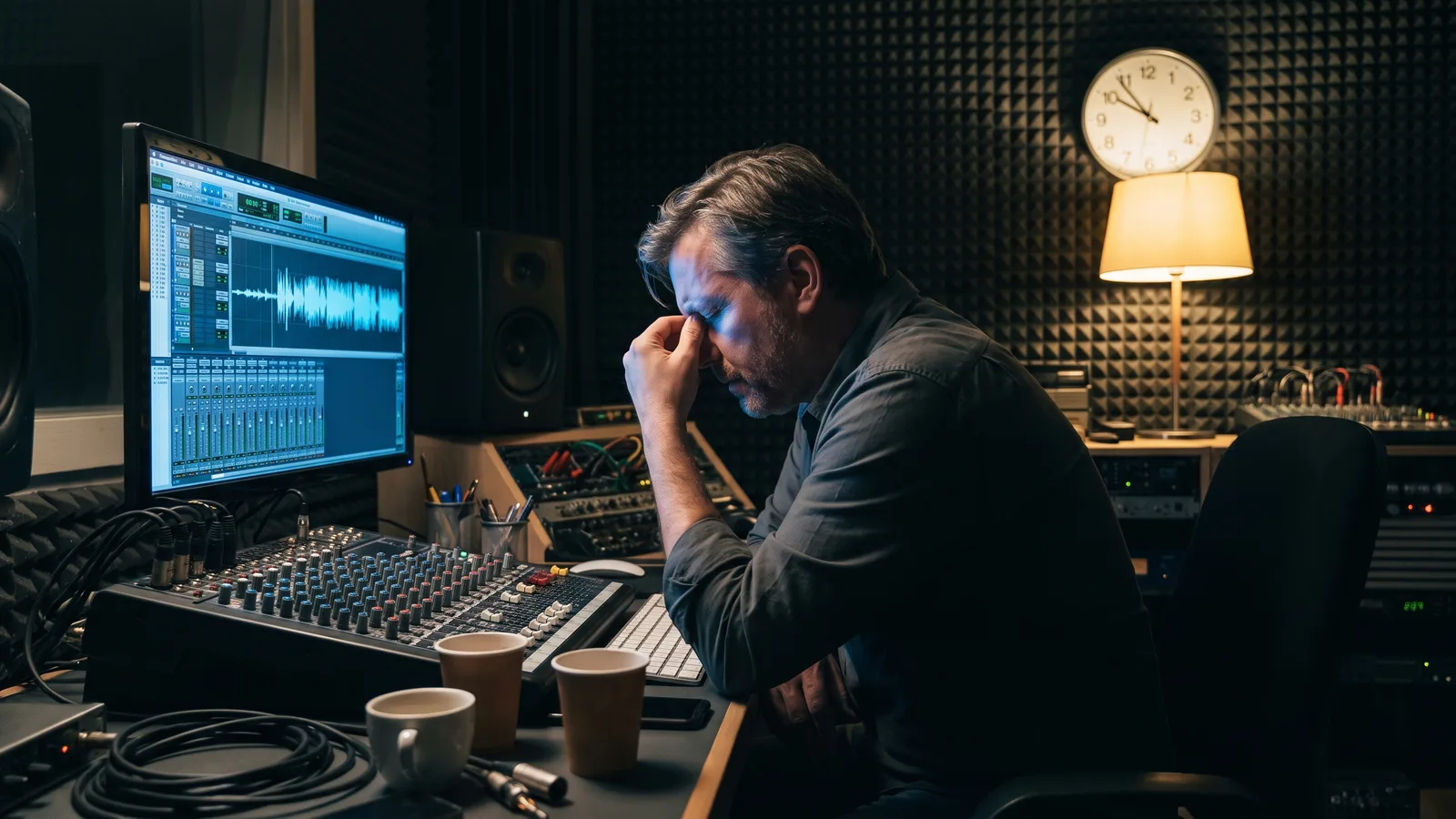
You know the moment. It's two, maybe three hours into a session. The mix sounded great around the one-hour mark, and now you can't tell if it's good, bad, or just loud. So you turn the vocal up. Then the guitars feel buried, so those go up too. Ten minutes later everything is fighting everything, the whole thing is somehow harsher and quieter than where you started, and you're squinting at the meters like they betrayed you.
They didn't. Your ears did. And the frustrating part is they lied to you gently, one small step at a time, so you never noticed the lie being told.
Why two hours in, your ears stop being reliable
Two things happen when you listen to anything loud for a long stretch, and they compound.
The first is temporary threshold shift. Loud sound tires out the tiny hair cells in your inner ear. After sustained exposure they get less sensitive, which means the whole world sounds a little quieter than it actually is. It comes back after a rest — that's the "temporary" part — but while it's happening your reference point is sliding out from under you. You compensate by turning up. Which tires the cells faster. Which makes you turn up again.
The second is loudness adaptation, and it's more of a brain thing than an ear thing. Play someone a sound at a fixed level and their perception of it fades over about twenty seconds. Your hearing is built to notice change, not to sit and admire a constant. So the bright, exciting top end you dialled in at the start stops registering as bright. You add more. The next morning it's an ice pick.
Put those together and you get the classic long-session trap: everything creeping up, everything getting harsher, and your own judgment quietly degrading the whole time without a single warning light coming on.
Decision fatigue rides in on the same horse
It's not only your ears. Mixing is hundreds of small choices — a dB here, a hair of high-mid there, is that reverb too long — and every choice spends a little of the same mental fuel. Psychologists have watched this happen in far duller settings than a studio: people making judgment calls all day get worse at them as the day goes on. Not dumber. Just more tired, more likely to second-guess, more likely to keep fiddling instead of committing.
So the third hour is a double hit. Your ears are less trustworthy and the part of you that decides is running on fumes. That's exactly when people do their worst overprocessing — not because they lack skill, but because they've run out of the resource that skill runs on.
Pick a reference level and stop moving it
The single biggest defense is to stop mixing loud, and to stop changing how loud.
Pros land on a monitoring level somewhere around 79 to 85 dB SPL at the listening position — loud enough to hear the low end honestly, quiet enough that you can go for hours without frying anything. Mastering rooms sit lower, near the 83 dB reference, for a reason. If you don't own an SPL meter, your phone has an app that's close enough to be useful. Set a comfortable level, mark the knob, and leave it.
The same idea applies inside the box. Give yourself a gain-staging target — peaks landing around -18 dBFS on your channels — so your plugins see the level they were voiced for and your mix bus isn't screaming before you've even started. Consistent input level in, consistent judgment out. When every track arrives at roughly the same place, you stop chasing loudness and start actually mixing.
And mix quieter than feels natural. Quiet listening is unforgiving in the good way: if the vocal is buried at a low level, it's buried, full stop, and turning everything up won't hide the balance problem — it'll only hide it from your tired ears. Balances that survive at whisper level survive everywhere.
Break before you think you need to
The threshold shift and the adaptation both reset with rest, so give them the chance. Step out every forty-five minutes or so. Not to check your phone in the same room — actually leave, get some quiet, let your ears recalibrate against the sound of a kettle and a hallway. Ten minutes is enough to bring back the top end you'd stopped hearing. You'll come back and instantly notice the thing that was wrong, which is either delightful or infuriating depending on how long you'd been grinding on it.
Cheap trick that works: keep a rough reference track you know cold and A/B against it now and then. It won't stop fatigue, but it gives your sliding reference something fixed to bump into.
Check in mono, check on the phone
When your ears are getting unreliable, lean on tests that don't care how tired you are.
Sum to mono. Balance and phase problems that hide in a wide, flattering stereo image jump out the second the width collapses — a vocal that vanishes, a bass that thins, a reverb that turns to mush. Then bounce a rough and play it on your phone, or a laptop speaker, or in the car. Small speakers ruthlessly expose the midrange, which is where fatigue makes you overcook things. If it holds up on a phone, your two-hours-in ears probably oversold the problem.
Commit early, then sleep on it
Do the decisions that need fresh ears first. The stuff that's easy to overthink — how bright the vocal sits, how much saturation, whether that reverb is too long — make those calls in the first hour and then leave them alone. Print them if you have to, so you can't keep touching them. A choice you commit to while sharp beats one you keep revising while fried. Something like Magnetite on a bus, set early and left, adds glue you'd only muddy by second-guessing it at hour three.
Then the oldest rule in the book, and still the best: sleep on the master. Don't send it the night you finished it. Bounce it, walk away, open it cold in the morning with a coffee and rested ears. The things that were wrong will announce themselves in the first ten seconds — a harsh 3k, a vocal that's too hot, a low end you couldn't hear at midnight. Nearly every "how did I miss that?" mistake was really a "my ears were gone and I kept going anyway" mistake.
None of this is about willpower or better monitors. It's about respecting that your hearing is a body part with limits, not a measurement tool. Set a level and leave it, work quieter, break before you're tired, and hand the final call to tomorrow's ears instead of tonight's. The gear will still be there in the morning. So will the mix. And you'll finally be able to hear it.

Add a comment
You need to be logged in to add comments.