Gear Shootout
Black Rooster VLA-2A vs Waves CLA-2A: Which LA-2A Is Right for Your Vocals?


Every vocal chain I've ever built has an opto compressor somewhere in it. Not because a rule says so, but because nothing else smooths a performance the way an LA-2A does — that slow, forgiving grab that rides a vocal instead of clamping it. The question was never whether to use one. It was which one.
For a lot of people that shortlist comes down to two plugins: our VLA-2A and the Waves CLA-2A. They chase the same 1960s tube-and-photocell circuit, and they both do the job. But once you get past the badge, they're not really the same class of tool anymore. Here's why, without the marketing gloss.
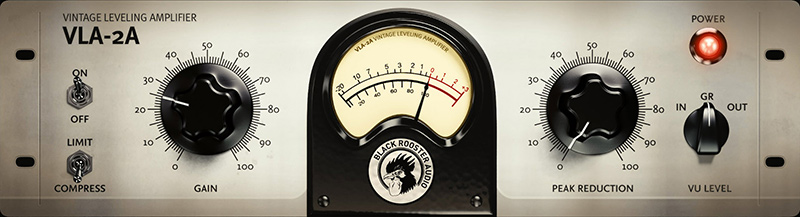
The same idea, built to very different depths
The LA-2A hardware gives you two controls that matter — Peak Reduction and Gain — plus a Comp/Limit switch. The character lives in the T4 optical cell: a light source and a photoresistor that react to the signal in a slow, program-dependent way. Feed it something dense and the release drags; feed it a sparse vocal and it breathes. That behaviour is the whole charm, and it's the hard part to model.
Waves modelled that circuit early, and for its day it was excellent. The CLA-2A has been on a thousand records and Chris Lord-Alge's name isn't decoration. Where it shows its age is the depth: it's a faithful snapshot of one unit, bright and finished-sounding, with the two knobs and not much underneath them.
We went further down. The VLA-2A models the signal path component by component — the T4B opto cell, the input and output transformers with real flux-based saturation, and the tube stages (a 12AX7 in the sidechain, a 6BQ5 driving the cell, a 12BH7 on the output) built on Koren tube models rather than a static curve. It runs at up to 4× oversampling so that colour stays clean instead of aliasing. That's not spec-sheet decoration; it's why the compression sits in a track with the weight of hardware instead of the glassiness people complain about in older emulations.
The base VLA-2A keeps it to the two classic knobs, a Comp/Limit switch and a selectable VU meter. Step up to the VLA-2A Mark II and you get the things the original box never had, kept out of your way until you want them: a built-in Mix knob for parallel compression, a proper external sidechain, an Emphasis control that makes the detector listen more to the highs, and a choice of three optical cells (A, B and C) with different attack and release speeds. Same opto heart, with room to shape it.
On a lead vocal
This is where most people are choosing, so let's start here. Put a slightly uneven pop vocal through both at around 4–6 dB of reduction, and the CLA-2A brings it forward and brightens it. That's useful when the singer already sits well. On a darker take it can also push sibilance you'll be fighting later, and its single fixed character is the only character you get.
The VLA-2A gives you room the CLA-2A doesn't. Even the base version hands you a Comp/Limit mode and a selectable VU meter the Waves leaves out. And on the Mark II you can really dial it in: start on Cell A for the classic slow bloom that sets a vocal deep in the track, switch to Cell C when you want it to react quicker, and lean on Emphasis so the compressor tames sibilance as it works, no separate de-esser. Reach for the Mix knob and parallel level control is right there on the channel. Same beloved opto sound, with the moves you'd normally open other plugins to get.
On the mix bus and the drum room
A hair of opto compression — a dB, maybe two — knits a mix together without the pumping a faster comp gives you. Here the modelled transformers earn their keep: they add the low-end weight and gentle harmonic thickness that makes a bus glue sound expensive rather than just quieter. Dial in heavier reduction and blend it back — with the Mark II's Mix knob, or the base version on a parallel bus — and you get density with the transients intact. I run it on drum rooms and mix busses constantly for exactly that.
The CLA-2A can do parallel too — by making an aux, a send and a return. Fine once. Less fine on every song, every session, forever.
The honest verdict
The CLA-2A is a good plugin and a piece of history. But for what most of us do today, the VLA-2A is simply the better tool: deeper modelling (transformers, real tube stages, oversampling) and a Comp/Limit mode — and in the Mark II, three optical voices, a built-in Mix knob, an external sidechain and Emphasis for frequency-aware compression — usually at a lower price. If you're buying your first serious opto compressor, buy the one that grows with you.
What you actually get, and the Mark II
None of the extra depth costs you simplicity. Load the VLA-2A, set Peak Reduction and Gain, and it behaves like the classic. The metering even lets you flip the VU between input, gain reduction and output so you're reading the right thing for the job. Everything else waits until you need it.
If you want the fullest version of all this, the VLA-2A Mark II is where the cell selection, Emphasis, external sidechain and Mix knob live — the one I'd point a working mixer at. And if you want to hear where the opto idea goes with a faster, solid-state cell, the VLA-3A is the punchier sibling that shines on drums and bass.
So which one?
If all you'll ever want is one fixed, bright LA-2A sound and you already live in the Waves world, the CLA-2A will do it. For everyone else — anyone who wants the real opto magic plus the control to place it, parallel it, and shape it — the VLA-2A is the one I reach for, and the one I'd tell a friend to buy.
Don't take my word for it, though; I'm hardly neutral. Grab the free trial, drop the same vocal into both, and spend ten minutes with your eyes closed and your hand on Peak Reduction. Then, on the Mark II, switch cells and nudge the Mix. That's usually the moment people stop asking which LA-2A and start asking why they waited.


Add a comment
You need to be logged in to add comments.