
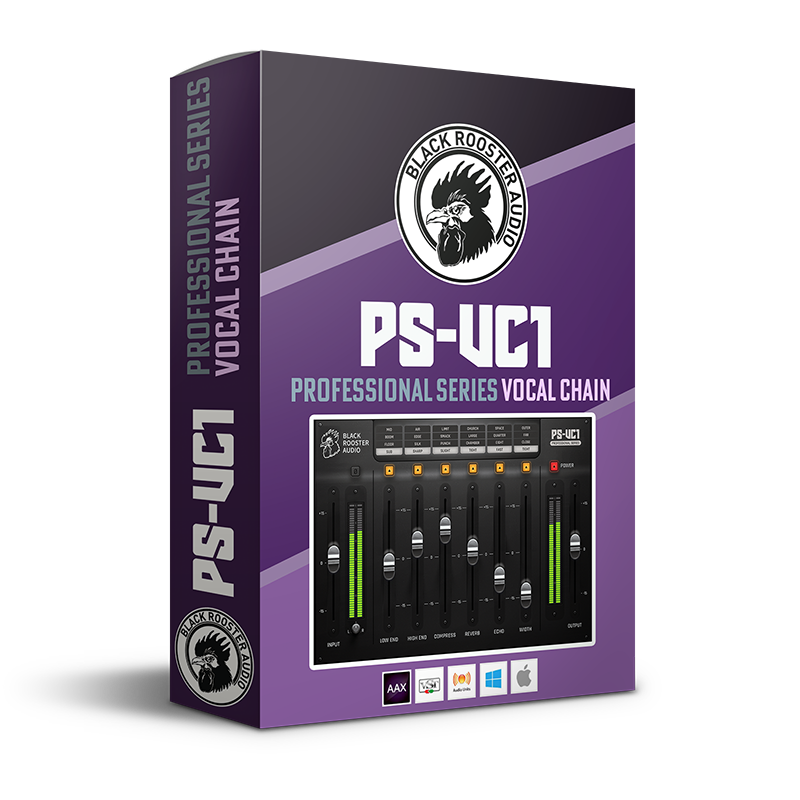
PS-VC1
Professional Series Vocal Chain
About the PS-VC1
The opening release of the Black Rooster Audio Professional Series: everything fourteen years of modelling classic studio hardware taught us, rebuilt as one precise modern vocal chain.
The PS-VC1 is a complete vocal chain: six processing modules — Low End, High End, Compress, Reverb, Echo and Width — sharing one panel and one signal path. It comes out of the same workbench as our vintage collection. Since 2012 we have taken apart the tube amplifiers, passive filter networks and transformers that made records sound the way they do, and rebuilt them component by component in software. Fourteen years of that teaches you which moves in a classic channel genuinely earn their place on a vocal — and which are simply the decade the box was built in. The Professional Series keeps the first and leaves the second behind: seventy years of studio practice as a precise, modern tool rather than a model of any single unit.
Six modules in the order engineers actually work
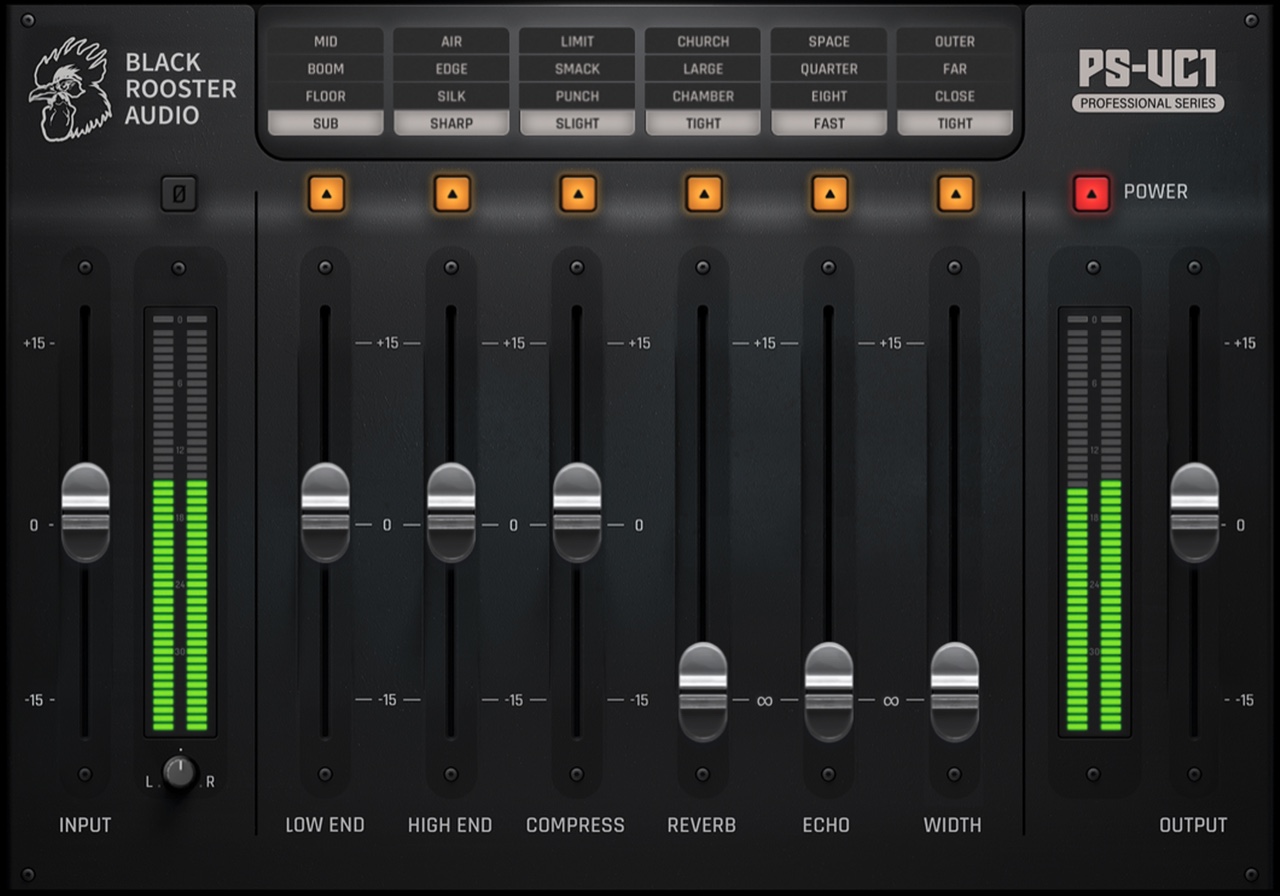
The chain runs in a fixed, mix-ready order, and that order is deliberate — clean the low end, control the dynamics, shape the top, then place the vocal in a space. Every module carries the same three controls: a preset selector, a fader and its own bypass — ±15dB on Low End, High End and Compress, a 0 to 100 mix on Reverb, Echo and Width. Low End covers the problems that show up on nearly every take — Sub reaches from 20Hz to 150Hz for rumble, Floor works 20Hz to 180Hz, Boom handles proximity effect and resonance between 40Hz and 340Hz, and Mid spans a broad 60Hz to 640Hz for the fundamentals. High End answers with Sharp for sibilance in a tight 5kHz to 6kHz window, Silk across 1.8kHz to 18kHz, Edge from 1.2kHz to 10kHz for presence, and Air reaching 3kHz all the way to 20kHz. Switch a module out and you hear the chain without it — instantly, no re-patching.
Presets that are calibrated, not decorative
Four presets per module sounds like a limitation until you use it. Each one is a starting point somebody already argued about, which means you spend your attention on the vocal rather than on a parameter grid. Compress offers Slight, Punch, Smack and Limit, running peak or vintage detection depending on the character you want, with attack times from 0.5ms to 40ms and release from 75ms to 1.5 seconds under the hood. Auto makeup gain is the part that changes how you work: because the module compensates for its own gain reduction, bypassing it compares character instead of loudness, and that is the only honest way to judge compression. Reverb moves from Tight through Chamber and Large to Church, built on an efficient algorithm that stays out of the CPU meter. Echo runs tempo-synced or free — Fast for slapback, Eight and Quarter for rhythmic repeats, Space for long ambient trails. Width uses three different stereo algorithms (All-Pass, Haas and Hilbert) across Tight, Close, Far and Outer, so widening a vocal doesn't have to mean gambling with mono compatibility.
Using the PS-VC1 on lead vocals, backing stacks and spoken word
On a lead vocal it does the whole job: pull the proximity buildup with Boom, sit the dynamics with Punch, open the top with Air, then set depth with Reverb and Echo and decide how far the voice spreads. On backing stacks, Smack plus a wider Width setting pushes a double behind the lead without burying it, and the per-module bypass makes it quick to strip a stack back when it starts competing. For spoken word, podcasts and voiceover, Slight and a touch of Silk produce a clean, even read with none of the analog character you'd otherwise have to dial out. When the take wants period character printed on it instead — transformers, tubes, deliberate colour — reach for the VWB-1X, built from the same modelling work that led here. Most engineers keep both and pick by the job.
PS-VC1 Features
Six-in-one vocal chain
Low End, High End, Compress, Reverb, Echo and Width in a single unified interface with one shared signal path — a fixed, mix-ready order that mirrors how a vocal actually gets mixed.
Low End filtering
Four presets for the low spectrum: Sub (20Hz–150Hz) for rumble and weight, Floor (20Hz–180Hz) for the lowest fundamentals, Boom (40Hz–340Hz) for proximity effect and resonance, and Mid (60Hz–640Hz) for the vocal's body.
High End shaping
Four presets for the top: Sharp (5kHz–6kHz) to tame sibilance, Silk (1.8kHz–18kHz) to smooth and polish, Edge (1.2kHz–10kHz) for presence and definition, and Air (3kHz–20kHz) for modern openness.
Compressor with peak and vintage detection
Slight, Punch, Smack and Limit cover gentle level control through to aggressive, upfront dynamics, with selectable peak or vintage detection behaviour driving the envelope.
Auto makeup gain
The compressor compensates for its own gain reduction automatically, so bypassing the module compares character rather than level — genuine A/B instead of "louder sounds better".
Efficient reverb algorithm
Tight, Chamber, Large and Church span small-room ambience to cathedral decay, built on an algorithm designed for rich spatial processing at minimal CPU cost.
Tempo-synced and free-running echo
Fast slapback, Eight and Quarter note repeats, and a long ambient Space setting — for corrective timing work as readily as creative sound design.
Three stereo width algorithms
All-Pass, Haas and Hilbert processing across Tight, Close, Far and Outer presets, each with its own spatial character, from subtle enhancement to extreme spreading.
Per-module and global bypass
Every one of the six modules bypasses individually, and the global Power switch disables all processing while maintaining signal flow for an instant whole-chain comparison.
Full gain staging and placement
Input and output gain from −30dB to +15dB, phase inversion for multi-mic sources, and a pan control that positions the signal in the stereo field before processing.
Precision LED metering
High-resolution LED VU meters on input and output with extended dynamic range, plus a dedicated gain-reduction readout for the compressor.
Scalable HighDPI interface
Seven interface sizes from XXS to XXL, rendered crisply on high-pixel-density displays under macOS and Windows.
PS-VC1 Audio Demos
Both takes play in sync. Press FX to switch the plugin in and out without losing your place.