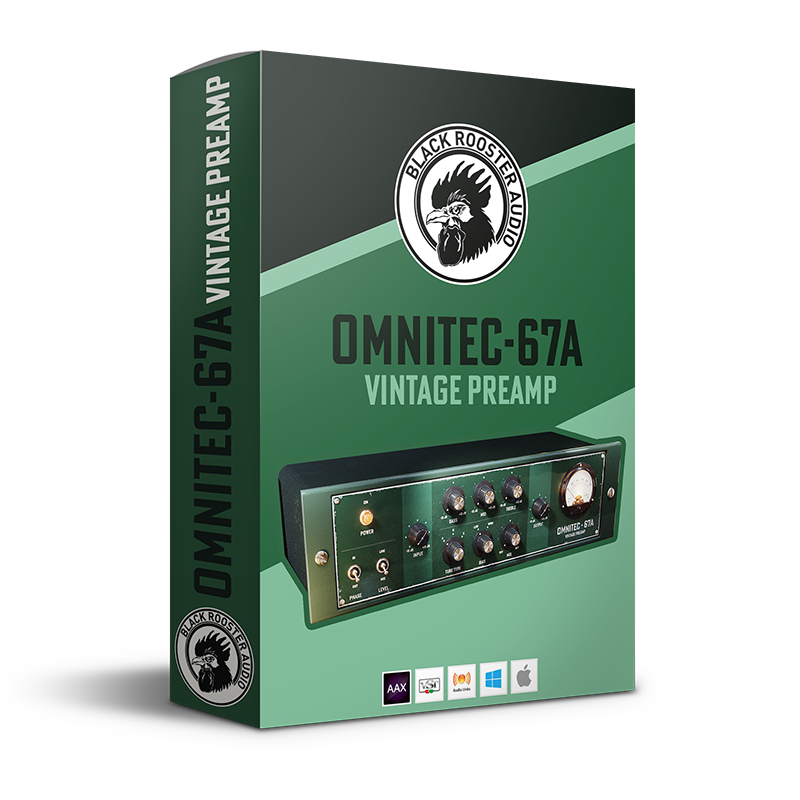
OmniTec-67A
Vintage Tube Preamp
About the OmniTec-67A
Inspired by the Altec 1567A: the early-1960s tube mixer with a signature green plate and a whopping 97dB of gain — the box behind a huge slice of the Motown sound.
The OmniTec-67A is a vintage tube preamp built for one thing: turning a sterile digital signal into something with grit, density and character. This isn't a clean gain box. The original Altec 1567A was a rack-mounted tube mixer with a simple two-knob EQ and enough gain to redline anything you fed it, and engineers used exactly that to their advantage. We modelled its drive-tube input and output stages so you can push a source into saturation, harmonics and subtle distortion — the raw analog tone Motown records are made of.
Motown's secret sauce, modelled tube by tube
The 1567A heavily influenced the sound of countless Motown hits, from The Supremes to The Temptations, and was famously worked by engineers like Russ Terrana and Matt Wallace. It's impossible to picture those records — the purposefully distorted brass, the oversaturated electric piano, the fat bass and vocals — without the sound this box made. After the Motown era it stuck around as a cheaper route to a coloured tube tone, and it never really left. Under the hood, the signal runs through a mic input transformer into a premix amplifier (the first half of a 12AX7), through an input control and a single-stage booster into the EQ, then into a further tube network (third 12AX7 and a 6CG7) and an output transformer for that extra oomph. We recreated the whole chain with our real-time circuit simulation, so the drive builds the way the hardware's does.
Three tubes, two bias voltages, one filthy tone
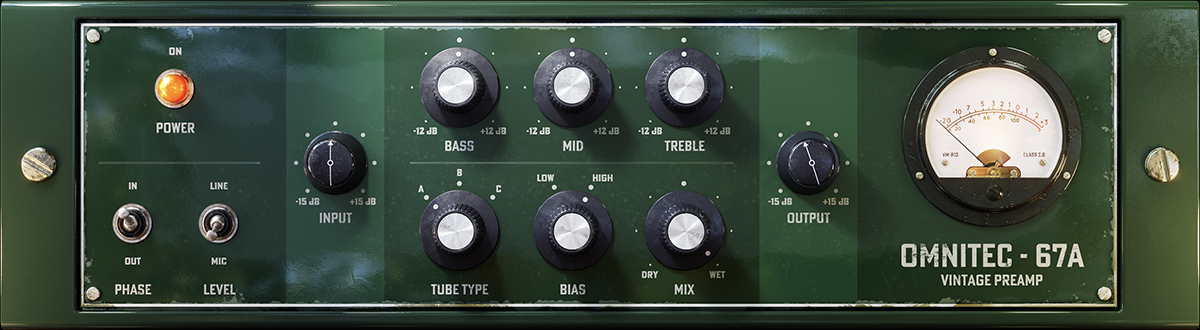
Where the original gave you one voice, the OmniTec-67A gives you three. The Tube Type control (A, B and C) swaps between three modelled valves, each with its own frequency response, output gain and harmonic range — go from a polite warm-up to full crunch just by changing tubes. A two-position Bias switch (Low or High) then sets how hard those tubes are driven: run them cold and the valve sounds thin; run them hot and it oversaturates — two discrete voltages, not a continuous sweep, so it's easy to recall. A Mic/Line switch chooses the input character (mic vs. line impedance, auto-compensated at the output), Phase flips polarity at the input, and the wet/dry Mix knob (0–100%) lets you dial saturation in parallel so you keep the dry punch underneath. Input gain (±15dB) and Output level (±15dB) let you set exactly how hard you hit the tubes and how loud you leave the stage.
Using the OmniTec-67A on vocals, bass and drums
On vocals, a hotter tube and a touch of bias push add the throaty midrange grit that makes a modern take sound recorded-to-tape. On bass and electric piano it delivers that saturated, harmonically dense Motown weight — try it on a DI'd bass to fake a room and an amp at once. On drums it turns thin samples into something that thumps, and on a full bus it adds cohesion and colour. The added vintage 3-band EQ shapes tone right where the tubes are working: Bass at 50Hz (±12dB), Mid at 400Hz (±12dB) and a sweeping Treble shelf whose corner slides from roughly 8kHz down to about 1kHz as you turn it (up to ±20dB) — more control than the hardware ever offered. If you want dynamic glue rather than harmonic drive, pair it with the vari-mu OmniTec-436C compressor.
OmniTec-67A Features
Modelled drive-tube preamp stages
The 1567A's input and output tube stages recreated as a living circuit — mic transformer, premix 12AX7, single-stage booster, a 6CG7 network and an output transformer — so pushing the input builds real saturation, harmonics and grit, not a static distortion curve.
Three switchable tube types
The Tube Type control (A, B, C) swaps between three modelled valves, each with a different frequency response, output gain and harmonic range — from a gentle warm-up to full crunch without touching another knob.
Low/High bias switch
A two-position Bias switch sets how hard the tubes run: Low runs them cold and thin, High runs them hot and saturated. Two discrete voltages rather than a continuous knob, so the tone is easy to recall.
Vintage 3-band EQ
An added tube-flavoured EQ the original never had: Bass at 50Hz (±12dB), Mid at 400Hz (±12dB) and a sweeping Treble shelf that slides from roughly 8kHz down to about 1kHz as you turn it (up to ±20dB), shaping tone right where the tubes are working.
Mic/Line input switch and gain staging
Select mic or line character — each with its own frequency response and impedance behaviour — with the output stage auto-compensated so levels stay usable as you switch. Input gain and Output level (±15dB each) set how hard you hit the tubes and how loud you leave.
Phase invert and wet/dry Mix
Flip polarity at the input to avoid cancellation in the mix, and use the Mix knob (0–100%) to blend the saturated signal against the dry for parallel drive that keeps transients intact.
Modelled VU metering
A faithful VU meter (reference level -14dB) shows how much drive you're generating so you can push the tubes with your eyes as well as your ears.
Authentic circuit emulation
Our real-time, SPICE-type component-based circuit simulation captures the sound and feel of the analog counterpart in every nuance, transformers and tube stages included.
SSE2-optimised code
DSP operations are pipelined on the SSE2 instruction set for high-performance operation, even under complex processing.
HighDPI / Retina support
Crisp, high-pixel-density rendering on macOS and Windows for a sharp interface on modern displays.
OmniTec-67A Audio Demos
Both takes play in sync. Press FX to switch the plugin in and out without losing your place.
OmniTec-67A — Frequently Asked Questions
What hardware is the OmniTec-67A based on?
The OmniTec-67A is inspired by the Altec 1567A, an early-1960s rack-mounted tube mixer with a two-knob EQ and roughly 97dB of gain. It became a Motown studio staple prized for its grit and saturation, and its signature green plate. We modelled its tube input and output stages in full.
Is the OmniTec-67A a preamp or a compressor?
The OmniTec-67A is a tube preamp built for saturation and harmonic colour, not dynamic control. It adds warmth, grit and drive rather than compressing peaks. If you need glue and leveling, look at the vari-mu OmniTec-436C — many engineers run the 67A into it.
What does the OmniTec-67A sound good on?
It shines on anything that needs analog attitude: vocals that need throaty grit, bass and electric piano that need Motown-style weight, thin drum samples that need thump, and full buses that need cohesion. Use the Mix knob to dial saturation in parallel so the dry punch stays underneath.
What do the three tube types and bias controls do?
The Tube Type control (A, B, C) swaps between three modelled valves, each with its own frequency response, gain and harmonic character. The Bias switch then sets how hard those tubes are driven via two discrete positions — Low for a cold, thin voice and High for hot, saturated crunch — not a continuous knob.
What EQ frequencies does the OmniTec-67A offer?
The added vintage 3-band EQ gives you Bass at 50Hz (±12dB), Mid at 400Hz (±12dB) and a sweeping Treble shelf whose corner slides from roughly 8kHz down to about 1kHz as you turn it (up to ±20dB). It sits inside the tube path, so it shapes tone right where the saturation is happening.
Which plugin formats and systems does the OmniTec-67A support?
The OmniTec-67A ships as AAX, VST, VST3 and Audio Units (AU) for both macOS and Windows, including native Apple Silicon support. It runs in all major DAWs. See the product manual for detailed system requirements.
Is there a free trial of the OmniTec-67A?
Yes. Registered users can create a free 14-day trial license from the license manager and demo the OmniTec-67A in full before buying. You only need a free Black Rooster Audio account to get started.