
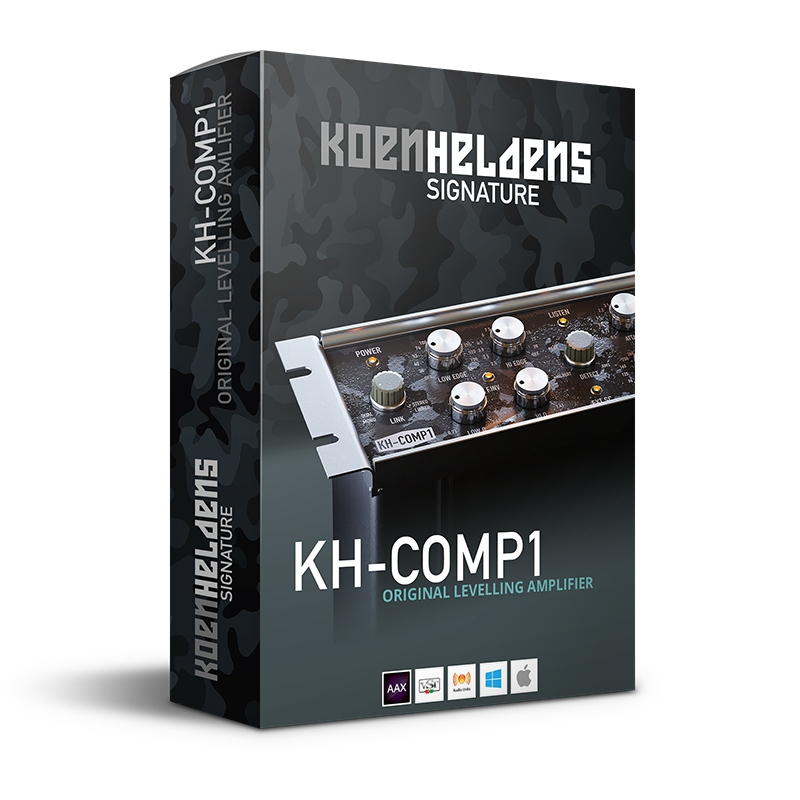
KH-COMP1
Koen Heldens Signature Compressor
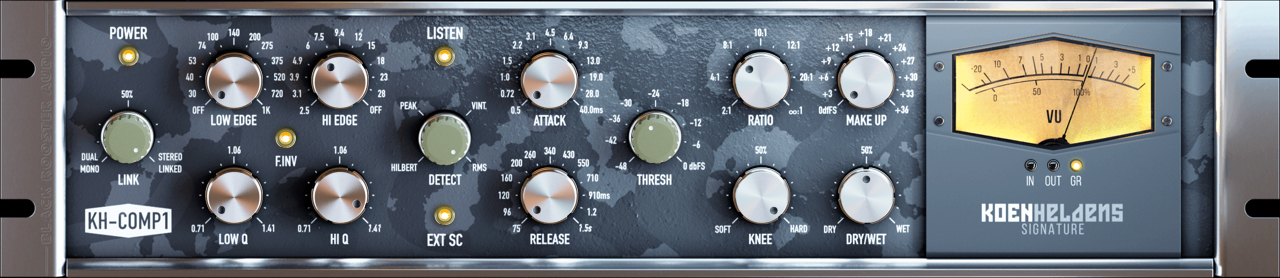
About the KH-COMP1
The KH-COMP1 is a compressor built from a blank sheet rather than a copy of some 50-year-old box. It's the first plugin in the Koen Heldens Signature Series — an original dynamics processor designed with the multi-platinum, award-winning mix engineer to do things his go-to gear couldn't. No vintage lineage, no borrowed schematic. Just a clean-sheet compressor aimed at the way records are actually mixed now, with four selectable envelope detectors, a fully invertible 2-band sidechain filter, an external sidechain input, blended stereo linking and true zero latency.
Built with Koen Heldens to break the vintage rulebook
When we started working with Koen on a signature series, the brief was simple and demanding: give him a compressor that behaves the way he thinks, not the way a 1960s circuit forces him to. He knows the technical limits of every plugin in his arsenal, and his ideas about process timing, channel linking and sidechain filtering pushed the team to build an entirely new tool. Countless development hours and listening sessions later, the KH-COMP1 is the most flexible dynamics processor we've made to date — transparent where you want precision, and characterful when you ask for it. At its core it's a clean feed-forward peak compressor: musical gain control that sits under a source without announcing itself, but with a control set that lets you push far past "invisible" when the track calls for it.
Four detector modes, an invertible sidechain, and zero latency
The heart of the KH-COMP1 is how it senses level. Four detector modes — Hilbert, Peak, Vintage and RMS — let you shape the envelope that drives the unit, from broad and forgiving to surgically precise. The Hilbert mode is the standout: it derives the analytic signal (a 90-degree phase-shifted pair) and reads a source's true envelope magnitude without the distortion or overshoots that trip up naive peak detection. On top of that, the 2-band invertible sidechain filter — a low band from 20Hz to 1kHz and a high band from 2.5kHz to 35kHz, each with its own Q — lets you EQ the detector's feed, then invert it to carve out a band for aggressive de-essing, ducking or pumping. A "Listen" button monitors that filtered sidechain so you're not guessing, and an external sidechain input ("Ext SC") lets a separate track drive the compression entirely. Because the whole thing runs at zero latency — no oversampling, no look-ahead, no sample delay compensation — it's genuinely usable for real-time monitoring and live tracking.
Using the KH-COMP1 on vocals, drums and the mix bus
On lead vocals, Hilbert detection with a fast attack (down to 0.5ms) rides a performance level without the pumping artefacts a classic RMS detector introduces, and the invertible sidechain filter doubles as a built-in de-esser. On drums, Peak mode and a short attack nail transients, while Vintage mode — a half-wave detector shape that emphasises even-order, K2-leaning content in the control signal — grabs a bus with a rounder, more forgiving feel. The Blended Stereo-Link lets you dial the exact relationship between dual-mono and stereo-linked processing, so a wide mix keeps its image instead of collapsing to the loudest channel. Threshold sweeps from 0 down to -48dBFS, Ratio steps from 2:1 up to a brick-wall infinity, and the stepless Knee plus a full dry/wet Mix control give you everything from soft parallel leveling to hard, edgy limiting. Make-up Gain runs to +36dB, release stretches from 75ms to 1.5s, and a switchable VU meter reads input, output or gain reduction. The Signature Series continues with more units designed alongside Koen — but the KH-COMP1 is where it starts.
KH-COMP1 Features
4 detector modes — Hilbert / Peak / Vintage / RMS
Shape the envelope that drives the unit for broad or surgical level capture. Hilbert derives the analytic signal (a 90-degree phase-shifted pair) to read the true envelope magnitude with no overshoots; Peak nails transients via full-wave rectification; Vintage uses a half-wave detector shape that emphasises even-order, K2-leaning content for a rounder feel; and RMS gives classic averaged response.
2-band invertible sidechain filter with Listen
EQ the detector's feed with a 2-band filter — low band 20Hz to 1kHz, high band 2.5kHz to 35kHz, each with its own Q — then invert it to carve out a band for precise ducking, pumping and de-essing. The "Listen" button auditions the filtered signal before it hits the envelope detector.
External sidechain input
Engage "Ext SC" to drive compression from a separate track fed into the plugin's dedicated stereo sidechain bus, rather than from the audio input — for classic ducking, rhythmic pumping and key-triggered gain riding without touching the source you hear.
Blended Stereo-Link
A stepless blend between dual-mono and stereo-linked processing set with a single control (0–100%). Dual mono treats left and right separately; fully linked drives both channels from the summed detector level — and everything in between lets you keep detailed control over the stereo image.
Threshold, Ratio, Knee and Mix
Threshold from 0 down to -48dBFS, a stepped Ratio from 2:1 up to a brick-wall infinity (2, 4, 8, 10, 12, 20, 100 and ∞), a stepless Knee to set how sharply compression grabs around the threshold, and a Dry/Wet Mix to blend input and processed signal for parallel compression.
Zero latency
The KH-COMP1 uses no oversampling and no look-ahead, so it reports no latency and needs no sample delay compensation — a genuine option for real-time monitoring and live environments where delay would otherwise get in the way.
Fast attack and flexible release
Attack from a super-fast 0.5ms up to 40ms, release from 75ms to 1.5s, and up to +36dB of make-up Gain — so you can catch the sharpest transients or ride slow programme material, with a switchable VU meter reading input, output or gain reduction.
SSE2-optimised code
DSP operations are pipelined on the SSE2 instruction set for high-performance operation even under complex processing.
HighDPI / Retina support
Crisp high-pixel-density rendering on macOS and Windows for a sharp interface on modern displays.
KH-COMP1 Audio Demos
Both takes play in sync. Press FX to switch the plugin in and out without losing your place.
KH-COMP1 Examples & Videos
Industry Reviews

I love how smooth and versatile the KH-COMP1 compressor is without breaking up the sound.

EJ Recourt
Producer/Mixer/EngineerFinally tried the Hilbert detector on drum bus, wasn't sure what to expect. I have to say I was pretty surprised when the KH-COMP1 beat every single bus compressor I threw at some drum in a bus shoot out. The way this can bring the kick and snare forward is crazy. Quick little kick drum flutter beats were easily defined through a dense mix. All the other comps struggled here. Why hasn't anyone made a compressor with this type of detector before? It seems superior for many purposes.
KH-COMP1 — Customer Reviews
a little extra control than average compressors
With this plugin you get a little extra control than average compressors. It also has nice, natural sound, its stable and fast enough. its a tool, a good tool witih some extra features and no bullshit added - a no brainer...
An excellent plugin
The plugin delivers exactly what it promises.
Excelente
una emulación muy fiel y poderoso compresor, produce tu música
Awesome Use!
Been using this compressor during every vocal sessions!
Excellent!!!
Great compressor, excellent in drums!!!
Ecxelente
Buen sonido. No lo rompe. Controla bien los picos.
Leave a Review
KH-COMP1 — Frequently Asked Questions
What is the KH-COMP1 based on?
The KH-COMP1 is an original Black Rooster Audio design, not an emulation of vintage hardware. It was built from scratch with mix engineer Koen Heldens as the first plugin in his Signature Series — a clean-sheet compressor with four detector modes, a Hilbert envelope detector, an invertible sidechain and zero latency.
What are the four detector modes?
Hilbert, Peak, Vintage and RMS. Hilbert reads the true envelope magnitude from an analytic (90-degree phase-shifted) signal with no overshoots; Peak captures transients via full-wave rectification; Vintage uses a half-wave detector shape that leans on even-order, K2 content for a rounder feel; and RMS gives classic averaged detection. Each changes how the compressor times and reacts to your source.
When should I use the KH-COMP1?
Use it almost anywhere. On vocals, Hilbert detection and a fast attack level performances cleanly and the invertible sidechain doubles as a de-esser. On drums, Peak mode nails transients and Vintage mode gives a rounder, more forgiving grab. It also works on the mix bus, where the Blended Stereo-Link preserves the image.
Does the KH-COMP1 have an external sidechain?
Yes. A dedicated stereo sidechain bus lets you key compression from a separate track when you engage "Ext SC" — useful for ducking, rhythmic pumping and key-triggered leveling. Combined with the invertible 2-band sidechain filter and "Listen" button, you can shape and audition exactly what drives the detector.
Does the KH-COMP1 add latency?
No. The KH-COMP1 is a zero-latency compressor that requires no sample delay compensation. That makes it usable for real-time monitoring and live tracking, where the delay of oversampled or look-ahead compressors would otherwise cause problems.
Which plugin formats and systems does the KH-COMP1 support?
The KH-COMP1 ships as AAX, VST, VST3 and Audio Units (AU) for both macOS and Windows, including native Apple Silicon support. It runs in all major DAWs. See the product manual for detailed system requirements.
Is there a free trial of the KH-COMP1?
Yes. Registered users can create a free 14-day trial license from the license manager and demo the KH-COMP1 in full before buying. You only need a free Black Rooster Audio account to get started.