
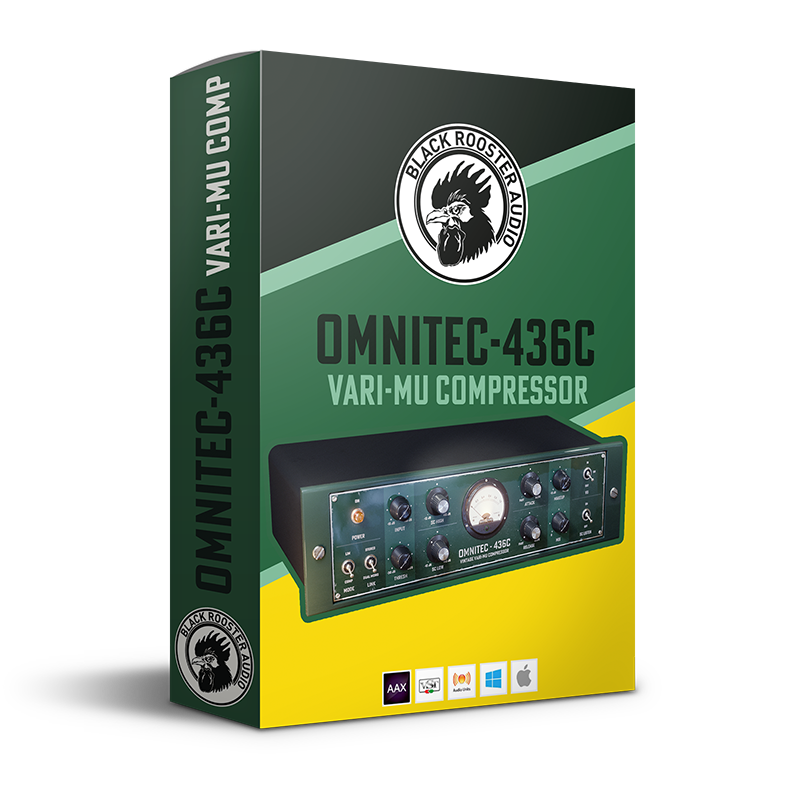
OmniTec-436C
Vintage Vari-Mu Tube Compressor
You need to be registered in order to demo our products.
Manual Download
OmniTec-436C ManualSupported formats




OmniTec-436C is available in AAX, VST, VST3 and Audio Units (AU) — compatible with all major DAWs.
Supported platforms (32/64 bit)
OmniTec-436C System Requirements
MINIMUM SYSTEM REQUIREMENTS (MAC)
- Intel Core CPU or Apple SIlicon M+ Processor
- 1GB of RAM
- MacOS 10.13 or newer (M1/M2 supported)
- VST, VST3, AU or AAX compatible host (64bit)
- Display resolution of 1280x1024 pixels or more
MINIMUM SYSTEM REQUIREMENTS (WINDOWS)
- SSE2 compatible processor (Intel Core CPU recommended)
- 1GB of RAM
- Windows 7 or newer
- VST, VST3 or AAX (x64) compatible host
- Display resolution of 1280x1024 pixels or more
About the OmniTec-436C
Inspired by the Altec 436C: the 1950s vari-mu tube compressor that Geoff Emerick leaned on at Abbey Road, and the reason so many records from that era sound glued together rather than squashed.
The OmniTec-436C is a vari-mu tube compressor built around one idea: compression you feel more than you hear. The original Altec 436C used a variable-mu (vari-mu) tube as its gain element, which means the amount of compression bends with the signal instead of clamping down on it. That's why it never sounds harsh. Push it hard and it doesn't spit — it thickens, mellows and pulls a mix together. We modelled that behaviour, then added the modern controls the hardware never had.
The Altec 436C, from Abbey Road to your DAW
The 436C was the third revision in Altec's leveling-amplifier line, reworked in the 1950s with threshold control, fully parametrised attack and an optimised release so the unit behaved musically under stress. Geoff Emerick made it a go-to limiter at Abbey Road Studios, laying the groundwork for records by The Beatles, Herb Alpert and Frank Sinatra, and it spread through pop studios across the US and Europe. Its vari-mu circuit went on to inspire later units from the likes of Fairchild and Manley. We rebuilt the gain stage and its tube-driven make-up amp as a living circuit, so the coloration shifts with how hard you drive it rather than sitting on a fixed curve.
Creamy, mellow, never brittle
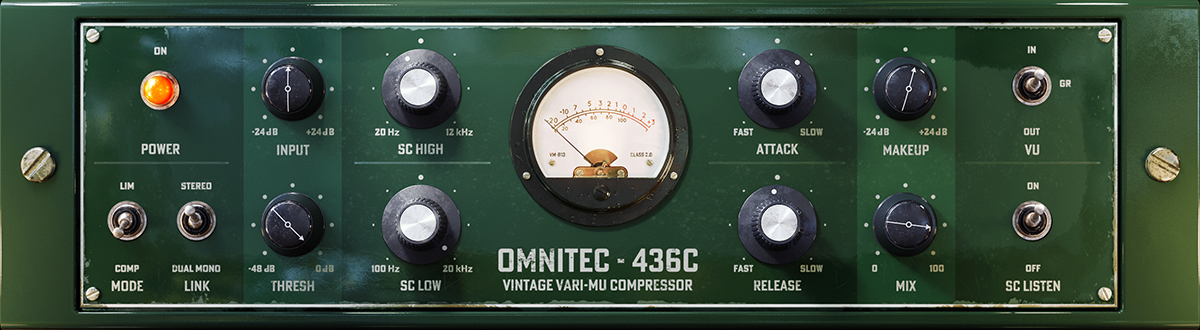
What you hear first is glue. A decent quantity of tube coloration is always present, yet it never overwhelms — the 436C consistently seems to hand a track exactly the right amount of cohesion. There's no ratio knob to fiddle with — the vari-mu curve is fixed and program-dependent, so you set how deep it bites with the Input (±24 dB) and Threshold (-48 to 0 dB) instead, then recover level with Makeup (±24 dB). The Mode switch picks how hard it clamps: Comp for a gentle, rounded knee, Lim for a firmer, faster grab on peaks. Shape the envelope with Attack (10 to 100 ms) and Release (250 ms to 2.5 s), and blend the compressed signal back against the dry with the Mix knob (0 to 100%) for parallel compression when you want density without losing transients. Because the whole thing is tube-based, running gentle gain reduction on a source already lays down a warm, slightly-worn character before you've made a single obvious move.
Using the OmniTec-436C on drums, bus and vocals
On the mix bus it's the classic move — a few dB of reduction with the Mix pulled back, and a loose collection of tracks suddenly reads as one record. On drums, the slow-ish attack lets transients through while the tails swell, giving you that big-room vintage punch. On bass guitar it adds weight and evens out fret-to-fret jumps; on vocals, strings and brass it sits a part forward with none of the edge a clean digital compressor can add. The two-band sidechain filter — SC High as a high-pass (20 Hz to 12 kHz) and SC Low as a low-pass (100 Hz to 20 kHz) — keeps low-end thump or harsh top from over-triggering the detector, and SC Listen lets you audition exactly what the sidechain hears. Feed it an external sidechain when you want a separate source driving the gain reduction, run the detector stereo-linked or as Dual Mono, and set the VU to watch input, gain reduction or output. If you're after harmonic drive and tube grit rather than dynamic control, its stablemate the OmniTec-67A preamp handles that side.
OmniTec-436C Audio Demos
OmniTec-436C Features
Modelled vari-mu gain stage
A variable-mu tube as the gain element, so compression bends with the signal instead of clamping it. The harder you push, the thicker and more forgiving it gets — the reason 436C-style compression sits under a mix so easily.
Fixed vari-mu curve, no ratio knob
There's no selectable ratio — the compression follows a fixed, program-dependent vari-mu curve that bends with the signal. You dial depth with Input (±24 dB) and Threshold (-48 to 0 dB), then recover with Makeup (±24 dB).
Comp and Lim modes
The Mode switch changes the knee and aggressiveness: Comp for gentle, rounded glue on the bus, Lim for a firmer, faster grab that catches peaks with authority on a track.
Stereo and Dual-Mono linking
The Link switch runs the detector stereo-linked to hold your image dead centre, or as Dual Mono so each channel compresses on its own — handy for uneven stereo sources and creative widening.
Two-band sidechain, SC Listen and external input
SC High is a high-pass (20 Hz to 12 kHz) and SC Low a low-pass (100 Hz to 20 kHz), so sub thump or harsh top can't over-trigger the detector. SC Listen isolates the filtered sidechain so you hear exactly what drives the gain reduction, and you can feed an external sidechain from another source.
Attack, Release and parallel Mix
Attack runs 10 to 100 ms and Release 250 ms to 2.5 s to shape how the envelope grabs and lets go, while the wet/dry Mix knob (0 to 100%) brings in parallel compression for density without sacrificing transients.
Input, Threshold and Makeup with switchable VU
Input (±24 dB) sets how hard you hit the tube, Threshold (-48 to 0 dB) chooses where compression starts, and Makeup (±24 dB) recovers the level — with the VU switchable to show input, gain reduction or output.
Authentic circuit emulation
Our real-time, SPICE-type component-based circuit simulation captures the sound and feel of the analog counterpart in every nuance, from the vari-mu tube to the make-up amplifier.
SSE2-optimised code
DSP operations are pipelined on the SSE2 instruction set for high-performance operation, even under complex processing.
Adaptive up-to-4x oversampling
A low-latency oversampling design attenuates aliasing and adaptively scales up to 4x with your session's sample rate to save CPU while staying clean.
HighDPI / Retina support
Crisp, high-pixel-density rendering on macOS and Windows for a sharp interface on modern displays.
OmniTec-436C — Frequently Asked Questions
What hardware is the OmniTec-436C based on?
The OmniTec-436C is inspired by the Altec 436C, a 1950s vari-mu tube compressor famous for its musical, gluing character. It was a go-to limiter for engineer Geoff Emerick at Abbey Road. We modelled its variable-mu gain stage and tube make-up amp, then added modern controls.
What is a vari-mu compressor and why does it sound so smooth?
A vari-mu compressor uses a variable-mu tube as its gain element, so the compression amount changes with the signal level rather than clamping down. That gives a soft, program-dependent response that thickens and mellows a source instead of squashing it, which is why it sits so naturally on a mix.
What should I use the OmniTec-436C on?
Reach for it when you want glue rather than tight control: the mix bus, drum submixes, bass, and vocals or strings and brass that need to sit forward without edge. Use the Mix knob for parallel compression to add density while keeping transients intact.
When should I use the OmniTec-436C instead of the OmniTec-67A?
Use the OmniTec-436C when you need dynamic control and glue — it is a vari-mu compressor. The OmniTec-67A is a tube preamp built for harmonic saturation, drive and colour with a 3-band EQ, not for taming dynamics. Many engineers stack the 67A for tone into the 436C for glue.
What does the sidechain filter and SC Listen mode do?
The two-band sidechain filter has SC High as a high-pass (20 Hz to 12 kHz) and SC Low as a low-pass (100 Hz to 20 kHz), so you stop low-end thump or harsh highs from over-triggering the compressor. SC Listen isolates that filtered sidechain so you hear exactly what the detector responds to, and an external sidechain input is supported.
Which plugin formats and systems does the OmniTec-436C support?
The OmniTec-436C ships as AAX, VST, VST3 and Audio Units (AU) for both macOS and Windows, including native Apple Silicon support. It runs in all major DAWs. See the product manual for detailed system requirements.
Is there a free trial of the OmniTec-436C?
Yes. Registered users can create a free 14-day trial license from the license manager and demo the OmniTec-436C in full before buying. You only need a free Black Rooster Audio account to get started.