Vocal Chain
Six modules — Low End, High End, Compress, Reverb, Echo and Width — on one panel, in the order a vocal actually gets mixed. Nothing modelled, nothing to dial back out.
See the chain Product page
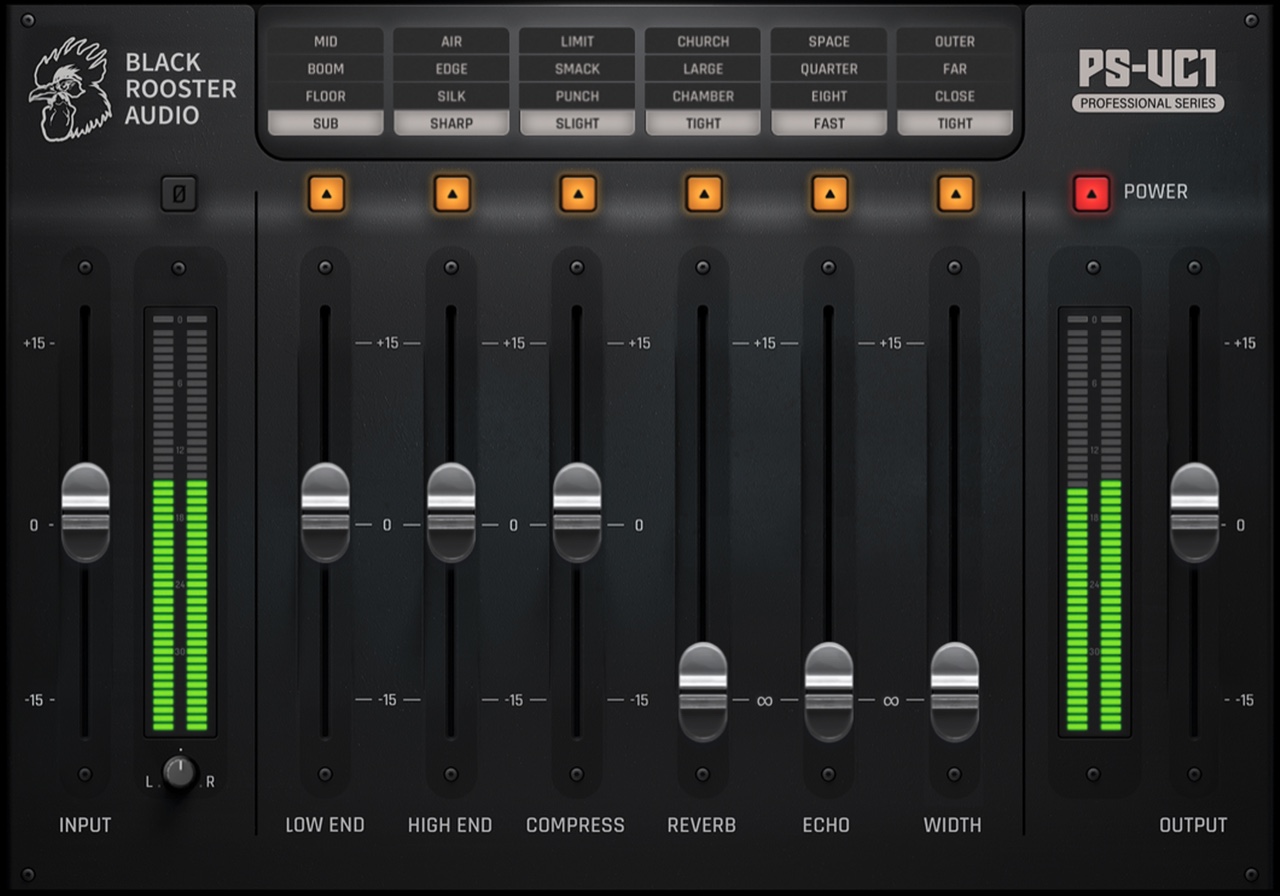
Four calibrated starting points per module — every one of them a decision somebody already argued about. Here is the whole chain, exactly as it sits on the panel.
Rumble, proximity effect and low-mid buildup, handled before anything else touches the signal. Sub reaches from 20 Hz, Mid runs up to 640 Hz for the vocal's fundamentals.
Sharp sits in a tight 5–6 kHz window for sibilance. Silk smooths, Edge brings presence, and Air opens the top all the way to 20 kHz.
Peak or vintage detection behind four styles, from transparent leveling to Limit. Auto makeup gain matches the level for you, so bypassing the module compares character instead of loudness.
A reverb algorithm written for this chain: small reflective rooms through to cathedral decay, designed to stay out of the CPU meter when you have forty of them open.
Tempo-synced or free-running. Fast for slapback thickness, Eight and Quarter for rhythmic repeats, Space for long ambient trails.
Three different stereo algorithms — All-Pass, Haas and Hilbert — across four amounts. Widen the vocal without gambling on what happens when the mix folds to mono.
The panel is laid out in the order most engineers already work in. Following it is the fastest route to a finished vocal.
Bring the vocal to a healthy working level on the input meter before any processing. Check phase here if the take used more than one microphone.
Remove rumble and proximity buildup first. The compressor reacts far more predictably once it is not reading energy you intend to throw away.
Pick a style, leave auto makeup gain engaged, and bypass the module repeatedly. Levels are matched, so you are judging character rather than volume.
Add presence and air, and tame any sibilance the compression has just brought forward.
Reverb and Echo last, then Width to decide how far the voice spreads. Check it in mono if the mix is headed for club, broadcast or phone speakers.
Trim the output so engaging and bypassing the plugin produces no level jump — then make the call with the Power switch.
The compressor compensates for its own gain reduction, so an A/B compares the compression instead of rewarding whichever version is louder.
Every module switches out on its own, and the global Power switch drops the whole chain while keeping signal flow intact.
High-resolution LED VU meters on input and output with extended dynamic range, plus a dedicated gain-reduction readout.
Input and output gain across ±15 dB, phase inversion for multi-mic sources, and a pan control ahead of the chain.
Rich spatial processing at a CPU cost that survives a session with a vocal chain on every track.
Seven interface sizes from XXS to XXL, rendered crisply on high-DPI displays under macOS and Windows.
Black Rooster Audio plug-ins (AAX/VST/VST3/AU) run in all major digital audio workstations and many more.
ProTools
Studio One
Cubase
Reaper
Bitwig
Audition
Live
Logic
Digital Performer
FL Studio
Registered users can create a free 14-day trial license from the license manager and run the PS-VC1 in full — no feature restrictions, no watermarks. A Black Rooster Audio account is free.
Go to the product page Back to top